
A catalogue manager opens Claude on a Tuesday morning. She types one sentence:
"Add the GOTS-certified badge to every product tagged organic-cotton across all four AU retail sites. Stage for the brand lead to approve by EOD."
Two minutes later, 147 products are queued for review. She didn't open the admin. She didn't write a script. She didn't raise a ticket. She didn't switch a tab.
This used to take days. It now takes one sentence.
For multi-property teams running on Core dna, the admin isn't the product anymore. The operations layer is. And it speaks plain English.
What Core dna MCP actually is
Core dna MCP exposes the full operations layer of the platform to any AI that speaks the Model Context Protocol. Pages. Products. Categories. Layouts. Users. Forms. Hooks. Scheduled automations.
The full Core dna entity graph, addressable from Claude, ChatGPT, Cursor, or any client that connects via OAuth. No API keys. No middleware. No data sync. No copy of your catalogue sitting in a vector database going stale. Below: ten workflows multi-property teams are running on it right now. Three you can watch run in under two minutes each. Seven more that change what a lean team can operate across every property.
1. Audit and fix SEO across every property in one prompt
The old way. An SEO specialist crawls each property with a separate tool. Exports CSVs per site. Stitches them together in a spreadsheet. Drafts meta descriptions for the top offenders. Sends to an editor. Editor loads them into each CMS individually, property by property. Two to three days for one round across a four-property network. Done quarterly if you're disciplined. Done never if you're like most teams.
The new way. One prompt. One review. Staged across every property.
The prompt:
"Find every page across all our properties with a missing meta description, or with a meta description over 160 characters. Show me the ten with the highest organic traffic. Draft replacements based on each page's H1 and opening paragraph. Stage them for review."
Core dna MCP queries the live page entities across the network, ranks them, drafts the new metas in the brand's voice, and stages each one as a draft revision against the live page. Your editor opens the admin, scans the diff, hits approve. Quarterly job, done before lunch.
2. Update copy across every property without breaking governance
The old way. A compliance change comes in. The cookie disclaimer needs to update across every retail site. The corporate sites are governed by Legal and shouldn't be touched. Someone makes a list of which sites are in scope. Someone else opens each admin, finds the footer component, edits, saves, publishes. Repeat seven times. Hope no one missed one. Two days, four people, three Slack threads.
The new way. Scope and edit in the same prompt.
The prompt:
"Update the cookie disclaimer copy on every retail brand to the new wording: [paste new copy]. Leave the corporate sites unchanged. Show me what's about to change before you stage it."
Core dna MCP filters the property network by brand category, finds the footer component on each in-scope site, generates a diff for review, and stages the change. You see what's changing before anything is touched. Governance intact. One reviewer, one approval, every property updated.
3. Draft a campaign landing page from a single prompt
The old way. Marketing briefs the agency. Agency mocks a design. Three rounds of feedback. Developer builds it. QA. Stage. Soft launch. Two weeks, minimum, for a one-week promo. Half the time the campaign is over before the page is live.
The new way. Brief becomes draft. Same conversation.
The prompt:
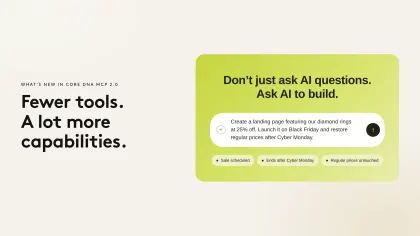
"Build a draft Mother's Day landing page on the AU retail brand using the standard campaign pillar template. H1: 'Made for the women who made us.' Pull the products tagged mothers-day-2026 into the featured collection block. Add a countdown to May 11. Stage as draft and notify the brand lead."
Core dna MCP builds the page from your modelled components — your governed layouts, your brand colours, your approved typography. It populates the collection from live product entities (no static export, no broken links). It stages. The brand lead opens the admin, reviews the page in context, publishes.
The mechanic that makes this work: Core dna pages aren't generated HTML. They're composed from the same modelled entities your platform already runs on. The AI doesn't invent structure. It composes governed parts.
Seven more workflows multi-property teams run on MCP
The three scenarios above are filmable in under two minutes each. The seven below run on the same MCP layer and the same modelled entities. They didn't make the screen recording — but they prove the breadth.
4. Move a catalogue change across every property in one motion
"Add the new ISO-9001 certification badge to every product in the 'industrial fittings' category across all three B2B sites. Update the PDP copy to reference the certification. Stage."
One prompt. Hundreds of products. Three B2B sites. Staged in minutes. Your reviewer approves once.
5. Ask the cross-property question and act on the answer
"Which products are out of stock at two or more warehouses heading into the weekend promo? Pull them from the Weekend Sale collection until restocked. Notify merchandising."
The query and the fix in the same breath. No data dashboard. No second tab. No walking the answer from BI to admin.
6. Audit layout and component drift across a network
"Which pages on the AU network still use the deprecated v1 hero layout instead of v2? List them by traffic, then prepare the migration to v2 — keeping each page's existing copy and imagery."
The hardest part of any rebrand isn't the design. It's finding every page that still uses the old one. Core dna MCP knows, because the layouts are entities, not screenshots.
7. Translate and stage across language properties
"Translate the latest five blog posts from EN to DE. Stage them in the German property with matching slugs and inherit the original tags and categories."
Translation pipelines that used to require a separate vendor and a separate workflow now sit inside the platform. One model, every language property.
8. Pull customer intelligence into the conversation
"Show me the top twenty customers by lifetime value across all stores. Include their last order date, segment tags, and the brand they buy from most. Flag anyone who hasn't ordered in 90 days."
Customer questions that used to need a BI seat now need a sentence. Same data. No extra tool.
9. Update lead routing across every property's forms
"Update every contact-us form across our properties so that enterprise enquiries — company size over 500 — route to the senior sales team. Smaller enquiries continue routing to inbound. Apply to all properties."
Form logic at network scale. Edited once. Applied everywhere governance allows.
10. Run on autopilot
"Every Sunday at 9pm, generate a top-products report per brand for the week. Email the results to each brand lead by 7am Monday. Include sell-through, returns, and inventory flag."
This is where MCP stops looking like a chat interface and starts looking like the spine of the operation. The work runs when no one is watching. The conversation was the configuration. The conversation isn't required to run it again.
Why this changes what a lean team can run
There's a pattern across these ten workflows. They aren't AI features bolted onto a CMS. They're the platform itself, addressable in a new way.
The same modelled entities you govern in the admin — pages, products, layouts, users, automations — are now operable from a sentence. Same data. Same governance. Same audit trail. Same staging discipline.
That's the shift. The admin isn't the product. The operations layer is. And for the first time, a lean team can operate at the scale of an enterprise network without an enterprise headcount.
One platform. Every property. Operable from any AI. Modelled to your business.
Connect Core dna MCP
Two minutes via OAuth. No API keys. No IT project. No middleware.
Core dna MCP plugs into Claude, ChatGPT, and Cursor, and exposes the full operations layer of your Core dna platform — every property, every entity, every workflow.
Ready to see what your team can run from a sentence? Book a walkthrough, or explore the multi-property platform built for this kind of operation.
Summarize with