

Agentic operations vs agentic commerce: what's the difference?
Two phrases that sound alike are being used for opposite things. "Agentic commerce" is everywhere right now, and a growing number of people typing "agentic operations" into a search box land on shopping-agent explainers that have nothing to do with what they were after. This piece settles the difference in plain terms, so you can tell which one you actually need.
Here is the one-line version. Agentic commerce is about AI agents buying on a shopper's behalf. Agentic operations is about one person running every property they own by prompting the platform. One sits on the customer's side of the checkout. The other sits on the operator's side of the business.
What agentic commerce means
Agentic commerce is the consumer-facing side. An AI agent searches, compares and completes a purchase for a person, often without that person ever visiting the retailer's website. The shopper tells an assistant what they want, and the assistant handles discovery, selection and payment.
This is a real and fast-moving market, anchored to two competing open standards:
- The Agentic Commerce Protocol (ACP), an open standard co-developed by OpenAI and Stripe. It has powered Instant Checkout inside ChatGPT since September 2025. OpenAI scaled the checkout feature back in March 2026 to rebuild it with greater flexibility.
- The Universal Commerce Protocol (UCP), Google and Shopify's standard, announced at the NRF 2026 keynote on 11 January 2026 with a coalition of over 20 retailers and payment networks behind it, including Etsy, Wayfair, Target, Walmart, Visa, Mastercard and American Express. It composes with Google's Agent Payments Protocol (AP2), which supplies the cryptographic proof that a shopper authorized the purchase. UCP is arriving across Google Search AI Mode and Gemini, where real-time pricing, live inventory and in-chat checkout through Google Pay are already running. Gap became the first major fashion retailer to allow a full purchase inside the chat, with Ulta Beauty following soon after.
The numbers explain the noise. McKinsey projects agentic commerce will drive between three and five trillion dollars globally by 2030, and eMarketer estimates AI platforms will account for 20.9 billion dollars in retail spending across 2026 alone.
So when most of the market says "agentic commerce", it means this: protocols, AI shopping assistants, and checkout happening inside ChatGPT or Gemini rather than on your own storefront. Answer-engine optimization (AEO) is the discipline that grew up alongside it, getting your products surfaced and cited by those assistants.
What agentic operations means
Agentic operations is the operator-facing side, and it is what Core dna is built for. Instead of an AI buying for a customer, a person prompts the platform to ship operational changes across every property they run.
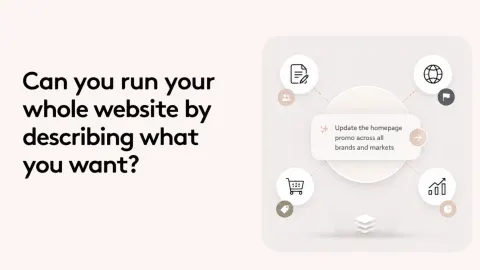
Picture a retailer with eight storefronts, a franchise network, a dealer portal and a membership site, all on one backend. With agentic operations, an operator types an instruction in plain language, for example "apply the winter banner to all Australian stores and exclude the two clearance sites", and the platform carries that change across the relevant properties. No ticket queue, no eight separate logins, no waiting on a developer for a routine edit.
The shopper is nowhere in this picture. The agent is acting for the business, inside the business, on operational work: catalog updates, content rollouts, pricing rules, page builds and campaign changes spanning many sites at once. The benefit lands with a lean team running a complex multi-property estate, not with a consumer at a checkout.
The two side by side
| Agentic commerce | Agentic operations | |
|---|---|---|
| Who the agent works for | The shopper | The operator |
| What it does | Searches, compares and buys products | Ships content, catalog and config changes across properties |
| Where it happens | Inside ChatGPT, Gemini and other assistants | Inside the operator's own platform |
| Driven by | A consumer's request | A business user's prompt |
| Standards involved | ACP, UCP, AP2 | None: it is a platform capability, not a checkout protocol |
| The win | Reach shoppers in AI channels | Run many sites with a small team |
| What you optimize for | Being found and cited by buying agents (AEO) | Speed and governance of operational change |
Why the confusion matters
If you run several online properties and you search for help managing them, the phrase "agentic" pulls you straight into shopping-agent territory: how to get your catalog into ChatGPT, how to support UCP, how to win the AI checkout. That is useful if selling through AI assistants is your goal. It is the wrong rabbit hole if your actual problem is that a simple banner change takes a week because it has to be repeated by hand across twelve sites.
The two are not in competition, and a large operator may well care about both. You might adopt ACP or UCP so AI assistants can sell your products, and separately use agentic operations to run the estate behind those products. They solve different problems at different ends of the business. Naming them correctly is the first step to choosing the right tool.
The trust question: governed autonomy
The first objection to any agent acting inside a business is safety. If a prompt can change every property at once, what stops a mistake going live everywhere?
The answer is governed autonomy: the agent proposes, a human approves, and every change is logged and reversible. Approval gates sit in front of anything that touches a live site. An audit trail records who asked for what and when. Rollback returns a property to its prior state if something looks wrong. The autonomy is real, and it operates inside guardrails an operations lead can defend to a CFO. This is the difference between an agent that helps a team move faster and one no governance team would allow near production.
What this means if you run multiple properties
If you operate a single store, agentic operations is not built for you, and the consumer-side agentic commerce conversation is where your attention belongs. If you run several stores, brands, franchises or sites on one platform, agentic operations is the capability that changes your week, because the cost of routine change stops scaling with the number of properties you own.
Core dna's position is specific: one backend for every property, one prompt to act across all of them, governed so the team can move quickly without breaking brand or breaking a live site. If that is the problem you came here to solve, you were looking for agentic operations, whatever the search box suggested.
See agentic operations on your own properties. Book a demo with a Core dna specialist.
Frequently asked questions
Agentic commerce is online buying carried out by an AI agent on a shopper's behalf. The agent searches, compares and completes the purchase, often inside an assistant such as ChatGPT or Gemini, using open standards like the Agentic Commerce Protocol (ACP) or the Universal Commerce Protocol (UCP).
Agentic operations is when a business user prompts their platform in plain language to make operational changes, such as content, catalog and pricing updates, across multiple websites or stores at once. The agent works for the operator, not the shopper.
No. Agentic commerce sits on the customer's side and is about buying. Agentic operations sits on the operator's side and is about running the business. A company can use both for different purposes.
Core dna is built for agentic operations: running many properties from one platform by prompt, with approval, audit and rollback. It is not a consumer shopping-agent or a checkout protocol, though an operator can still sell through agentic commerce channels alongside it.
Governed autonomy means an agent can act across your properties while a human approves changes, every action is logged, and any change can be rolled back. It gives a team speed without giving up control of live sites.
Short answer: AI shopping agents don't browse your site the way people do — they query structured data, ingest feeds, and increasingly call APIs to evaluate and transact. To be discoverable you have to make your catalog machine-readable (structured data), reachable (feeds and APIs pushed to the surfaces agents use), and trustworthy (accurate, fresh, well-reviewed). Get those three layers right and your products enter the agent's consideration set; skip any of them and you're simply invisible on the fastest-growing discovery channel in retail.
This is now a revenue question, not an IT-backlog one. Adobe's reporting showed AI-driven traffic to retail sites grew roughly sevenfold over the 2025 holiday season, and by early 2026 AI-referred shoppers were converting better than traditional traffic — a reversal from a year earlier, when the same cohort converted worse. The gap between merchants whose catalogs are agent-ready and those who aren't is widening fast.
If the search box keeps pointing you at shopping agents when what you need is a way to run many sites at once, you now have the language to redirect it. Agentic commerce is how shoppers buy. Agentic operations is how you run the business behind the storefronts.
Summarize with