
Liferay vs Core dna
Liferay’s legacy infrastructure was built for the portal era of the early 2000s. Core dna was built for today’s world, where business teams need speed, and developers need modern architecture.
Ready for a modern commerce experience? Switch to Core dna and get support with your migration.
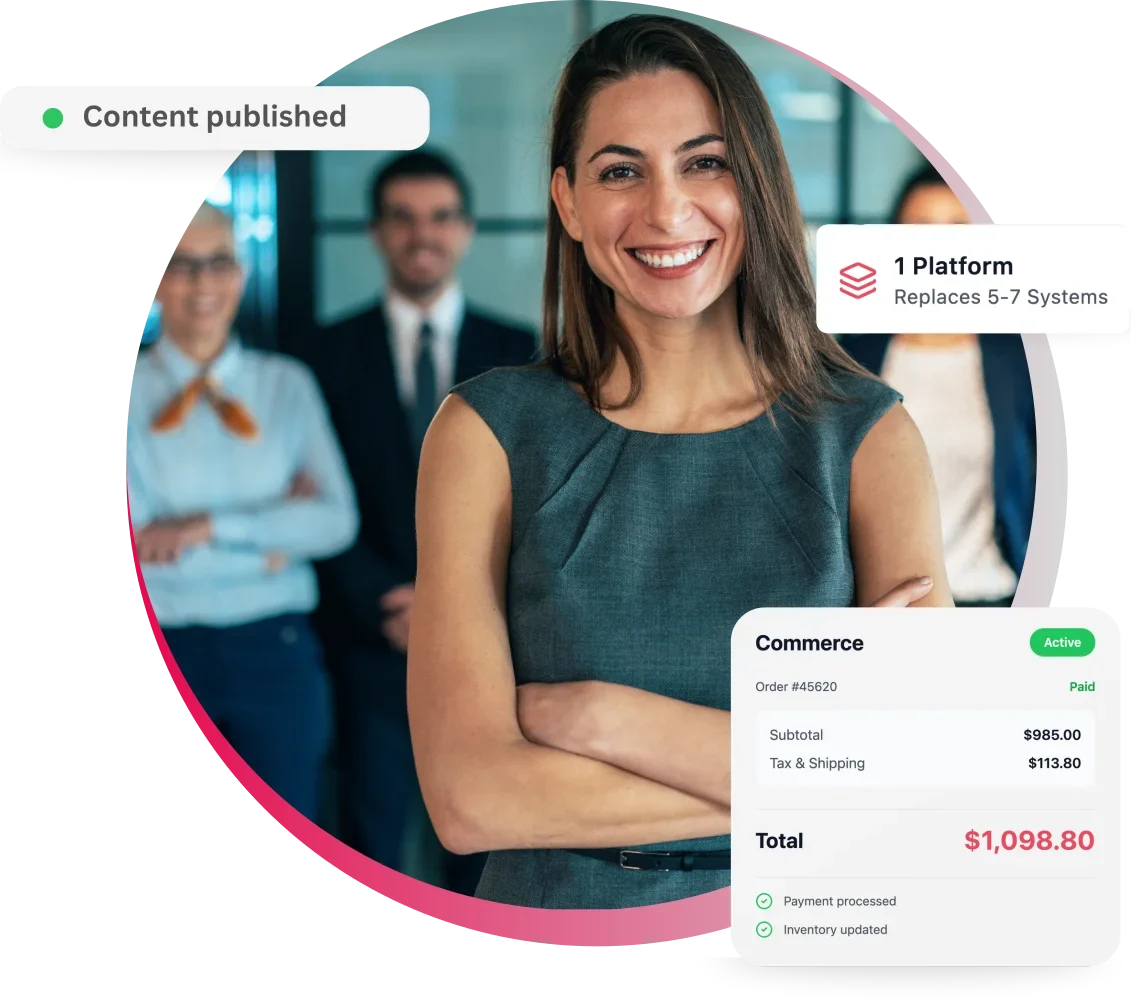
Complexity that slows down modern commerce
Moving past portal-era platforms
Liferay requires knowledge of the Java enterprise stack just to get started and is built on outdated Java portlet technology. Plus, there is expensive portal licensing for functionality that many businesses just don't need.
Companies choosing modern architecture over Liferay’s legacy stack are moving to Core dna. Here's why.
| Capability / Reality | Core dna | Liferay |
|---|---|---|
| Built for | ✓ Modern commerce with composable flexibility | ✕ Enterprise portals from the early 2000s |
| Modern architecture | ✓ Microservices, API-first, composable when needed | ✕ Monolithic portal framework with tightly coupled frontend and backend |
| Content management | ✓ Intuitive CMS with WYSIWYG editing | ✕ In-line content editing available in the CMS |
| Developer requirements | ✓ Modern frontend development capabilities | ✕ Requires Java enterprise stack, OSGi module development, and portlet expertise |
| Business user autonomy | ✓ Marketing teams publish content without dev tickets | ✕ Steep learning curve for non-technical teams |
| Customization | ✓ Flexible | ✕ Customizations can be challenging to accomplish |
| Implementation complexity | ✓ Weeks to launch with intuitive setup | ✕ A steep learning curve, potentially months of configuration, and specialized consultants often required |
| Total cost of ownership | ✓ Transparent pricing with predictable costs | ✕ High licensing costs, expensive upgrades, and significant maintenance overhead |
| Time to value | ✓ Days to weeks for initial deployment | ✕ Months of Java configuration and specialized training |
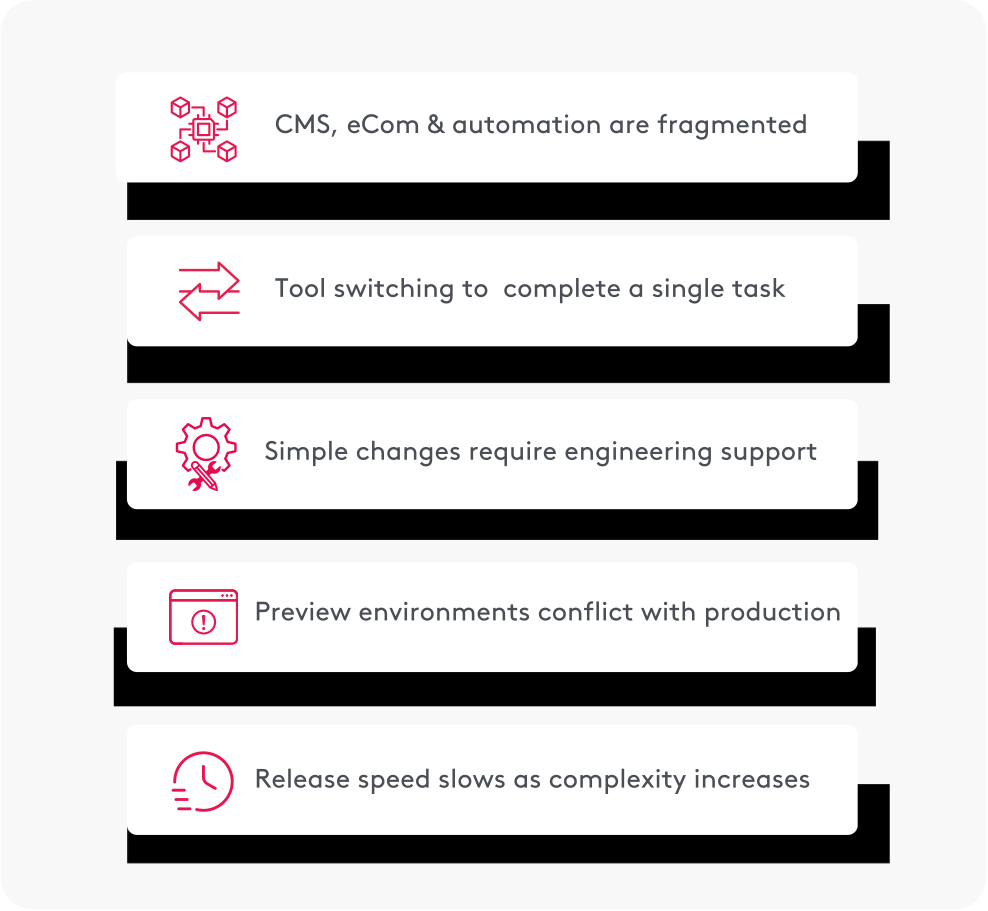
Built for commerce, not portals
Liferay's portal framework is powerful if you're building an enterprise portal in 2005. For modern commerce teams who need to move fast, ship content, and iterate without filing Java developer tickets, that portal architecture creates friction. With Core dna:
- No expensive Java consultants or portlet specialists required
- A modern architecture means developers aren’t relying on legacy skillsets
- API-first approach connects to any system without constraints
- Marketing teams can publish content and launch campaigns independently
- Intuitive setup replaces steep learning curves

Trusted by enterprises to deliver powerful digital experiences
Companies choosing Core dna over headless-only platforms report faster time-to-market, lower total cost of ownership, and marketing teams that can actually ship without waiting on developers.
- YMCA Toronto: $100k in annual savings + 500% growth in registrations after consolidating 7 systems into Core dna.
- Standard Process: 60% increase in eCommerce without hiring a single developer.
- Clark Rubber: 47 franchises unified under one digital platform, managed by a lean team of 4.
- RANDYS Worldwide: 4x revenue growth in year one with 7 integrated sites and 30,000 SKUs.
We built Core dna just right.
A modern architecture and a complete platform, without complexity
Liferay? Portal-era complexity
Liferay's portal framework made sense for building enterprise portals in the early 2000s, when centralized IT departments controlled all content. It doesn't make sense for today's distributed commerce teams who need to ship content daily, test campaigns rapidly, and iterate on customer experiences.
Modern headless-only? Too incomplete
Platforms like Contentful give you a headless CMS but leave you to assemble commerce, personalization, search, and everything else yourself. That assembly tax adds up fast in both dollars and development time.
Monolithic suites? Too rigid
Adobe and Sitecore lock you into their ecosystems with upgrade cycles that break things and costs that spiral out of control. You replace one form of vendor lock-in (Liferay's portal architecture) with another (suite dependency).
Core dna? Just right
Core dna delivers modern composable architecture with native commerce + CMS + personalization. You get the flexibility of microservices without the assembly complexity and Java enterprise stack dependencies.
With Core dna, you're composable when it makes sense (integrate your ERP, connect your PIM, link your CRM). You're integrated by default when that makes sense (commerce + content + personalization).
The vision is simple, a modern architecture and a complete platform, without complexity.
Secure, Speedy, Seamless
✓ 99.9% uptime SLA
✓ 100% Lighthouse performance scores
✓ Auto-scaling infrastructure
✓ Global CDN and regulatory compliance
✓ No versioning, no disruptive upgrades
✓ Continuous innovation included