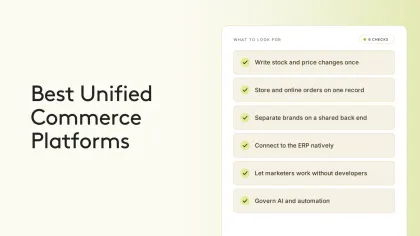

Shopify is arguably the most well-known ecommerce platform, and Shopify Plus, its enterprise-grade version, is what many businesses opt for when they’re looking to handle larger operations. However, Shopify Plus isn’t the right fit for several situations, particularly multi-property operators with hybrid business models.
A manufacturer that decides to add a DTC channel alongside its B2B wholesale work, or a membership organization that sells merchandise and wants to offer online learning within the same digital environment, might find that Shopify Plus isn’t designed for their needs.
In this article, we’ll explain the structural limitations that often surface for multi-property operators with hybrid business models, and the five enterprise alternatives worth evaluating, including Core dna.
What Multi-Property Operators Run Into on Shopify Plus
Multi-property operators on Shopify Plus usually consider alternatives because the platform was not a good fit for their unique needs. More often than not, the business grew into territory Shopify Plus was never designed to cover, and the gaps became harder to work around.
Built for One Model, Not a Hybrid Business
Shopify Plus was designed for DTC retail and does it exceptionally well. However, when the business model is hybrid, such as when a business runs B2B alongside B2C, an LMS alongside a store, or brick-and-mortar alongside digital, they may run into issues.
Adding another business model beyond DTC requires a third-party app, separate integration, or separate subscription. For lean teams managing a multi-location or multi-property footprint, that overhead becomes harder to control.
“Beyond the base platform fee, many critical enterprise features require additional paid apps or custom development, which increases the total cost of ownership significantly compared to self-hosted solutions,” said one G2 reviewer.
App Complexity Compounds With Every Use Case You Add
Shopify Plus has one of the strongest app ecosystems in ecommerce, but for hybrid operators, that strength comes at a cost. These multi-property operations often require additional apps or integrations with another vendor. That can lead to another monthly bill, with no shared layer above them to coordinate any of it.
One reviewer mentioned that, “There's a heavy dependence on paid apps for basic features like advanced filtering, subscriptions, or detailed analytics.”
One Brand Per Contract Limits Portfolio Operators
Shopify Plus is built around one brand per contract. The expansion store model allows up to nine additional storefronts, but those apply to a single brand selling across different markets, not to a parent company running multiple distinct brand identities. Operators who have acquired a new brand and called Shopify support to ask how to bring it under the same contract are typically told they need a new subscription.
For operators whose growth strategy involves acquisitions, that means platform costs grow with every brand added to the portfolio, more than they might expect.
No Native CMS Means Content Always Lives Somewhere Else
Shopify Plus is a commerce engine, and content management has always required a separate platform. Companies that opted for Shopify Plus only for commerce won’t have an issue with this. However, for a hybrid operator trying to manage campaign content, inventory updates, and publishing workflows across multiple properties, it can become hectic.
This is where teams often start evaluating a unified content management platform or a broader CMS and ecommerce platform consolidation strategy.
Customization Ceiling for Non-Standard Business Models
Shopify Plus offers meaningful customization for standard DTC use cases, but non-standard business models hit a ceiling quickly. For instance, a franchise operator needs corporate brand governance above individual franchisee storefronts, but the platform controls who can access stores, not what each franchisee can change in their own store.
Operators running B2B and DTC from the same store often find they need a dedicated expansion store for B2B, which adds complexity rather than reducing it.
One review mentioned, “there are limitations in flexibility compared to fully custom platforms, especially for very specific or complex requirements.”
Shopify Plus Alternatives Worth Evaluating
The following Shopify Plus alternatives are good fits for multi-property operators with hybrid business models.
Core dna
Best for: Multi-property operators with hybrid business models who need CMS, commerce, and agentic operations in one platform
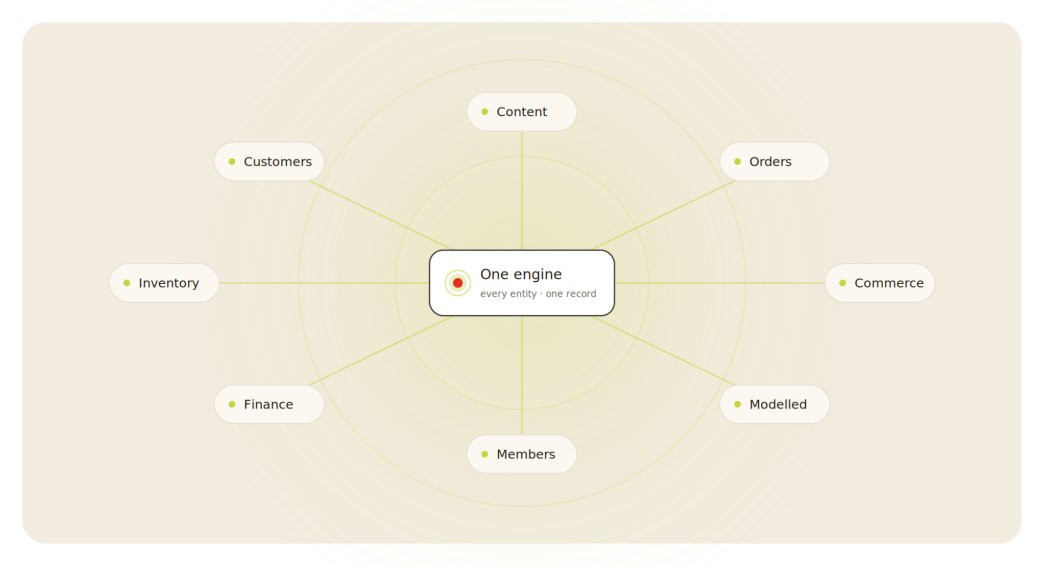
Core dna is built for operators whose business model does not fit neatly into one category. While Shopify Plus separates B2B and DTC architecturally and requires a separate subscription for every additional brand, Core dna gives each brand or property its own storefront, pricing, and customer experience while sharing the same backend operations.
Other Shopify Plus alternatives on this list handle commerce but still require a separate CMS. Or they can manage a B2B commerce scenario but require a separate DTC configuration. Meanwhile, Core dna runs B2C catalogs, B2B contract pricing, recurring billing, and more on a single shared ecommerce platform, so companies don’t need additional middleware to connect separate tools.
Whether a franchise operator, a membership organization running an LMS alongside commerce, or a manufacturer serving trade buyers and consumers from the same environment, all of those models run natively without a separate app or contract for each. The platform is also headless when you need it and hybrid when you do not, with one content graph serving both a visual editor for marketers and an API layer for storefronts, so nothing falls out of sync.
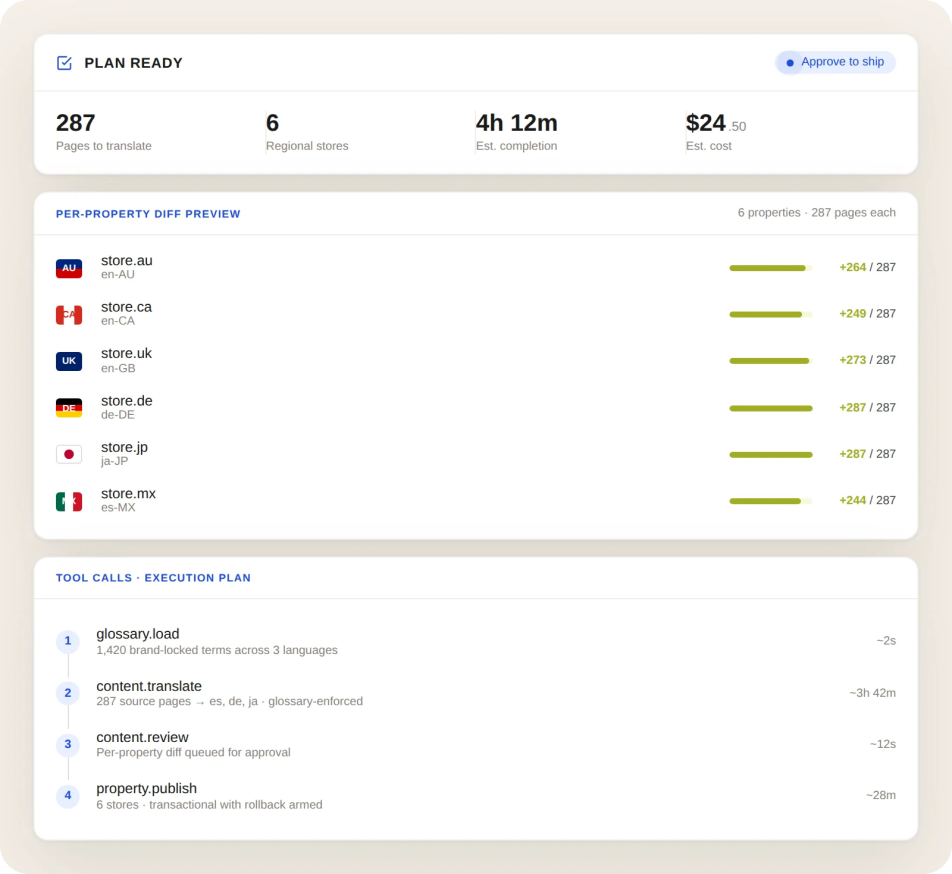
Plus Core dna’s MCP server connects to Claude and other AI agents, with 80 tools and 400 APIs available, allowing operators to describe a change in plain language and push it across every property with approval, audit, and rollback built in. For lean teams managing growing property footprints, that changes what is operationally possible without adding headcount or vendors.
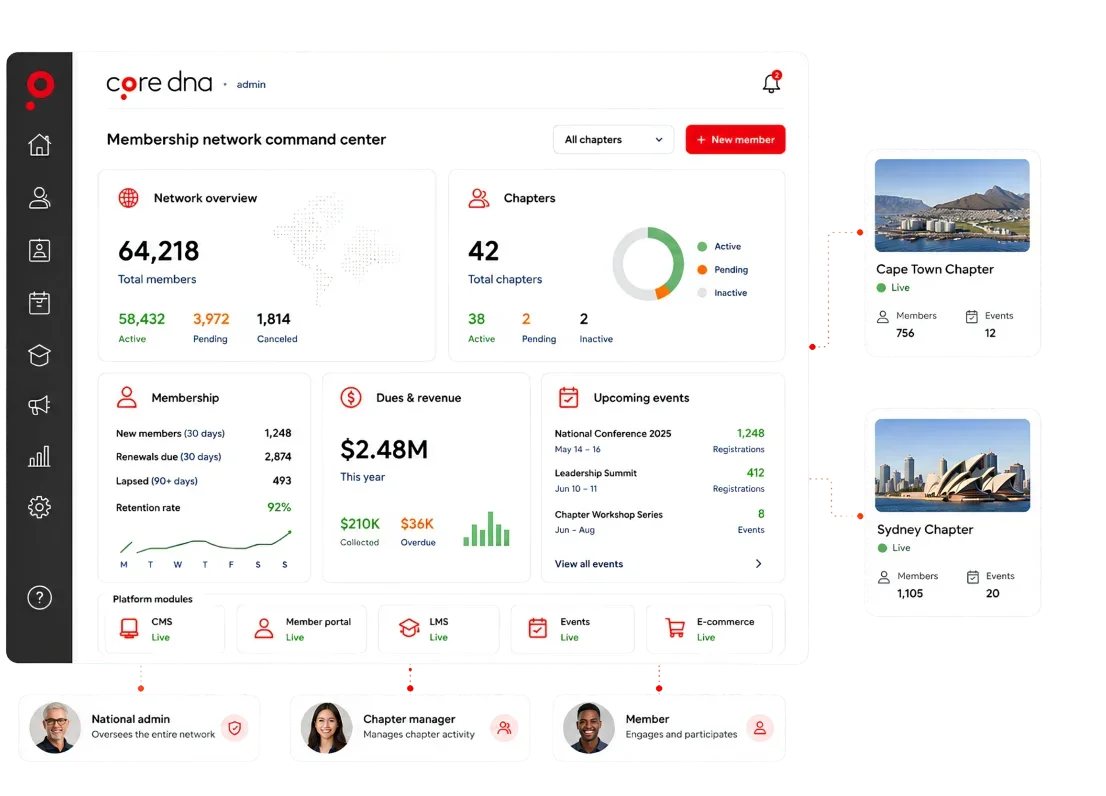
When YMCA Greater Toronto replaced multiple CMS and LMS tools with one Core dna platform across 19 digital properties and 440 physical locations, their CMS adoption increased from 20% to 90%, and online registration increased by 500%.
 Advantages
- B2C, B2B, and subscriptions share one product and customer, with no middleware or separate models per contract.
- Each brand or property gets its own storefront and customer experience without requiring a separate platform subscription.
- A headless API is available for storefronts, and a visual editor is available for marketers. Plus, both write to the same content graph to keep everything in sync.
- An MCP server with 80 tools and 400 APIs allows operators to push changes across all properties with a single instruction, including approval, audit, and rollback.
- LMS, membership management, and franchise governance are native capabilities, not integrations.
Limitations
- Smaller ecosystem than some incumbents with fewer pre-built third-party integrations.
- Agentic capabilities are live but maturing, so operators with conservative governance requirements should carefully evaluate their approval and audit workflows with the Core dna team.
commercetools
Best for: Commerce teams building a composable multi-property stack

commercetools is a composable commerce platform built for enterprise operators, whether they are running B2C, B2B, or hybrid business models. It provides commerce APIs across product catalog, pricing, cart, checkout, and order management that engineering teams use to compose custom storefronts and commerce experiences per property.
Multi-property operators frustrated with Shopify Plus due to its one-app-per-model architecture and per-brand subscription requirement can use commercetools to serve all commerce models through a single API backend.
Each brand or property gets its own storefront configuration while sharing product data, pricing logic, and order management. However, its headless architecture means there is no frontend or CMS, which can be challenging for some multi-property teams to manage.
Advantages
- Serves B2C, B2B, and hybrid business models from one shared backend without separate platform contracts per model.
- Each brand or property gets an independent storefront with shared product data, pricing, and inventory.
- Strong multi-currency, multi-language, and multi-region support.
- MACH ecosystem membership means complementary vendors for CMS, search, and personalization are available to integrate.
Limitations
- Every user-facing capability must be built and maintained by a development team, as there is no front-end, CMS, or visual editor included.
- The total cost of ownership exceeds the platform subscription alone once development, integration, and ongoing maintenance are factored in.
- Not practical for lean teams without dedicated engineering resources or a capable implementation partner.
- Composable architecture gives more options but also means that CMS, search, personalization, and analytics each require separate selection and integration.
OroCommerce
Best for: Manufacturers, distributors, and wholesalers running complex B2B alongside DTC
OroCommerce is a B2B ecommerce platform designed for manufacturers, wholesalers, and distributors. Unlike platforms that add B2B as a feature layer on a DTC foundation, OroCommerce was designed specifically for complex B2B sales processes. The platform combines ecommerce, CRM, CPQ, invoicing, and AI tools into a single unified platform under a single license, with multi-website and multi-locale support.
While Shopify Plus treats B2B as an app or an add-on, OroCommerce is ideal for running complex dealer portals with RFQ workflows, contract pricing, and account hierarchies alongside a DTC channel. However, that complexity requires third-party support for most teams to manage.
Advantages
- Purpose-built B2B with native CPQ, RFQ, multi-tier approval workflows, contract pricing, and account hierarchy management.
- A CRM is included natively alongside commerce, eliminating a separate integration for account and relationship management.
- Multi-website, multi-locale, and B2B2X functionality from one platform without separate contracts per model.
Limitations
- Not designed for DTC-first operators where the primary business is consumer retail rather than B2B or wholesale.
- Implementation complexity is significant for operators without B2B ecommerce experience or an implementation partner.
- The interface can feel complex for non-technical business users unfamiliar with B2B administration tools.
VTEX
Best for: Multi-brand retailers and hybrid operators who need B2C, B2B, and marketplace from one platform
VTEX is a composable commerce platform that supports B2C, B2B, channel management, and marketplace business models. It offers a multi-brand architecture that allows independent storefronts per brand alongside shared order management, inventory, and operations.
Unlike Shopify Plus, which requires a separate contract per brand and a separate app for every commerce model beyond DTC, VTEX handles B2C, B2B, DTC, and marketplace commerce without per-brand subscription requirements. Operators can manage multiple brands with independent storefronts while sharing catalog, pricing, and order management across the portfolio. However, the platform has a steep learning curve and relies heavily on developers.
Advantages
- Native B2C, B2B, DTC, and marketplace from one platform without per-brand subscription requirements.
- Multi-brand architecture with independent storefronts and shared back-office operations.
- Dynamic, tiered, and contract-based pricing are built into both B2C and B2B models.
Limitations
- Implementation complexity is significant for operators without VTEX partner experience.
- The ecosystem is stronger in Latin American and Southern European markets, with fewer established implementation partners in other markets.
- No native CMS is included as a core capability, so content management still requires a separate integration for most deployments.
- The pricing model can produce unpredictable total costs as transaction volume and multi-brand complexity scale.
Spryker
Best for: Manufacturers, distributors, and wholesalers running complex hybrid B2B and B2C from one platform
 Spryker is a composable commerce platform built specifically for enterprises with complex business models. It supports B2B, B2C, marketplace, and hybrid operations from one platform with a modular, API-first architecture.
Spryker enables multiple business models from a single platform, so operators can manage B2C, DTC, and B2B marketplace operations without splitting platforms. However, Spryker is a PaaS platform, not SaaS, which gives operators more control but requires more engineering investment to implement and maintain than a managed solution.
Advantages
- Supports B2B, B2C, DTC, and marketplace models from one platform without separate contracts or app stacks per model.
- Modular, API-first architecture allows operators to add capabilities without replatforming as the business model evolves.
- Strong B2B native capabilities, including buyer-specific catalogs, approval workflows, contract pricing, and self-service portals.
Limitations
- The PaaS model gives operators more control but requires significant engineering investment to implement and maintain.
- Not designed for operators looking for a managed or low-code solution, as business user self-service is more limited than on SaaS platforms.
- Implementation requires experienced Spryker partners, and timelines are significant for complex multi-model deployments.
- There is no native CMS so content management requires a separate integration.
How to Choose the Right Shopify Plus Alternative
Before evaluating specific platforms, it helps to determine what is actually driving the need for a change.
1. Is your primary frustration the per-brand subscription cost?
Every platform on this list eliminates Shopify Plus's one-brand-per-contract model. However, the subscription savings can be offset quickly by implementation overhead on more complex platforms.
commercetools, VTEX, Spryker, and OroCommerce all require significant engineering investment to get to a working multi-brand environment. However, Core dna offers greater out-of-the-box capabilities and faster time-to-launch.
2. Is your business model hybrid, such as running B2B alongside B2C, wholesale alongside retail, or commerce alongside LMS or membership?
Shopify Plus was built for DTC and layers on top of every other model through apps or separate subscriptions. OroCommerce is a strong alternative if B2B is the primary model and DTC is secondary. Spryker handles complex hybrid B2B and B2C at enterprise scale but requires a PaaS implementation. Meanwhile, VTEX handles B2C, B2B, and marketplace sales natively from a single platform.
However, Core dna is the only platform on this list that natively handles content, B2C commerce, B2B commerce, membership, and LMS in one codebase without a separate app or contract for each model.
3. Do you need full architectural control and have a strong engineering team?
commercetools gives engineering-led teams maximum flexibility with a shared commerce backend across all models and properties. Spryker offers a similar level of composability with stronger out-of-the-box B2B functionality.
However, both require significant ongoing engineering investment, and neither is the right answer for lean teams who need to move fast without a large development operation behind them.
4. What does your total cost of ownership look like across all brands and models?
Companies should map the full cost of a new platform across their entire business model, not just one brand. This means including per-brand subscription costs, app and theme licensing per store, integration maintenance, and developer overhead.
For example, the Shopify Plus per-brand contract cost looks very different at two brands than at five or eight. However, alternatives like Core dna, VTEX, and OroCommerce can offer lower total costs for hybrid operators.
Read more: 6 Rules of Enterprise eCommerce Replatforming.
Wrapping Up
Shopify Plus remains one of the strongest platforms for businesses that need a commerce engine. However, for multi-property operators whose business model has grown beyond DTC, the additional overhead from the lack of a CMS or the need for multiple subscriptions for additional brands can be problematic as the operation grows.
For those operators, Core dna offers content, commerce, and agentic operations in one platform built specifically for multi-property hybrid businesses.
If you are comparing enterprise ecommerce platforms, you may also want to read our guide to BigCommerce alternatives for multi-property operators.
Get a demo to learn how our platform can help grow and manage your digital presence.
Summarize with