

Contentstack Alternatives in 2026: What Type of Agentic Experience Matters to You?
Contentstack has traditionally been known as a headless CMS. Now, the Agentic Experience Platform (AXP) is making AI agents that deliver personalized, adaptive experiences the cornerstone of its product. This includes a combination of content, real-time customer data, and a proprietary Agent OS.
However, while Contentstack works well for content and enterprise functionality, as a platform, customers have complained about opaque pricing and developer dependency. On top of that, while Contentstack may be an agentic platform, whether that works for your business depends on what you need from agentic capabilities.
In this article, we will explain some of the downsides of Contentstack, break down the different types of agentic solutions, and share some alternatives to consider.
Why You Might Need a Contentstack Alternative
Developer Dependency
Contentstack is a platform that requires heavy developer involvement. While enterprises might expect this during implementation, G2 reviewers have noted that this is an ongoing occurrence, even after the initial platform is up and running. "We have found that it can feel very developer-heavy. To get the level of customization we need, we have consistently had to bring in a developer to step in and make the necessary refinements."
Localization Challenges
Contentstack offers localization functionality to help teams adapt their content to different locales; however, managing that localized content is also very complex. That means global teams with multiple properties or languages can struggle to create the right experiences for each. As one reviewer mentioned, "Although localization is a core feature, there is complexity in managing localized content, with workflows that can be unintuitive."
Opaque Pricing & High Total Cost of Ownership
Like many other enterprise platforms, prospects are expected to contact a sales team to receive a custom quote. However, customers have noted that Contentstack is on the higher end compared to other solutions on the market. When combined with limited out-of-the-box features, since everything outside the core CMS is an add-on, running Contentstack often means dealing with a high total cost of ownership. As one reviewer said, "I find the pricing to be higher compared to other options available in the market.
Additionally, the platform seems to provide only a limited set of out-of-the-box features, particularly when it comes to advanced personalization and analytics reporting."
No Native Commerce
Contentstack offers agentic capabilities and personalization, but this means companies need to integrate a separate ecommerce platform to handle commerce-driven experiences, which can lead to more overhead and additional contracts to manage.
Understanding the Agentic Layers
Before comparing platforms, as Contentstack alternatives, it helps to name the approaches the market is taking toward agency and what that means for your business and specific use cases.
- Agentic Experiences: Vendors using AI in this way aim to improve what end customers see. It includes personalization engines, content generation, and other adaptive journeys. Platforms like Contentstack or Optimizely fall into this category.
- Agentic Content Operations: This refers to vendors that use AI to automate the creation, translation, auditing, and governance of content. For example, many CMS vendors, such as Kontent.ai, Sanity, and Storyblok, fall into this category.
- Agentic Operations: Here, AI runs the operational layer across multiple sites, stores, brands, or locations simultaneously. This includes pushing campaigns across franchise networks, managing commerce and content together, and governing brand standards with approval and rollback. Core dna falls into this category.
- Agentic Commerce: While this is not critical to the platforms we are comparing, it is worth noting that agentic commerce is arguably the most commonly referenced agentic format to date. This is where an AI agent searches, compares, and completes a purchase for a person, often without that person ever visiting the retailer's website. Commerce vendors such as Shopify Plus and BigCommerce are included in this category.
Read More: Agentic Operations vs Agentic Commerce: What's the Difference?
The 7 Best Contentstack Alternatives
| Platform | Agentic Layer | MCP | Commerce | Multi-Property | Best Fit |
|---|---|---|---|---|---|
| Contentstack | Experience | Proprietary Agent OS | No | Limited | Large B2C enterprise |
| Core dna | Property operations | Yes with 80+ tools | Yes | Yes | Franchise, multi-brand, membership |
| Kontent.ai | Content operations | Yes | No | Limited | Enterprise content, regulated industries |
| Sanity | Content operations | Yes | No | No | Developer-resourced teams |
| Storyblok | Content operations | Yes + FlowMotion | No | Limited | Marketing-led teams |
| Contentful | AI Actions beta | Yes | No | No | API-first, Salesforce ecosystem |
| Strapi | MCP + AI translations | Yes | No | No | Open-source, developer-first |
| Hygraph | MCP | Yes | No | No | GraphQL-native, content federation |
1. Core dna
Best for: Franchise networks, multi-brand retailers, membership organizations, and B2B operators
Core dna is an agentic operations platform for multi-property operators. The platform offers content, commerce, and orchestration in a single system. This means that teams not only get a CMS alternative to Contentstack, but they also do not have to stitch together five other tools to manage commerce and AI functionality.
Core dna is built for multi-site, multi-region, and multi-brand companies, and teams can run everything from the same admin. The MCP server connects Claude and other MCP-compatible AI clients to CMS, commerce, LMS, and membership management across every property simultaneously.
Core dna's MCP connects 80 tools and 400 APIs, so an agent can push campaigns, update pricing, govern content, and manage franchise permissions from a single prompt, with approval and rollback built in, allowing small teams to run operations across a distributed property footprint.
2. Kontent.ai
Best for: Enterprise content teams in highly regulated industries
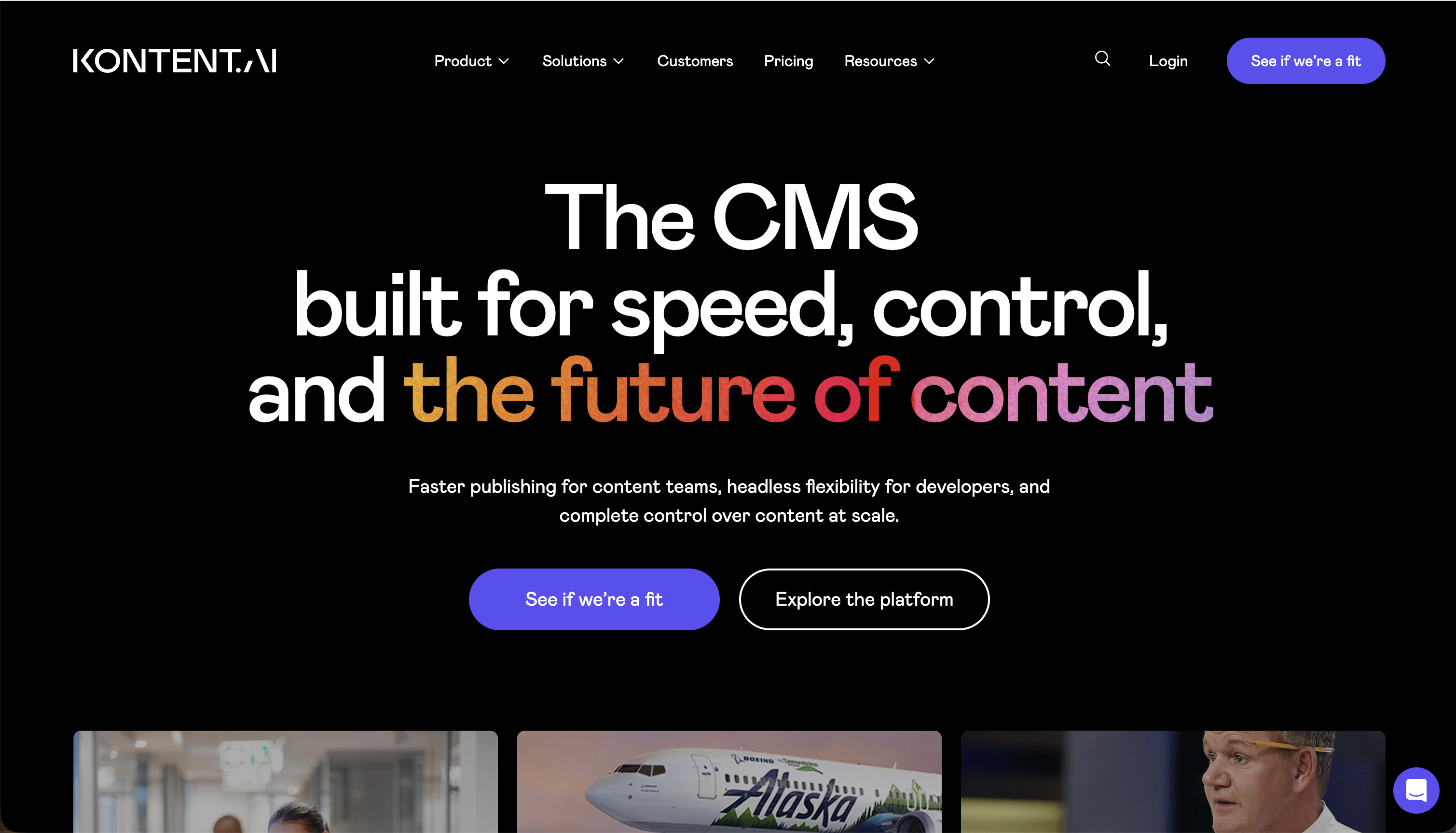
Kontent.ai offers an agentic headless CMS that introduces AI agents into content workflows, to enable organizations to automate operations, enforce governance, and accelerate time to market.
Its primary AI Agent operates the platform through natural language, while Expert Agents are always-on solutions that automatically handle governance, translation, lifecycle management, compliance auditing, and SEO optimization. While it works well as a Contentstack alternative, the platform is only a CMS with no native commerce, multi-property operational layer or other tools that enterprise teams need to complete their digital stacks.
3. Sanity
Best for: Developer-resourced teams that want maximum schema flexibility
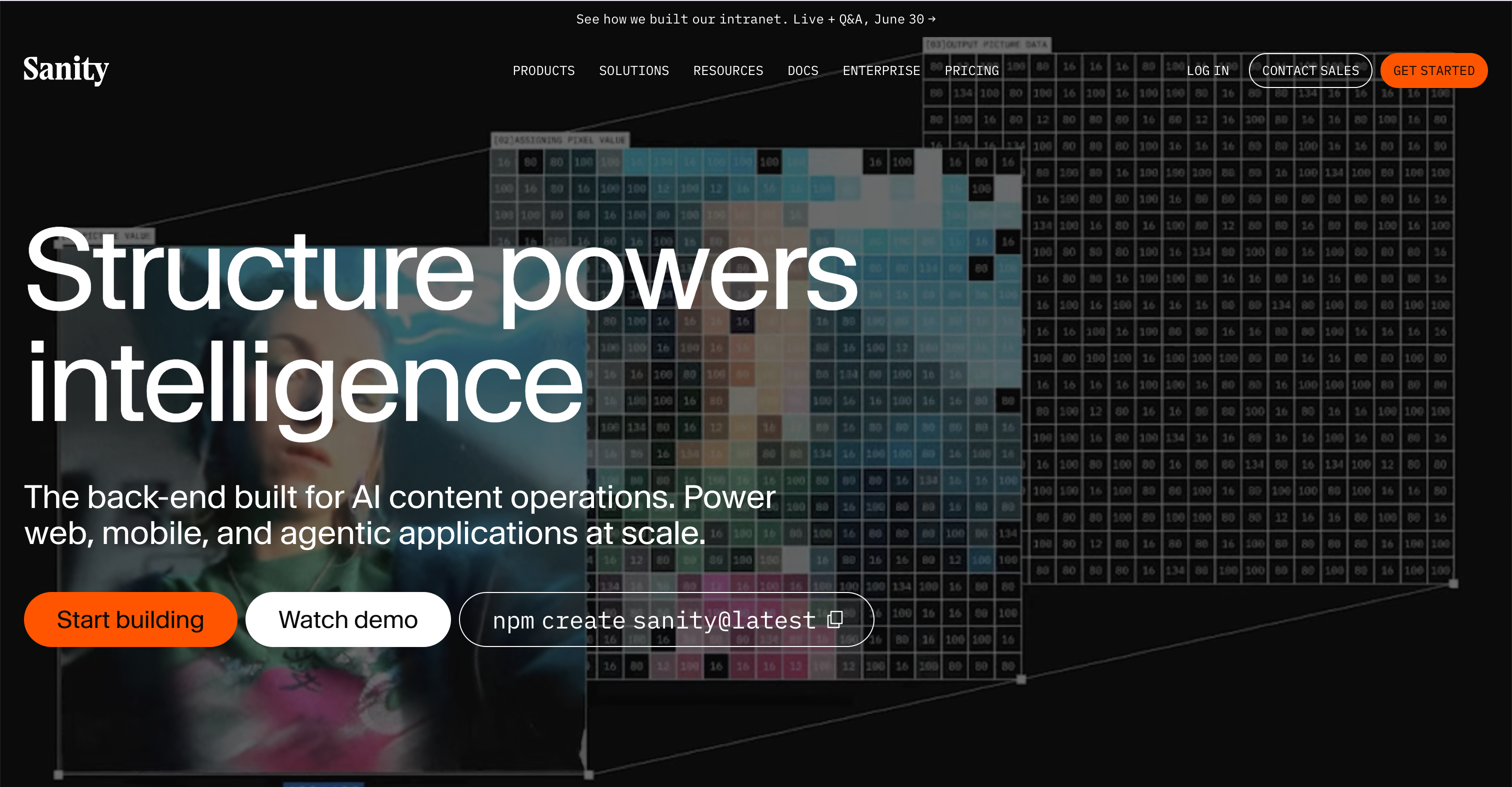
Sanity is a headless CMS that offers a customizable all-code backend for content-driven websites and apps. For its agentic capabilities, Sanity's Content Agent lets teams manage and bulk-update thousands of documents using natural language. Agent Actions automate content enrichment triggered by dataset mutations, while the MCP server gives AI agents structured read and write access to the content layer.
However, while it offers more flexibility than Contentstack, Sanity also comes with similar developer dependency, and non-technical content teams will find limited out-of-the-box agentic capability without engineering support.
4. Storyblok
Best for: Marketing teams who want to avoid developer dependency for publishing changes
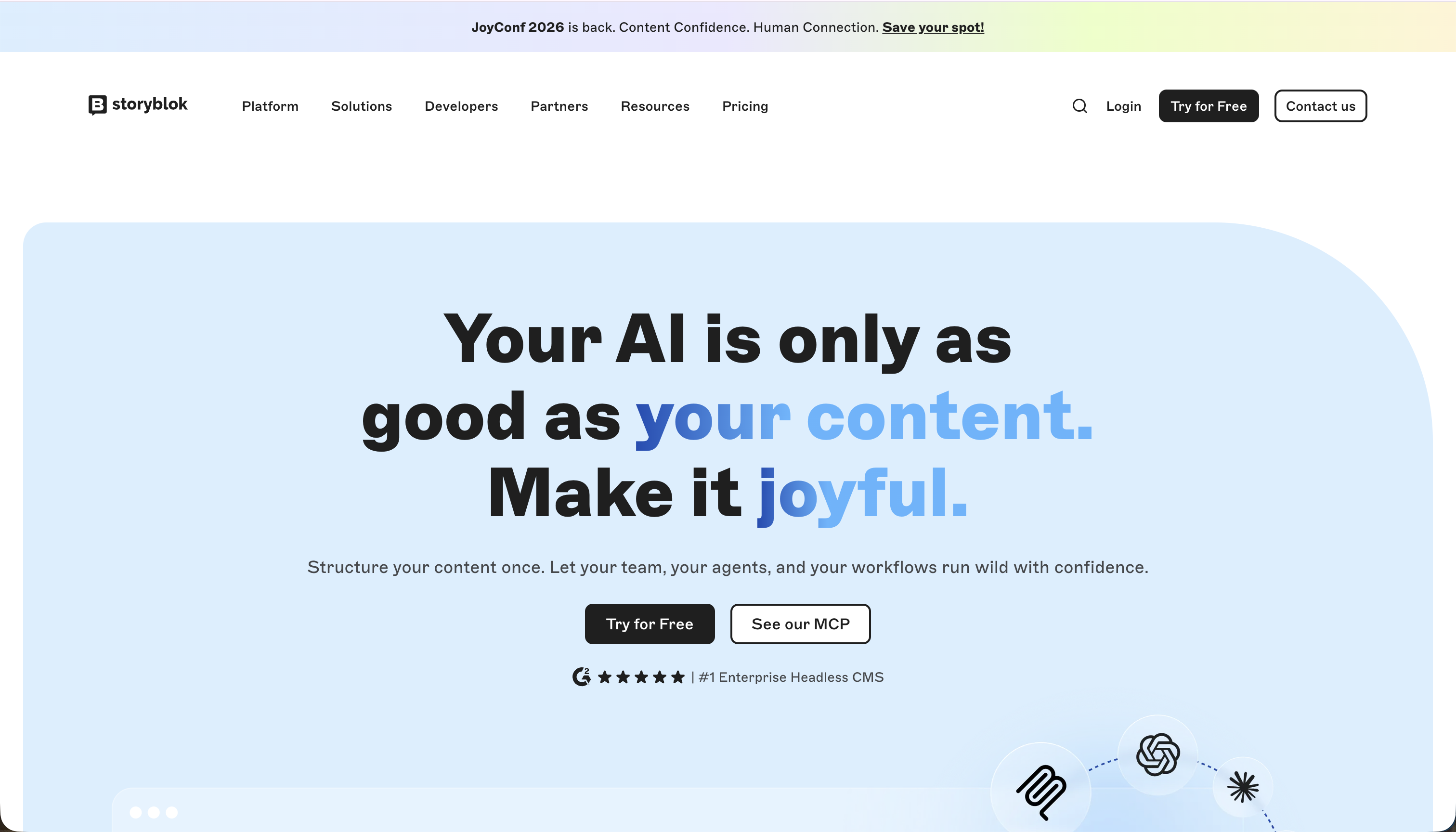
Storyblok is a headless CMS designed for developers, marketers, and agents. Their MCP Server connects any MCP-compatible AI agent directly to the content and management layer. FlowMotion lets marketers orchestrate multi-step agent workflows without writing code.
Although Storyblok is more marketer-friendly than Contentstack, its agentic capabilities focus on content creation and publishing workflows rather than property operations or commerce.
5. Contentful
Best for: Enterprise teams already embedded in the Salesforce ecosystem
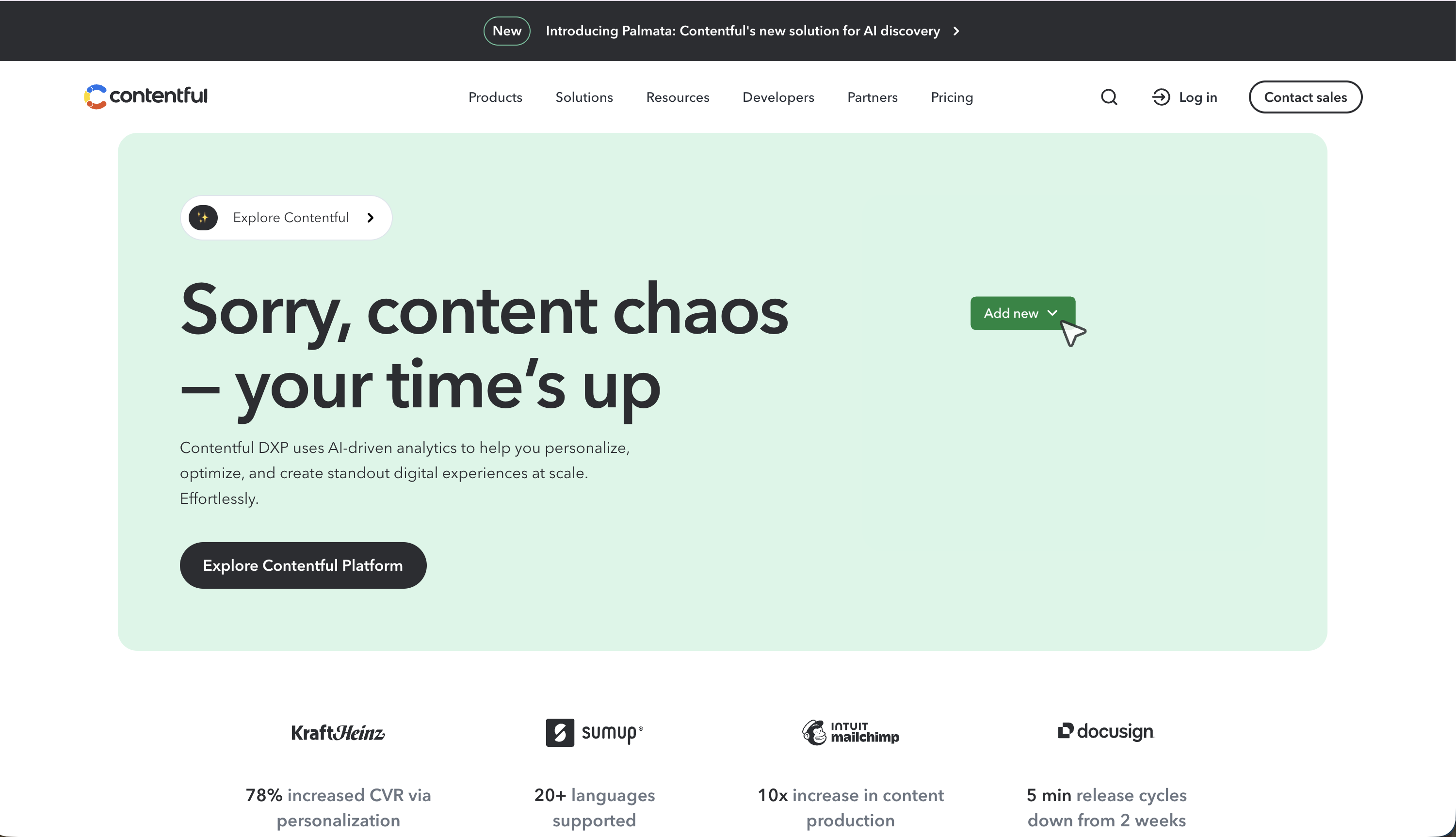
Contentful is a digital experience platform for marketers, developers, and digital teams. It combines a headless CMS with native, contextual AI. Having been acquired by Salesforce, teams already in the Salesforce ecosystem will find better alignment. However, teams outside of it will struggle with what the acquisition could mean in the future. Additionally, Contentful's AI Actions is in beta and focused on content operations, including writing, translation, and content optimization within the editor, and not more advanced functionality.
6. Strapi
Best for: Developer-focused teams who want an open-source platform
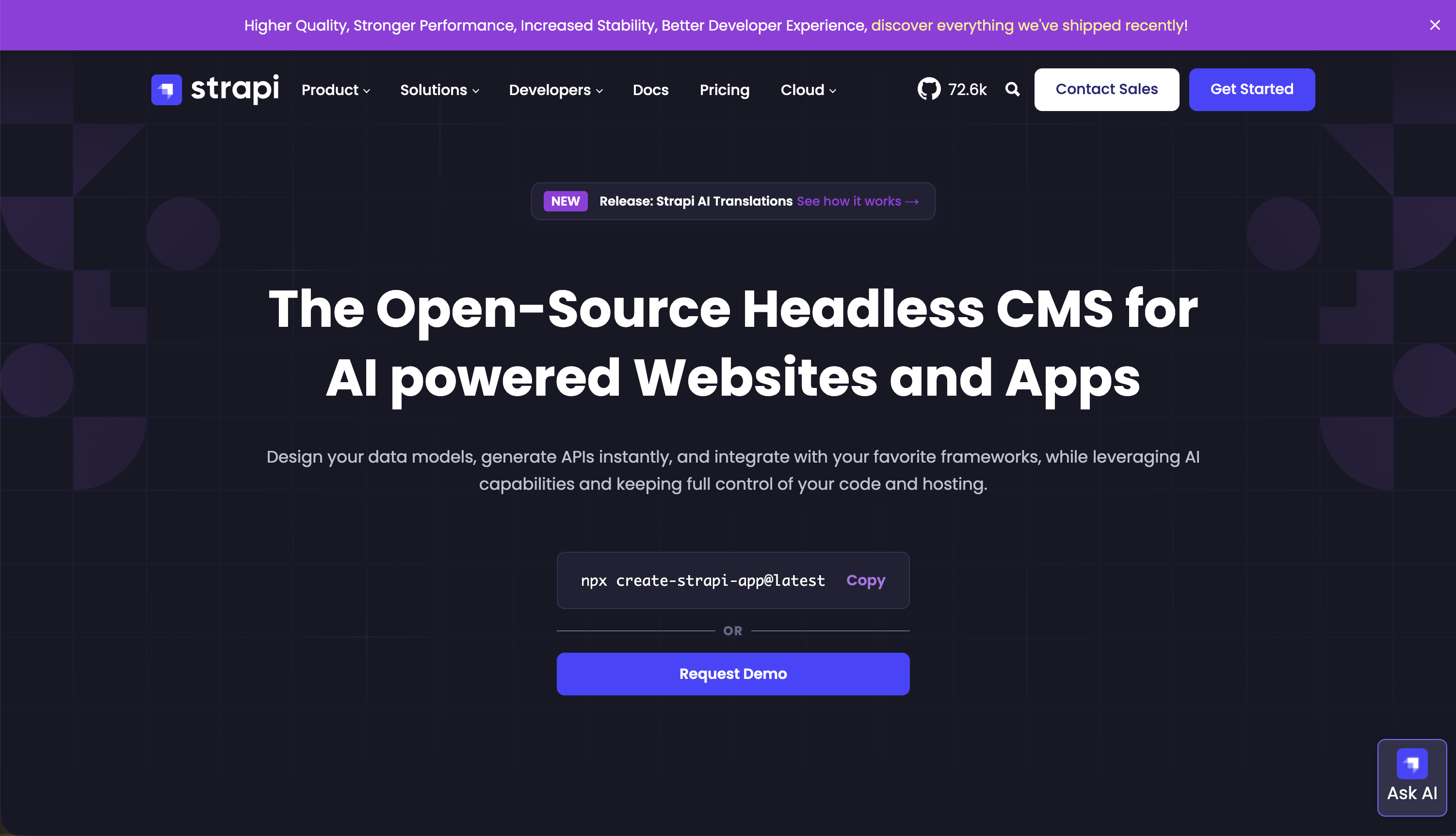 Strapi is an open-source headless CMS that lets developers build projects faster by providing a customizable API out of the box and giving them the freedom to use their favorite tools. Its AI automates content modeling, media metadata, and translations. The built-in MCP server lets AI agents read, write, and publish content directly. However, there can be a steep learning curve for content teams and the upgrade cycles can be complex.
7. Hygraph
Best for: Engineering teams that want GraphQL-native structured data delivery
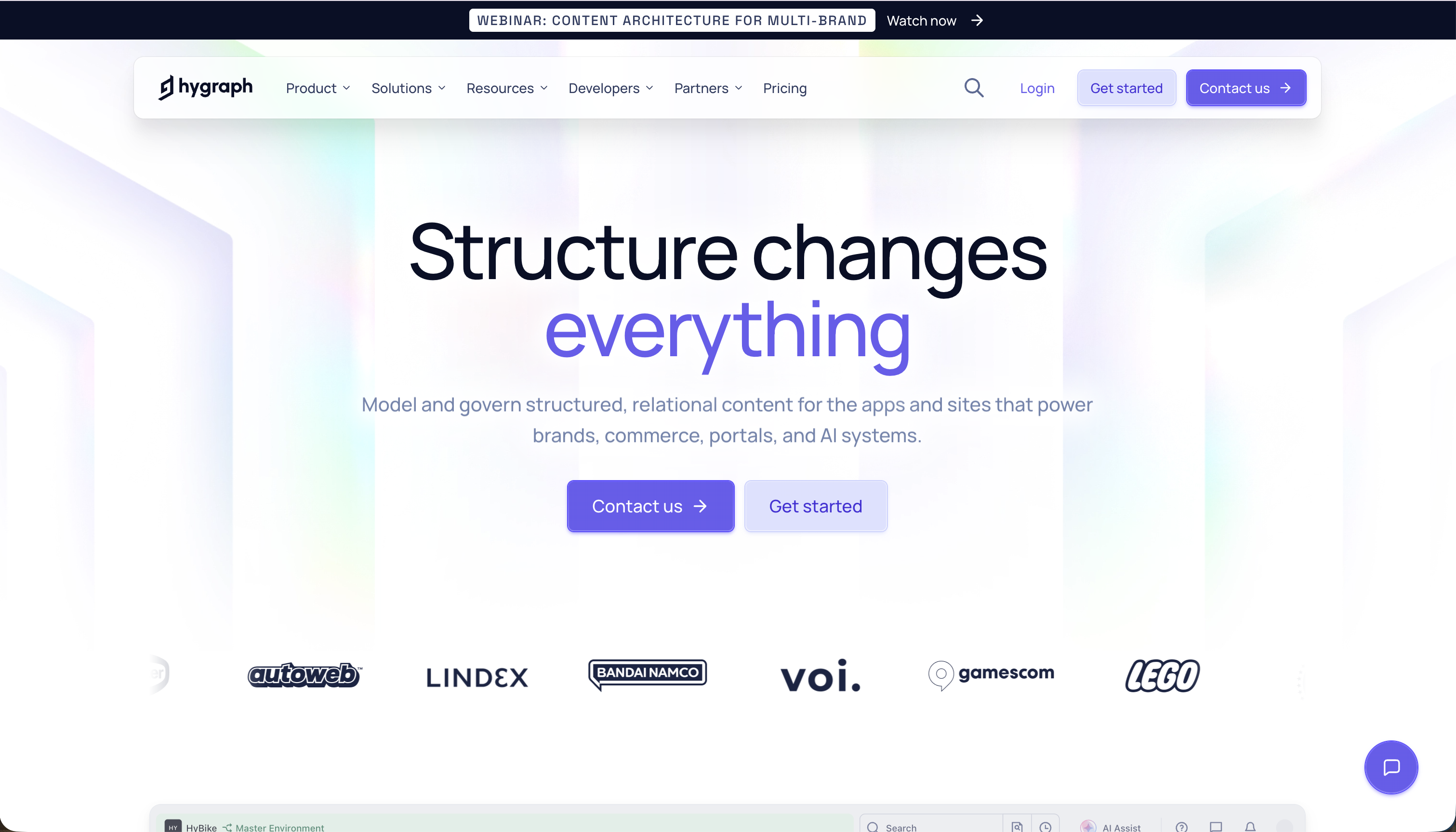
Hygraph is a GraphQL-native headless CMS that structures content and launches faster across every channel. With the flexible content modeling and fine-grained permissions, both developers and content teams can move faster and work better together. Hygraph's primary differentiator is its GraphQL-native content federation, which pulls from multiple data sources into a single clean API layer. However, customers have complained about the price changes and needing to upgrade.
How to Evaluate a Contentstack Alternative
For teams evaluating a Contentstack alternative, the standard platform checklist misses a few questions that matter more in 2026 than they did two years ago.
What does "agentic" actually mean on this platform?
Most platforms in this category now use the word. Few mean the same thing by it. Ask vendors to show you a specific workflow their AI runs autonomously, not a demo of a text generation feature inside the editor. The difference between an agent that runs continuously across your content inventory and a button that helps a writer draft a paragraph is significant, and the marketing language rarely makes that distinction clear.
Does it solve the actual reason you are leaving Contentstack?
Pricing opacity, developer dependency, and the absence of native commerce are the three complaints that show up most consistently in Contentstack reviews. Not every alternative solves all three.
Strapi addresses pricing with an open-source model. Storyblok addresses developer dependency with a visual editor that gives marketing teams publishing autonomy. Core dna addresses the commerce gap natively. Identifying which problem matters most narrows the list quickly.
Is multi-property management native or bolted on?
Ask vendors how long it takes to launch a new location or brand on their platform, and what ongoing maintenance that property adds to the team's workload. If a platform allows new properties to inherit brand settings, content structure, and integrations immediately rather than requiring a new build each time, it changes what lean teams can realistically manage without scaling headcount.
What does the total cost of ownership look like at your property scale?
Teams should model cost across their full property footprint rather than a single site. This includes per-site licensing, integration maintenance for commerce and CMS if they run separately, developer overhead for campaign deployment, and the cost of building and maintaining a composable stack if the platform only covers one layer. For multi-property operators, these costs compound in ways that a single-store evaluation will not surface.
Wrapping Up
For large B2C brands running sophisticated personalization across a single digital presence, the combination of Content Cloud, Data Cloud, and Agent OS in Contentstack is worthwhile.
For teams running franchise networks, multiple brands, or membership organizations, however, the evaluation criteria are different. Per-site complexity, the absence of native commerce, and pricing that requires a sales conversation before any number appears add overhead that compounds as the property footprint grows.
Contentstack is built to improve what customers experience on a single brand. It is not built to run operations across 20 or 60 properties simultaneously. For those operators, Core dna offers content, commerce, and agentic orchestration in one platform built for that specific complexity.
For teams thinking beyond a CMS replacement, the broader opportunity is consolidating content and commerce under one operational layer rather than adding another integration to an already complex stack.
See how Core dna handles multi-property operations and decide if the architecture fits what you are actually trying to do.
Summarize with