

BigCommerce is a popular enterprise ecommerce solution, but it is not the right fit for every situation. It works well for a single digital store, but for multi-property operators like franchise networks with 100+ locations, non-profits with 40 regional chapters, or retailers with 50 stores nationwide, things are not always straightforward.
Multi-property operators often run into challenges with BigCommerce's limits, including a pricing model that punishes growth and the need to buy multiple products to manage their digital experience, since BigCommerce only handles commerce.
These problems, though solvable, add operational overhead that makes running multiple digital properties on BigCommerce difficult, particularly if your internal team is lean. In this article, we break down the alternatives that may work better for your business, including Core dna, which offers content, commerce, and orchestration in one platform.
Where BigCommerce Shows Its Limits for Multi-Property Operators
BigCommerce works for many use cases and industries, including fashion and retail brands and food and beverage companies, but it is not designed around the operational reality of multi-property operators.
Pricing that scales against you
BigCommerce's pricing is linked to annual revenue thresholds. When you cross a sales limit, the platform moves you to the next tier. If you add properties, you also pay per additional storefront on top of that.
For a single-store operator, this model is predictable. For a franchise network adding locations each year or a multi-brand retailer with revenue spread across multiple storefronts, these two cost factors compound in ways that are hard to forecast at contract time.
“Most disappointing is the revenue-based plan thresholds which force plan upgrades based on trailing 12 month sales. More cost without using any extra features.”
B2B is a bolt-on, not a foundation
BigCommerce offers B2B commerce functionality via its B2B Edition. However, because BigCommerce originally served a B2C customer base, the B2B Edition is essentially a separate product available only on Enterprise plans.
For operators adding a wholesale channel to an existing DTC setup, the Edition delivers enough to get started. But operators with genuine B2B complexity reach their limits quickly and often struggle to implement features such as buyer-specific catalogs, multi-tier approval workflows, or contract pricing beyond price lists without significant customization or third-party support.
No native CMS means running two stacks
BigCommerce is a commerce engine, which means adding content management requires a separate platform. For a single-store operator running a WordPress blog alongside a store, that integration can be manageable. For a multi-property operator managing brand standards, seasonal campaigns, localized content, and publishing workflows across 10 or 20 properties, it means two platforms to license, two integrations to maintain, and two places where something can break.
One of BigCommerce's strengths is that it is open and headless, so operators can bring their own CMS. But the system integration overhead persists, and each new property adds to it.
Customization at scale requires ongoing developer dependency
Another challenge of working with BigCommerce is that meaningful storefront customization often requires developer involvement. For a single-store operator, this can be frustrating. For a multi-property operator customizing per brand, franchise location, or region across many storefronts, it becomes an ongoing operational cost that grows with every property added.
“It’s missing a drag-and-drop editor, which makes it difficult to customize especially for people who aren’t developers.”
Enterprise BigCommerce Alternatives Worth Evaluating
Salesforce Agentforce Commerce (formerly Salesforce Commerce Cloud)
Best for: Large enterprise networks already using Salesforce.
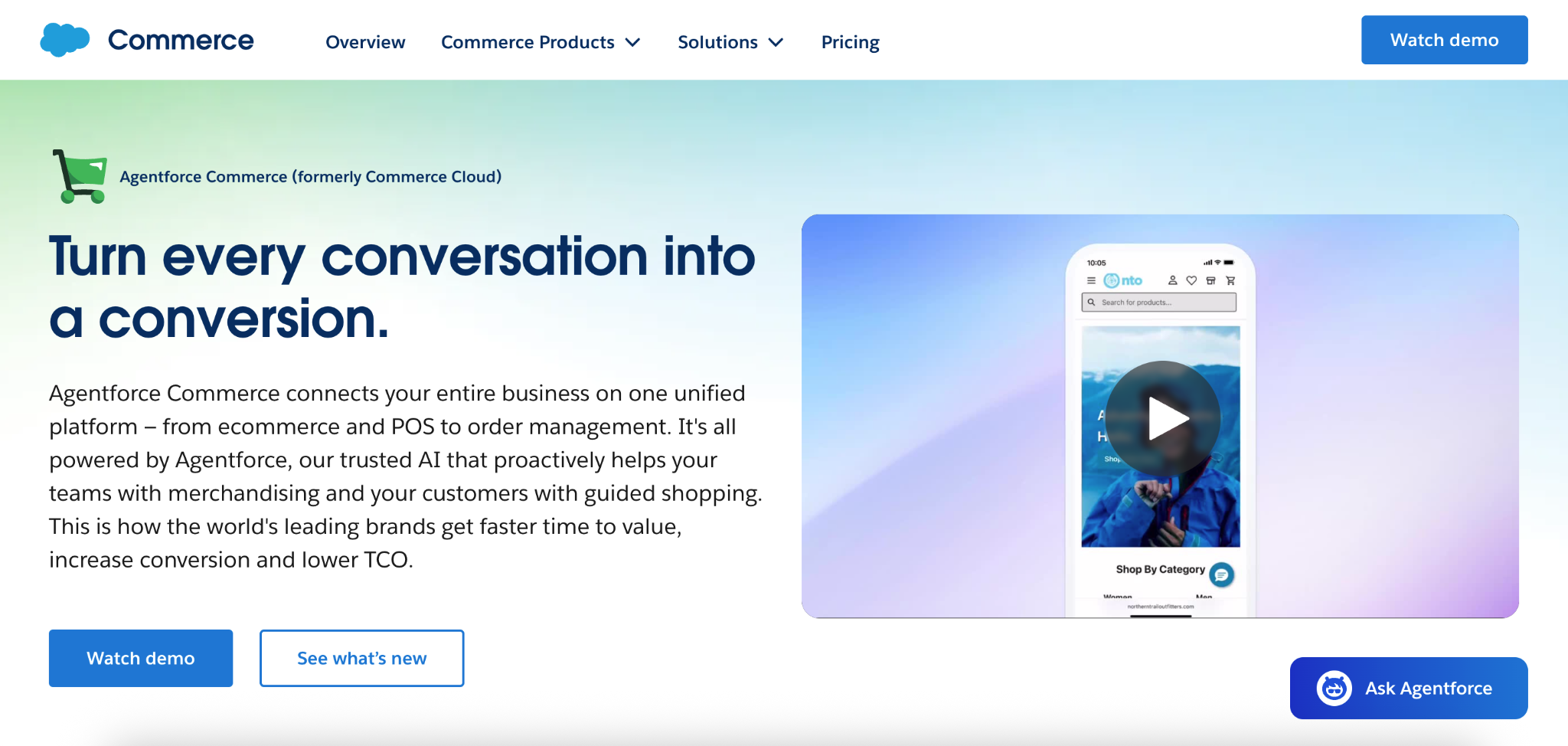
Salesforce rebranded Commerce Cloud as Agentforce Commerce, showing a shift toward AI-native commerce orchestration across the full customer lifecycle. The platform connects B2B commerce, B2C storefronts, point of sale, and order management into a single unified platform.
While BigCommerce charges per storefront and keeps B2B behind a separate Enterprise add-on, Agentforce Commerce handles B2B and B2C on a single platform. Multi-property operators can manage multiple brands and sites from a single admin console, localizing language, currency, and catalogs per property while sharing pricing rules and promotions across sites.
For organizations already running Salesforce CRM, Sales Cloud, or Service Cloud, the integration case is straightforward. For those that are not, the overhead of adopting the wider Salesforce ecosystem is a real consideration before the platform delivers its full value.
Advantages
- Multi-site, multi-region, and multi-currency support at enterprise scale.
- Deep integration with Salesforce CRM, Sales Cloud, and Service Cloud for unified customer data.
- Strong partner ecosystem and implementation network for complex deployments.
- Proven at large franchise and multi-brand scale with named enterprise references.
Limitations
- GMV-based pricing can create unpredictable total cost as revenue grows across properties.
- Implementation needs experienced SI partners and can take 9 to 18 months for complex multi-property deployments.
- Practical value depends heavily on existing Salesforce ecosystem investment.
What customers say: “While the platform is unmatched for complex B2B logic, the GMV-based pricing model can feel like a 'success tax,' which makes long-term TCO forecasting harder.”
Adobe Commerce (Magento)
Best for: Complex catalog operations with existing Adobe investment.
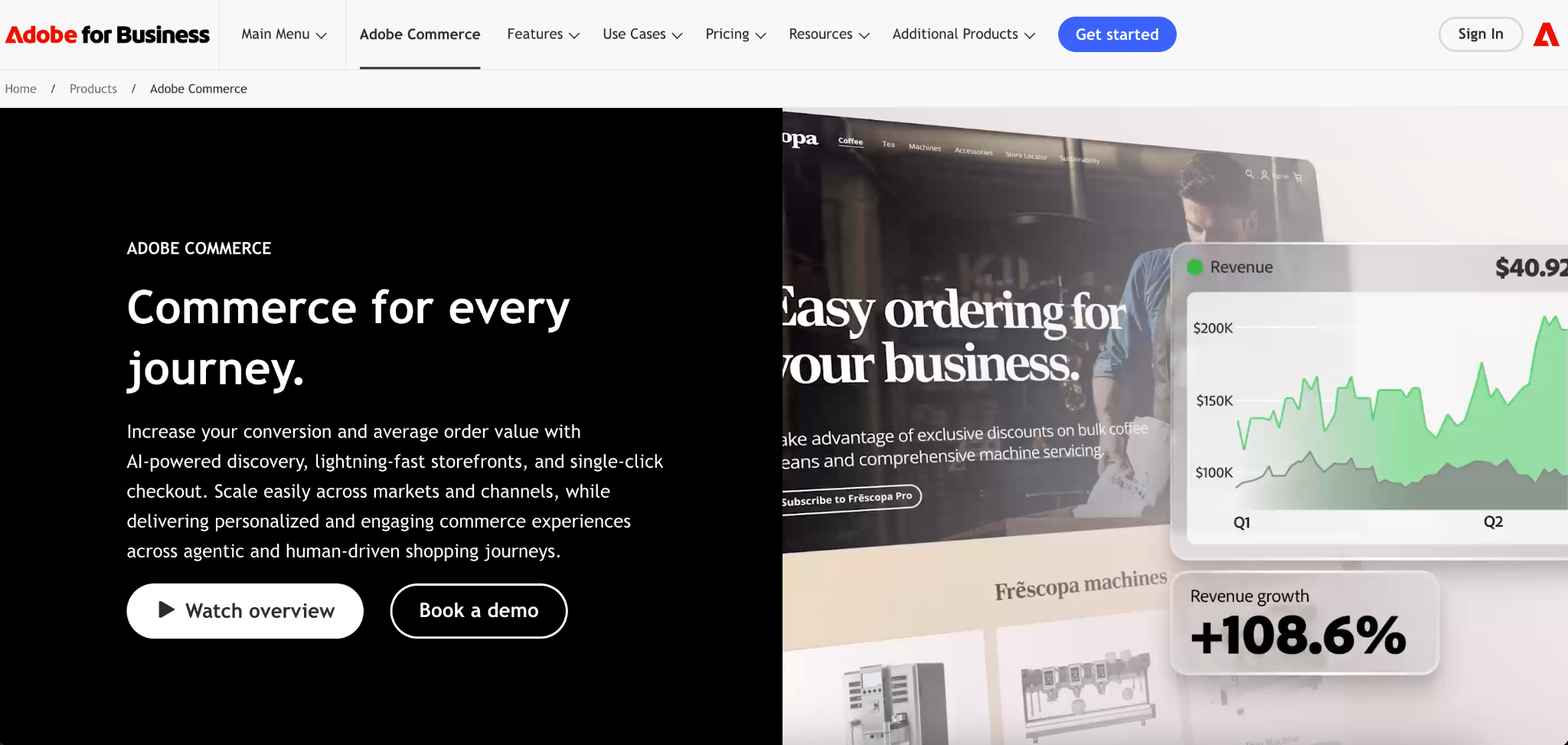
Adobe Commerce handles complex commerce at scale, including millions of SKUs. Brands can manage thousands of prices per SKU and configurable products across multiple storefronts from a single backend, with shared business logic and independent brand configurations per site.
For multi-property operators whose primary challenge is not just managing multiple storefronts but managing large, overlapping product catalogs across brands, regions, or channels, that catalog depth is the genuine differentiator.
Adobe Commerce is built for that complexity, with native multi-site architecture, composable APIs for custom storefront experiences per brand, and a large global ecosystem of pre-built extensions and implementation partners. However, it also requires a dedicated implementation partner and ongoing developer resource to maintain and extend, which makes it the wrong fit for operators who want less overhead.
Advantages
- Native multisite architecture supports multi-store, multi-brand, and multi-region deployments from a single backend.
- Deep catalog management for complex SKU structures, configurable products, and tiered pricing.
- Strong integration with Adobe Experience Manager, Analytics, and Target for a unified DXP.
- Large ecosystem of certified extensions and implementation partners globally.
Limitations
- High total cost of ownership, with implementation timelines that frequently exceed estimates.
- Full value requires commitment across multiple Adobe products, each with separate licensing.
- Implementation complexity makes it difficult for lean teams to own and maintain without dedicated agency support.
What customers say: “The developer dependency is the most frustrating part honestly. A lot of customizations that feel like they should be manageable through the admin panel end up requiring developer involvement, which slows things down and adds cost.”
Composable and Headless BigCommerce Alternatives
commercetools
Best for: Engineering-led teams building a composable multi-property stack.

commercetools is a composable commerce platform built for enterprise operators running B2C, B2B, and hybrid business models from one unified system. It provides commerce APIs across product catalog, pricing, cart, checkout, and order management that engineering teams use to compose custom storefronts and commerce experiences per property.
For operators frustrated by BigCommerce's ceiling on multi-model flexibility, per-storefront fees, B2B add-ons, and configuration limits, commercetools offers full architectural control. The tradeoff is that every user-facing capability must be built and maintained by an engineering team.
- Advantages: B2C, B2B, and hybrid business models from one shared backend; shared commerce backend for product data, pricing, and inventory; strong multi-currency, multi-language, and multi-region support; active MACH ecosystem.
- Limitations: No front-end, CMS, or visual editor included; higher total cost once development and integration are included; not practical for lean teams without dedicated engineering resources; broader vendor surface area.
What customers say: “We want it to have mobile app building capability on the front side. We only use it to build websites but we feel having mobile app is critical nowadays.”
Commerce Layer
Best for: Brands that need a headless commerce API layer behind an existing content experience, particularly for international or multi-market operations.
Commerce Layer is a headless commerce API built for multi-market and multi-currency operations. It sits behind an existing content experience and handles commerce logic across pricing, inventory, checkout, order management, and fulfillment.
Rather than maintaining separate storefronts per country, Commerce Layer handles per-market configuration at the API level while the front end stays consistent. For operators that have outgrown BigCommerce's per-storefront model and need to serve multiple markets from a single commerce backend without rebuilding for each region, that is the core architectural advantage.
- Advantages: Purpose-built multi-market and multi-currency operations; clean API layer for existing CMS or front-end frameworks; strong developer experience and composable architecture.
- Limitations: Assumes an existing content layer; provides no front-end, CMS, or business-user interface; less suited to multi-brand retail governance than international pricing variation; smaller partner ecosystem.
B2B and Unified Commerce Alternatives
Elastic Path
Best for: B2B operators and manufacturers who need complex catalog management, custom pricing, and multi-tiered workflows across multiple properties.
Elastic Path is a composable commerce platform built specifically for B2B enterprise operations, with catalog management tools designed for operators managing large, overlapping product catalogs across different storefronts and buyer segments. It supports native multi-store, multi-brand, and multi-currency configurations.
The platform also includes native search, content management, and hosted frontend services, reducing reliance on external vendors for a full commerce stack. For operators that hit BigCommerce's ceiling with catalogs, custom pricing tiers, and approval workflows, Elastic Path addresses those requirements as core platform capabilities rather than add-ons.
- Advantages: Native multi-store, multi-catalog, and multi-currency support; catalog management for buyer-specific pricing, availability, and merchandising; native search, CMS, and hosted frontend; API-first architecture with strong B2B workflow support.
- Limitations: Repositioned primarily for B2B, so B2C retailers may find the platform calibrated for a different use case; complex requirements can still involve developer support; fewer community resources and case studies than larger platforms.
Kibo Commerce
Best for: Unified commerce operators, including franchise networks, multi-location retailers, and businesses that need a consistent experience across digital and physical touchpoints.
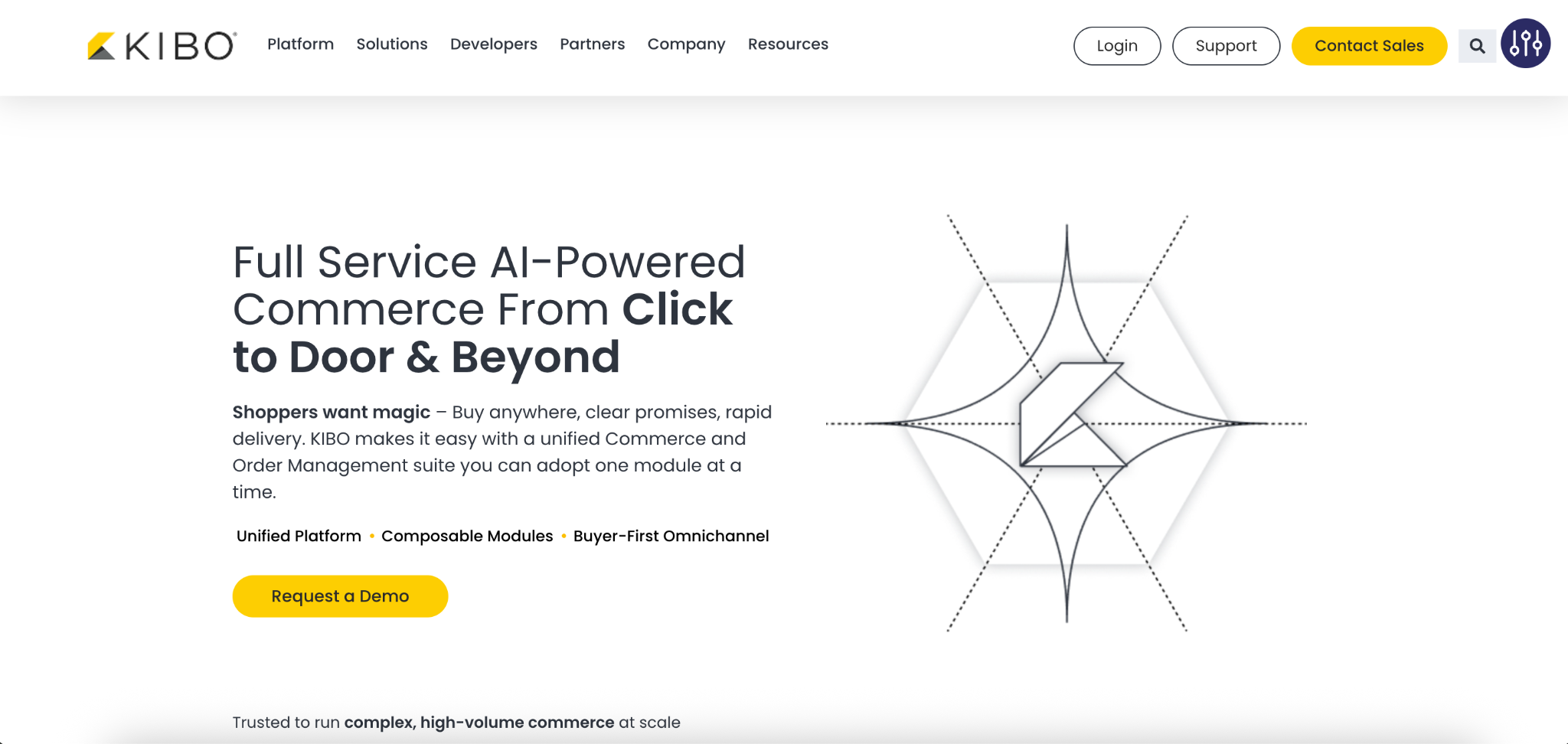
Kibo is a unified, headless commerce and order management platform with modular capabilities covering B2B and B2C commerce, real-time inventory, and order orchestration. Where BigCommerce handles a single store well and requires per-storefront fees as the property footprint grows, Kibo is built for operators who need commerce and order management to work across every channel and location from the start.
For franchise networks or multi-location retailers whose complexity comes from local inventory, click-and-collect, cross-store order routing, and local pricing, Kibo addresses the core requirements more directly than a platform designed for single-store retail.
- Advantages: Multi-location and multi-site commerce as a primary design target; unified ecommerce and order management; strong cross-location inventory, click-and-collect, and order routing capabilities; more accessible for business users than pure composable platforms.
- Limitations: Smaller market presence and partner ecosystem; CMS is an add-on rather than a core capability; self-serve evaluation is limited; less suited for multi-brand retail operators that need independent brand storefronts.
Core dna
Best for: Multi-property operators looking for content, commerce, and orchestration in one platform.
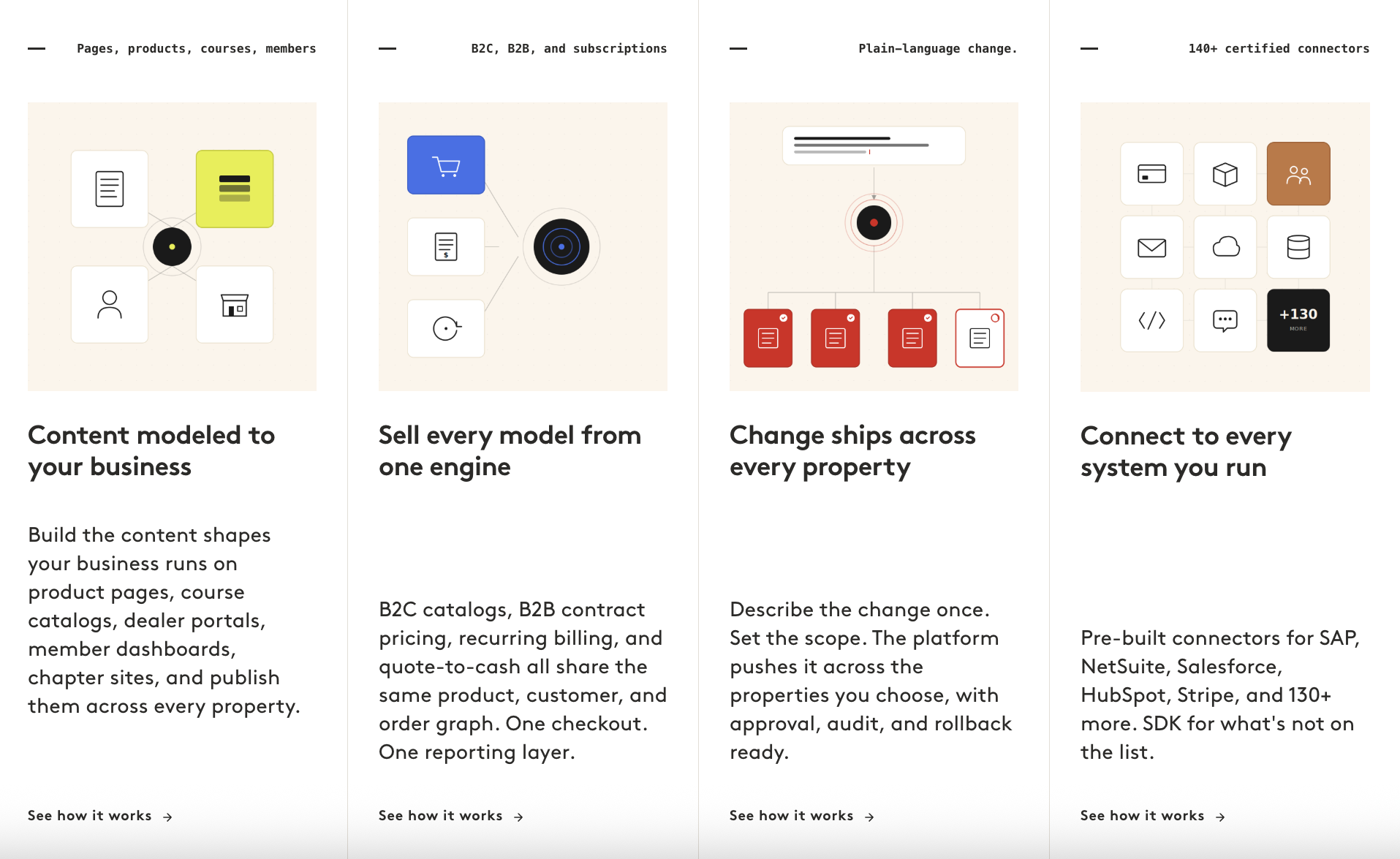 Core dna takes a different approach to the multi-property operator problem compared to every other platform on this list. Rather than providing a commerce API layer that requires a CMS, a front-end, and an integration layer, Core dna natively combines content management, ecommerce, workflow orchestration, and agentic operations in a single platform.
This simplifies operations for multi-property businesses that have already run into the two-stack problem: managing a CMS and a commerce platform that need to be kept in sync across every property.
Where this matters most is for franchise networks, multi-brand retailers, multi-location service operators, and membership organizations where content and commerce are inseparable. A franchise operator cannot easily push a campaign across 60 locations if the CMS and commerce engine are on different platforms, requiring separate deployments.
Similarly, a multi-brand retailer cannot easily give each brand its own storefront, pricing, and catalog while sharing customer data and operations from one place if those capabilities live in different systems.
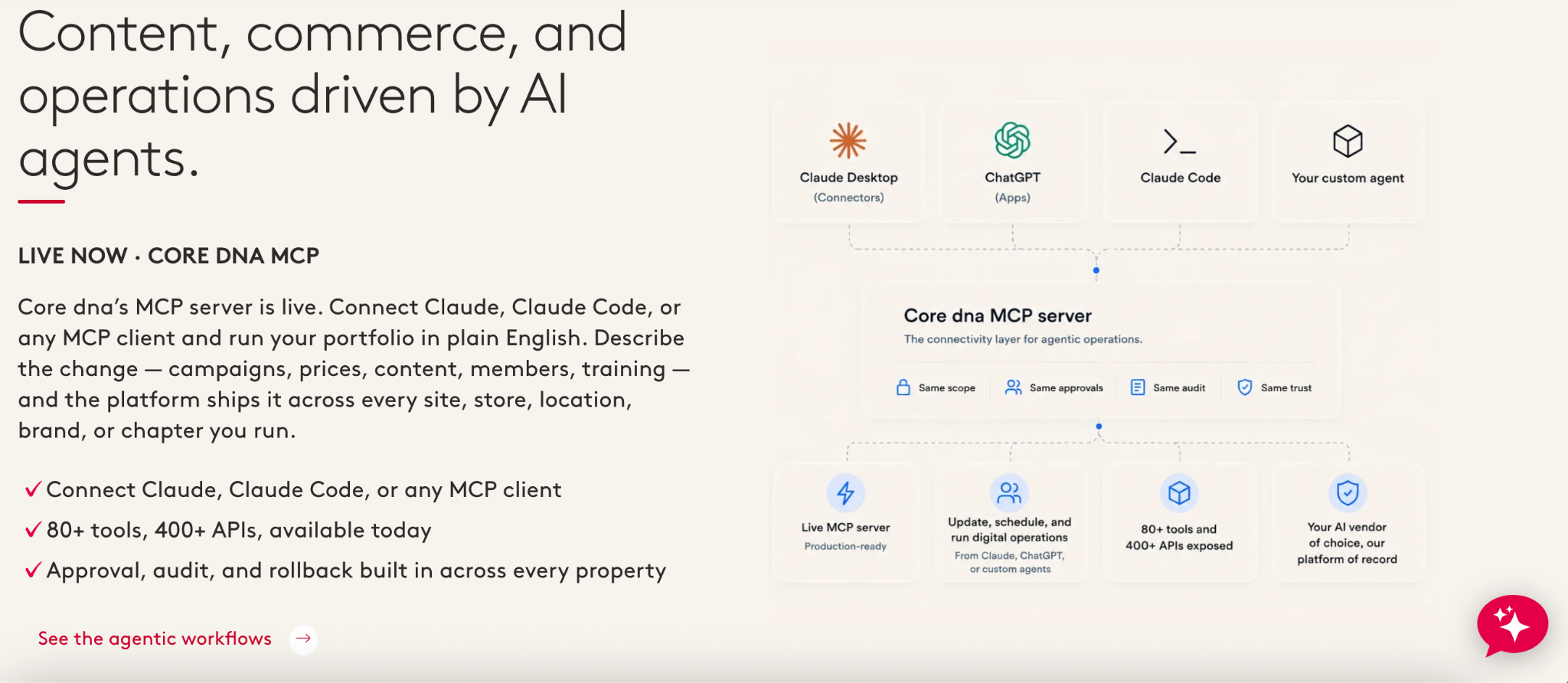
The agentic layer is what distinguishes Core dna's current positioning from alternatives. The platform's MCP server connects to Claude and other AI agents, allowing operators to describe a change in plain language and ship it across every property with approval, audit, and rollback built in. For lean teams managing growing property footprints, that changes what is operationally possible without scaling headcount.
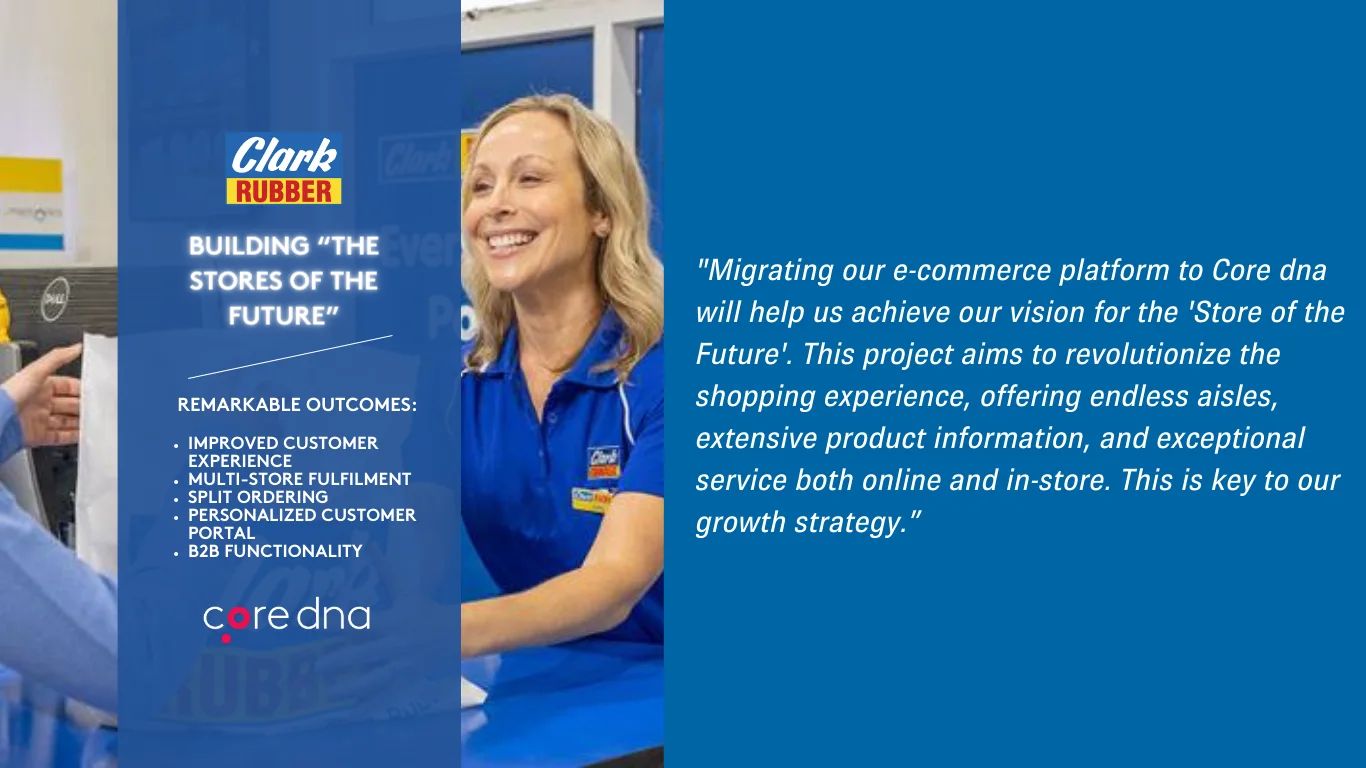
It is how Clark Rubber can manage 60+ franchise storefronts on one multi-property ecommerce platform with real-time inventory sync across locations, and have marketing and ecommerce managed without developer involvement for routine operations.
Advantages
- Native CMS and commerce on a single platform eliminates the integration overhead that grows with every property added.
- Multi-site architecture, brand governance, and franchise-level permissions are built into the core, not added as extensions.
- Agentic workflows via the MCP server allow operators to push changes across all properties from a single instruction, with approval and rollback.
- B2C, B2B, subscription, and membership commerce are supported in the same platform without separate product SKUs.
- Direct engineering access as part of the platform relationship means there is no SI partner dependency for implementation.
- Average time to launch is under 90 days, with the same team that builds the platform running the implementation.
Limitations
- Less suited for operators whose primary requirement is a complex enterprise portal, such as partner intranets or supplier portals, rather than multi-property content and commerce.
- Agentic capabilities are live but maturing, so operators with conservative governance requirements should evaluate the approval and audit workflow carefully before committing.
How to Evaluate a BigCommerce Alternative
For multi-property operators evaluating a BigCommerce alternative, there are a few things to consider beyond the standard platform evaluation checklist.
Is the platform designed for multiple sites or stores natively?
Ask vendors how long it takes to launch a new location or brand on their platform, and what ongoing maintenance that property adds to the team's workload. If a platform allows new properties to inherit brand, catalog, and integrations immediately rather than requiring a new build each time, it can save significant time and operational burden.
Does the platform handle content management natively?
For a single store, a separate CMS integration may be manageable. For 20 or 50 properties, it becomes compounding overhead. If the answer is “bring your own CMS,” model the total cost of that integration across your full property footprint, not just one store.
What does total cost of ownership look like?
Teams should model the full cost across their multi-property footprint, not just a single store. This includes per-site fees, integration maintenance costs, developer overhead for customization and campaign deployment, and the cost of maintaining separate CMS and commerce platforms if they are not unified. For composable platforms that only offer commerce, companies should also add the cost of the front-end build, CMS license, and ongoing engineering required to maintain the stack.
Does the platform offer agentic capabilities?
Platforms that allow operators to describe a change once and push it across multiple properties, with approval and rollback built in, represent a different operating model than platforms that require developer involvement or manual repetition for each property. For lean teams managing growing property footprints, this capability determines what is actually possible without scaling headcount.
If the decision is part of a broader migration, it is worth planning it as a multi-property replatforming project rather than a like-for-like ecommerce replacement.
Wrapping Up
BigCommerce is a reliable enterprise commerce platform for single-store operators and DTC brands, and for many businesses, it does exactly what they need.
However, for multi-property operators managing franchise networks, regional locations, or multiple brands, per-storefront pricing, the separate B2B product, and the need to run a CMS alongside the platform add overhead that compounds as the business grows.
For those operators, Core dna offers content, commerce, and orchestration in one platform built specifically for that complexity. For teams trying to reduce vendor sprawl, the broader opportunity is CMS and ecommerce platform consolidation, not just replacing one commerce tool with another.
Get started today and see how Core dna can simplify your multi-property operations.
Summarize with