

So look, the past two years have been absolutely wild. If you're working in digital, you know what I'm talking about. We all watched AI go from this thing we experimented with on the side to something we literally can't work without anymore, and we are seeing now define the digital trends for 2026.
LLMs didn't just give us some new tools to play with. They fundamentally changed how we do the work. How we write. How we build stuff. How we make decisions. Once you cross that threshold, you can't help but ask bigger questions about what a digital business even means now.
We're way past talking about which vendor to pick or what shiny tool to implement next. This goes deeper. It's about completely rethinking how you operate, because machines aren't just helping us anymore, they're out there discovering and acting on information right alongside people. That changes everything about your digital presence.
Here's the thing: if machines can't parse your site properly, all those automated search and recommendation systems? They just skip you. Your referrals drop off a cliff. Conversions tank.
How do we avoid that? Well, let's take a look at what trends will help you build the digital foundation for the future.

The Post-Click Reality: How to Adapt Digital Strategy for 2026 and beyond
Before diving into our analysis, it's worth looking at what's happening on the ground with marketers who are already adapting to these shifts. Neil Patel recently broke down his 2026 marketing strategy, and honestly, it validates a lot of what we're seeing across the industry.
The biggest shift isn't some new marketing channel opening up. It's how discovery and conversion actually work now. Search platforms, social networks, They're answering questions directly way more often.
The patterns he's betting on align pretty closely with the infrastructure and platform shifts we're tracking. Here's what stood out:
Search fragmentation is real
Search isn't just happening on Google anymore. It's everywhere: Instagram, YouTube, TikTok, ChatGPT, even browsers themselves. This isn't theoretical. People are discovering content and making decisions across completely fragmented surfaces. If you're only optimizing for Google, you're missing most of the game.
Platform friction is killing conversion
Sending people off-platform to landing pages? That's throttling your reach and adding friction at the exact moment intent is highest. The shift toward capturing leads directly within platforms; using conversational tools, native forms, in-feed experiences; isn't just convenient. It's becoming essential for performance.
AI discovery favors authority and structure
AI engines don't just crawl content - they cite sources. And they're heavily favoring structured, authoritative content. Niche listicles, well-organized data, digital PR that builds external credibility. This completely changes what "ranking" even means. You're not trying to rank a page anymore. You're trying to get cited as a trusted entity.
Live content compounds value
Live video isn't just engagement theater. It builds trust in real time and generates reusable content you can repurpose across formats. One live session can become clips, transcripts, blog posts, social content. The content infrastructure angle here is huge; you're creating assets that compound instead of decay.
Multilingual reach is suddenly accessible
AI dubbing and translation tools are making global expansion way more feasible. You can now reach audiences in multiple languages without rebuilding your entire content operation. This isn't a nice-to-have anymore; it's a competitive advantage that's available right now.
What this means for infrastructure
Here's why this matters beyond tactics: these trends don't work if your infrastructure can't support them. You can't do search-everywhere optimization if your content isn't structured and reusable. You can't capture leads on-platform if your systems depend on off-platform conversions. You can't scale multilingual content if video is trapped in campaigns instead of managed as data.
The tactics are changing because the environment changed. But tactics fail without the right foundation. That's what the rest of this article breaks down - the infrastructure shifts that make these strategies actually work at scale.
In this post-click world, websites can't just be destinations anymore. They need to work as service platforms. And here's the tricky part: they need to serve two completely different audiences at the same time. Humans and machines.
Key Digital Trends to Focus on in 2026
1. Focus on AI as foundational infrastructure
Not a feature, not an experiment
What’s changing
If the last two years were the AI rollercoaster, 2026 is where things settle into reality.
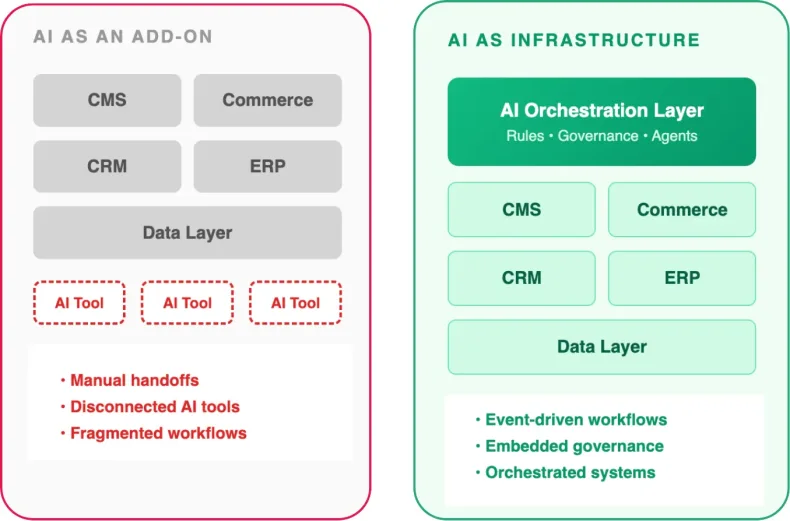
AI is no longer something digital teams experiment with on the side. It’s becoming the environment digital systems operate within. It shapes how work moves through an organization, how decisions are made, and how experiences are delivered, often without a human pressing a button at every step.
Large language models didn’t just introduce new tools. They changed how we write, build, discover, and decide. And once that becomes normal, it forces a bigger question: what does a digital business look like when machines are actively discovering, evaluating, and acting on information alongside people?
As AI takes on more responsibility, weak foundations stop being a technical inconvenience and start becoming a business risk.
What this looks like in practice
Once you see AI as part of the environment, day-to-day operations start to look very different.
AI stops sitting beside teams and starts acting for them. Things that used to require manual attention, routing content, applying pricing rules, approving standard updates, triggering downstream actions, now happen automatically across systems.
You can see this clearly in how platforms like Core dna approach orchestration. AI agents aren’t added as separate tools. They run inside the platform and are triggered by real operational events.
When new content is published, an AI agent can generate SEO metadata, populate structured fields, and pass that information into connected systems without a marketer manually stitching everything together. The automation follows the same business rules, permissions, and governance as the rest of the platform.
The commercial impact shows up just as quickly. In many buying journeys, the first interaction with your product is no longer a person. It’s an AI assistant comparing options under clear constraints. If product data is inconsistent, pricing and availability aren’t machine-readable, or checkout behavior is unpredictable, the assistant fails and moves on.
There’s no bounce rate or abandoned cart to analyze, just a missed opportunity you never see. At that point, AI readiness and commercial readiness collapse into the same problem.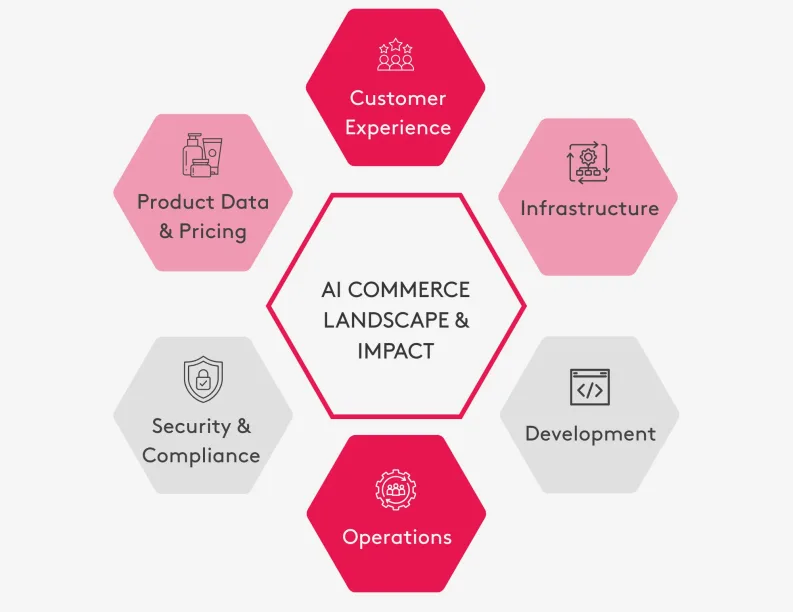
What to focus on
This is where digital strategy in 2026 really sits.
Organizations that treat AI as infrastructure stop chasing novelty and start investing in stability and clarity. They build structured content, data, and business logic that machines can reliably interpret. They design workflows and approvals that make it clear where automation can act on its own and where human oversight is required.
They also choose platforms where AI operates inside core systems rather than being layered onto peripheral components. When automation is embedded into everyday operations, it scales without eroding trust or control.
A practical starting point is simple. Treat AI like any other critical system. Assign clear ownership, define responsibility for automated decisions, and pilot one contained workflow, such as automated metadata generation or routine approvals, before expanding further.
What to ignore
Ignore isolated AI tools that don’t integrate with your core systems. Ignore impressive demos that never make it into real operations. Ignore automation initiatives without clear ownership or accountability.
Without structure and governance, AI doesn’t make a digital business faster. It makes it harder to understand, harder to control, and harder to recover when something goes wrong.
2. Focus on personalization as operational relevance
Ignore personalization as novelty or guesswork
What’s changing
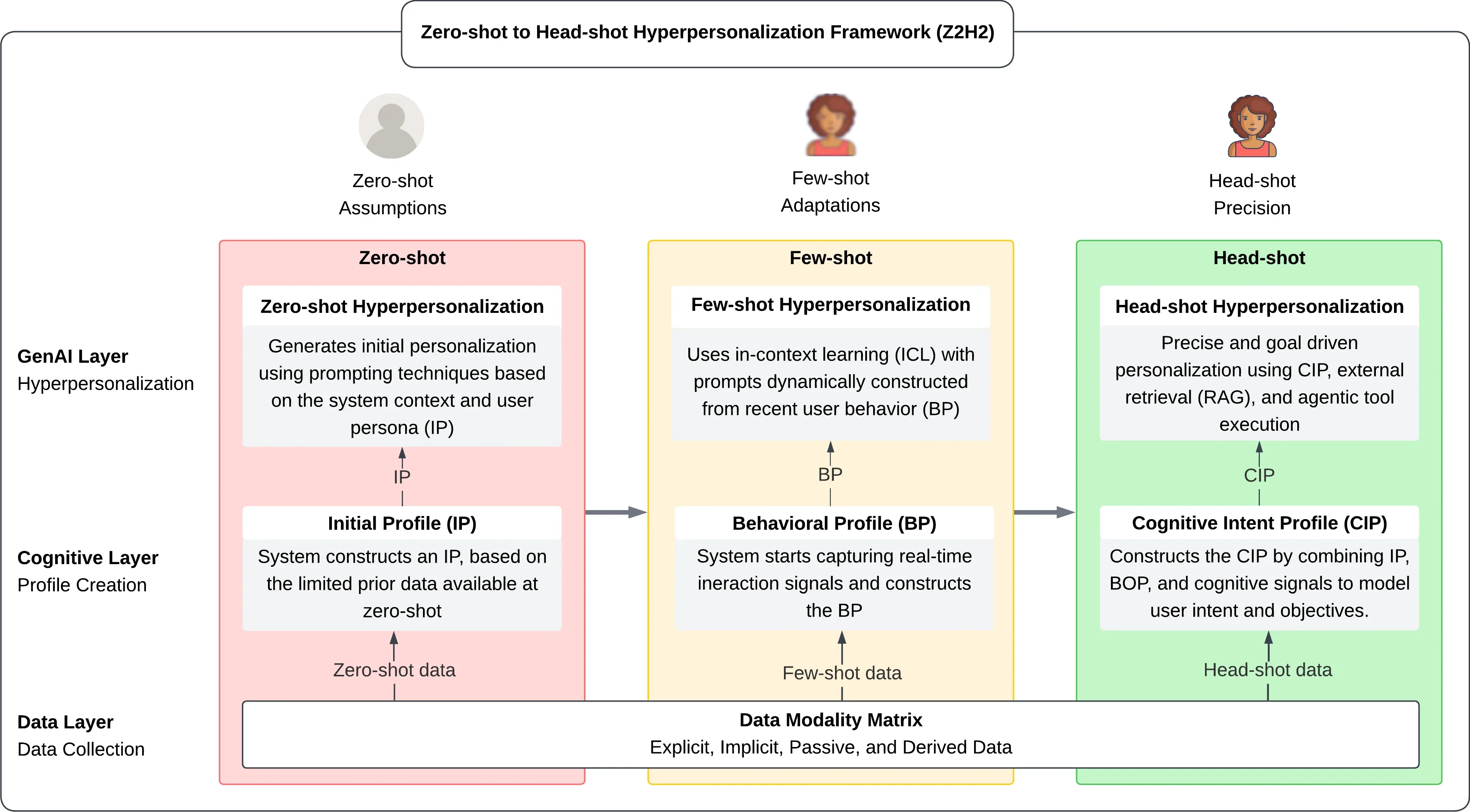
Personalization in 2026 shifts from experience design to operational relevance.
For years, personalization was treated as a way to make digital experiences feel more engaging. That framing is no longer sufficient. What matters now is not how personalized something appears, but whether it adapts meaningfully to context in real time.
Customers, members, and partners increasingly expect interactions to reflect who they are, what they need, and where they are in their journey. When experiences fail to adapt to role, account context, location, or lifecycle stage, they don’t feel neutral, they feel inefficient.
Impact on the digital business
As journeys compress and intent rises, irrelevant experiences introduce friction faster and at greater cost.
In B2B, franchise, and membership-driven environments, personalization directly affects operational efficiency. Showing the wrong content, pricing, offers, or actions forces users to self-navigate, contact support, or abandon tasks entirely. That friction compounds across sales, onboarding, support, and renewal.
At the same time, personalization becomes harder to sustain at scale. When relevance is built through manual segmentation, one-off rules, or disconnected tools, complexity grows faster than value. Teams spend more time maintaining journeys than improving outcomes.
In practice, the cost of poorly grounded personalization shows up as slower conversion, higher support burden, and inconsistent experiences across channels.
How context is captured
A practical shift supporting personalization is how context is collected.
As third-party tracking continues to fade, the most reliable inputs come directly from users through small, value-first interactions. High-performing teams replace long lead-generation forms with micro-milestones, quick assessments, fit finders, onboarding questions, and preference checkpoints that return immediate value.
This approach turns data capture into a service rather than a barrier, creating richer context for personalization while keeping the experience fast and frictionless.
What to focus on
Organizations that get this right treat personalization as a system, not a feature.
They anchor relevance in clear business logic and real-world context, role, account status, geography, lifecycle stage, and permissions, and use AI to assist within those boundaries rather than replace them. Rules and AI work together, allowing personalization to be governed, explained, and adjusted as the business evolves.
The goal is not maximum sophistication. It is predictable, useful relevance that reduces friction at every stage of the journey.
What to ignore
Ignore black-box personalization no one can explain or control, over-engineered journeys teams can’t maintain, and one-size-fits-all experiences disguised as relevance.
In 2026, personalization earns trust not by being clever, but by being consistent, understandable, and genuinely helpful. That’s what makes it operationally relevant.
3. Focus on digital trust as a strategic asset
Ignore security as a downstream technical problem
What’s changing
In 2026, trust shifts from a background security posture to strategic credibility, and increasingly, to business continuity.
As AI becomes embedded across digital platforms, the nature of risk changes. AI-driven phishing, deepfakes, automated impersonation, and synthetic interactions don’t just threaten systems, they undermine confidence at the exact moment decisions are made. Verification, identity, and provenance increasingly surface inside conversion, checkout, and approval flows.
At the same time, the rise of AI-assisted development and “vibe coding” changes how software itself is created.
Teams can now generate working code, integrations, and workflows in minutes. While this accelerates experimentation, it also introduces new risk vectors. Code is shipped faster than it can be reviewed, logic is copied without full understanding, and security assumptions are inherited blindly from AI-generated output.
Trust is no longer assumed. It is evaluated continuously.
Impact on the digital business
These shifts directly affect how safely and confidently a digital business can operate.
Rapid AI-driven development increases the surface area for error. Small misconfigurations, insecure defaults, or unclear permission boundaries can propagate quickly across systems, especially when generated code touches authentication, data access, pricing logic, or automation rules.
From the outside, customers and partners don’t see “vibe coding.” They see hesitation, inconsistent behavior, or unclear verification at moments that matter. From the inside, teams compensate with manual checks, workarounds, and reactive controls that slow everything down.
In AI-driven environments, trust failures rarely announce themselves. They show up as abandoned transactions, stalled approvals, increased support volume, and rising operational drag.
In practice, digital trust becomes inseparable from the ability to move fast without breaking confidence.
What to focus on
Organizations that treat trust as a strategic asset design guardrails, not just policies.
They ensure AI-generated code, workflows, and integrations operate within clearly defined boundaries. Identity, permissions, and access rules are centralized rather than reimplemented repeatedly. Decisions are traceable. Actions are auditable. Automation operates inside a governed system, not alongside it.
This doesn’t slow innovation. It allows teams to experiment and move quickly without introducing hidden risk or fragility.
Trust is embedded into how systems are built, extended, and operated, not added later as a compliance exercise.
What to ignore
Ignore security strategies that exist only in documentation, AI-generated code shipped without review or ownership, and rapid experimentation that bypasses identity, permissioning, or auditability.
Also ignore the assumption that trust can be “handled later.” In 2026, later usually means after damage is done.
Trust doesn’t just protect the digital business. It makes speed sustainable.
4. Focus on becoming an AI-native organization
Ignore adding AI tools without changing how work flows
What’s changing
AI-native organizations don’t just adopt AI, they restructure work around it.
By 2026, this shift is less about mindset or culture and more about coordination. Most organizations already have AI touching different parts of the business, content, marketing, analytics, support, and development. What separates leaders from laggards is whether those systems are merely connected, or actively orchestrated.
In AI-native organizations, systems don’t just exchange information. They act together.
Impact on the digital business
When work depends on humans to move information between systems, speed becomes fragile.
Manual handoffs, duplicated data entry, and informal processes introduce delay, inconsistency, and hidden risk. As AI increases the volume and pace of activity, these gaps become more visible. Teams spend more time supervising workflows than improving outcomes.
A visible outcome of this shift is marketing moving closer to product.
As prototyping becomes cheaper and faster, teams increasingly build small tools, calculators, configurators, assessments, and guided flows that solve a problem in minutes. These are not campaign assets. They are operational experiences that generate qualified intent, guide decision-making, and capture useful context that feeds directly into sales, onboarding, or support.
This only works when systems coordinate. If tools live outside core workflows, their value is short-lived. When they operate inside an orchestrated platform, they become part of how the business runs.
The practical question shifts from “Where can we apply AI?” to: “Do our systems move work forward on their own, or do they still depend on people to connect the dots?”
What to focus on
Organizations that succeed embed orchestration into the platform itself.
Business logic lives centrally rather than being recreated across tools. Workflows are event-driven instead of manually triggered. AI agents operate inside governed systems, coordinating content, commerce, data, and automation as one cohesive flow.
This allows teams to build and deploy new experiences quickly, including interactive tools, without introducing fragmentation or operational drag.
The goal is not maximum automation. It is reliable coordination.
What to ignore
Ignore isolated AI pilots, point-to-point integrations that don’t scale, and productivity goals that rely on people compensating for system gaps.
Also ignore treating interactive tools as disposable campaigns. Without orchestration, they create short-term lift and long-term complexity.
In 2026, AI-native organizations don’t feel more automated.
They feel more fluid.
5. Focus on content as infrastructure in a video-first world
Ignore content as disposable campaigns
What’s changing
In 2026, content shifts from creative output to operational infrastructure, with video at the center of that shift.
Short-form, authentic video continues to dominate attention, but its role extends far beyond social feeds. Video increasingly supports sales enablement, onboarding, support, training, and AI-driven discovery. It becomes a functional component of how the business communicates, educates, and converts.
The challenge for leaders is no longer producing video. It’s deploying it intelligently across the organization.
Impact on the digital business
When video is treated as a one-off asset, its value decays quickly.
Videos get trapped inside campaigns, platforms, or pages. Teams recreate similar content repeatedly for different channels. Knowledge becomes fragmented. As demand for video grows across sales, support, and operations, this model collapses under its own weight.
In contrast, when video is treated as infrastructure, it scales.
Object-based video treats video as a structured component rather than a page-level embed. The same video can appear in a B2B portal, a sales workflow, onboarding journeys, help desk responses, or be referenced by AI search engines and agents automatically, without duplication or re-uploading.
This turns video from a marketing task into a shared operational asset that compounds value over time.
At the same time, audiences are developing a premium for visible humanity.
As generic AI-generated content floods feeds, overly polished assets can reduce trust instead of increasing it. The content that performs best is often real, specific, and slightly imperfect, employee-led demos, unedited customer proof, behind-the-scenes clips, and transparent explanations. In 2026, authenticity isn’t a creative style. It’s a trust mechanism.
What to focus on
Organizations that scale video effectively design it as data.
They manage metadata, permissions, versions, and lifecycle centrally. Ownership is clear. Governance is built in. The same video object can serve marketing, commerce, education, and support simultaneously, adapting to context without being recreated.
This allows teams to move quickly without sacrificing consistency, trust, or control.
The practical shift is from asking, “How fast can we produce video?” to asking, “How easily can our video be reused, surfaced, and trusted across the business?”
What to ignore
Ignore video trapped in external platforms, one-off campaign assets that can’t be reused, and content systems that treat video as decoration rather than capability.
Also ignore the assumption that polish equals credibility. In a video-first world, reusability and authenticity are what make velocity sustainable.
6. Focus on designing for a dual audience
Ignore websites built only for human visitors
What’s changing
By 2026, websites no longer serve a single audience.
They serve two audiences at the same time: humans and machines.
Human visitors still matter, customers, partners, members, and internal teams. But alongside them are AI search engines, recommendation systems, autonomous agents, and internal workflows that increasingly rely on websites to interpret content, retrieve data, and initiate actions.
If a site works beautifully for people but fails for machines, it will still underperform.
Impact on the digital business
This shift changes what a website actually is.
Websites are no longer just brand destinations or marketing assets. They function as operational interfaces within a broader digital system. They communicate not only value and credibility to humans, but intent, structure, and capability to machines.
Search is also changing shape. Google and new answer engines increasingly summarize and cite sources instead of sending clicks. Success shifts from “ranking pages” to being referenced as a trusted entity. If your brand isn’t included in the answer, it effectively doesn’t exist for that interaction.
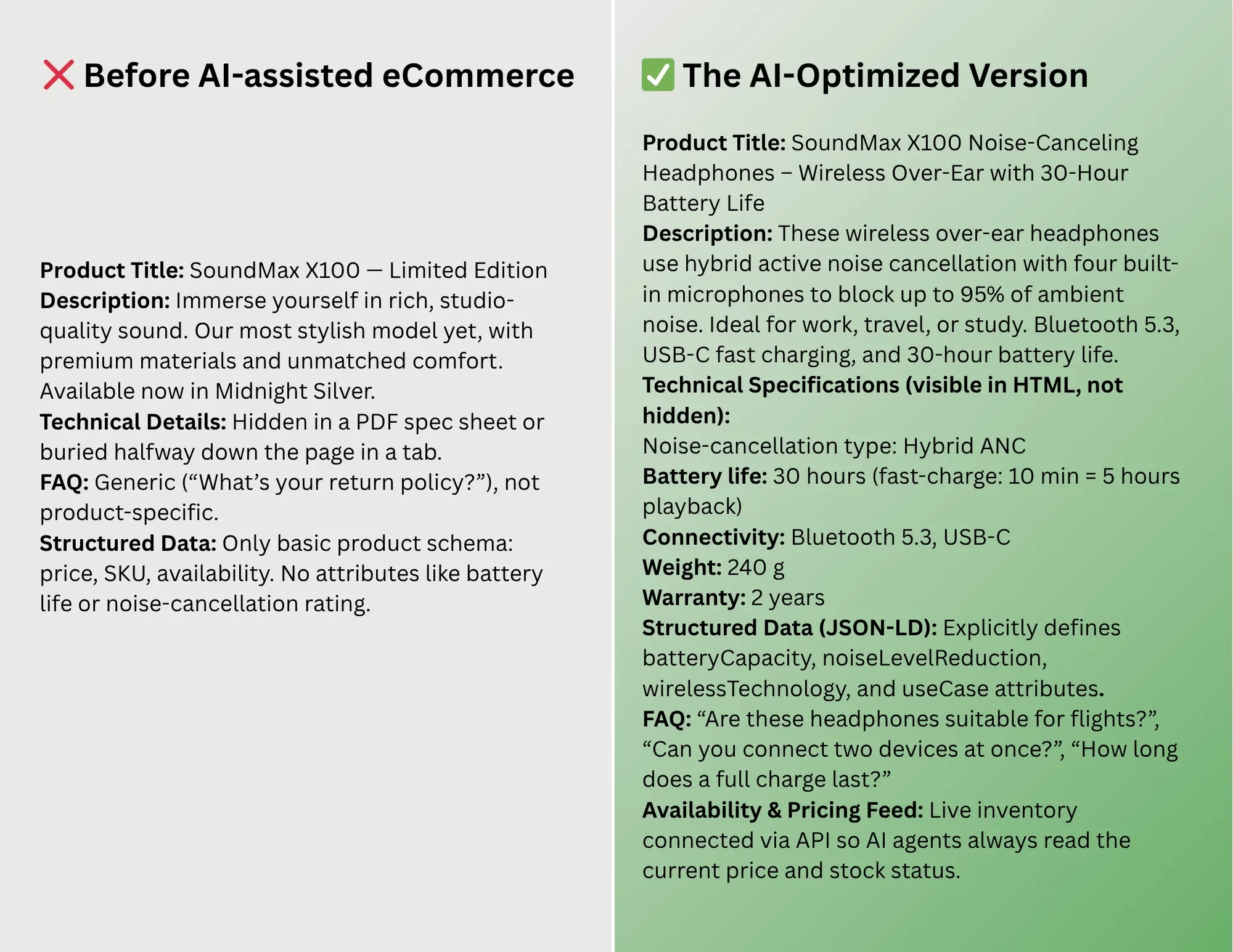
At the same time, AI agents increasingly act on behalf of users. When machines cannot reliably read pricing, availability, permissions, product logic, or content meaning, opportunities disappear quietly. Agents fail. Search summaries omit the brand. Internal automations stall. Revenue is lost before a human ever sees the experience.
In a post-click environment, where fewer interactions carry higher intent, these failures are increasingly costly.
What to focus on
Organizations that succeed design for both audiences simultaneously.
For humans, this means clarity, speed, accessibility, and visible trust.
For machines, it means structure, consistency, performance, and machine-readable logic.
Structured content and technical data become a discoverability layer. Schema markup, consistent product data, and authoritative, sourceable assets allow AI systems to interpret, reference, and act on information with confidence. APIs and integrations enable systems and agents to interact cleanly with the platform rather than scraping or guessing.
The leadership question shifts from “Does our website look good?” to: “Does our website reliably communicate intent and capability to both humans and machines?”
What to ignore
Ignore sites that prioritize visual polish at the expense of speed or stability, platforms optimized only for publishing, and architectures that assume humans are the sole consumers of digital experiences.
Also ignore the idea that machine-readability is a technical detail to be handled later. In 2026, it directly affects discovery, conversion, and automation.
The most effective websites won’t just persuade people.
They will quietly enable systems, agents, and workflows to operate with confidence.
Embracing the dual audience isn’t a technical consideration.
It’s a strategic advantage.
The 2026 Digital Strategy Reset
| Area | What to stop carrying forward | What to build instead in 2026 |
|---|---|---|
Search & Discovery | High-volume, generic blog content written to chase rankings | Structured, authoritative data assets designed to be cited by AI search engines |
Content Strategy | Campaign-driven content created for single moments | Reusable content infrastructure, especially modular, object-based video |
Trust & Brand | Over-polished, “perfect” brand assets that feel manufactured | Human-first content that shows real people, real usage, and real context |
Personalization | Black-box personalization no one can explain or govern | Context-driven personalization grounded in clear business rules and data |
Data Collection | Long lead-gen forms that interrupt intent | Micro-milestones that exchange instant value for preference data |
Commerce Experience | Friction-heavy journeys optimized only for human users | Agent-ready commerce with clean data, fast flows, and predictable logic |
Marketing Output | Static landing pages and PDF-style guides | Interactive tools and small utilities that actively help users decide |
AI Adoption | Isolated AI tools and pilots with no operational ownership | AI embedded into workflows through orchestration and governance |
Platform Strategy | Best-of-breed stacks no one owns end-to-end | Unified systems designed to absorb change without increasing complexity |
Bringing the 2026 Digital Strategy to Life
The last few years taught us how quickly digital can change. 2026 will test how well it can hold together. Most leaders don’t need more ideas, tools, or trends.
They need clarity. They need to know which investments will still make sense a year from now, and which ones quietly add friction. The goal isn’t to slow innovation.
It’s to build systems where innovation doesn’t feel risky. That’s what this reset is about. And it’s the mindset that will define the strongest digital strategies moving forward.
Everything we’ve covered in this article points to the same reality: 2026 rewards platforms that are designed as systems, not stacks.
- AI as infrastructure.
- Personalization as operational relevance.
- Trust as strategic credibility.
- Content and learning tied directly to revenue.
- Websites built for humans and machines.
- And orchestration that replaces manual handoffs with intelligent flow.
This is the thinking behind Core dna 2.0.
Rather than stitching together content tools, commerce engines, learning systems, automation platforms, and business rules, Core dna brings them together into a single, unified digital experience platform, designed to work as one from day one.
The video below walks through that foundation in action.
You’ll see how content and commerce are managed in the same workflow, how AI agents run autonomously in the background, how learning connects directly to products and revenue, and how intelligent rules and personalization operate from a single engine. Most importantly, you’ll see what it looks like when systems are coordinated, not just integrated.
This isn’t about adding more capabilities.
It’s about removing friction.
It’s the difference between managing digital experiences and operating a digital business.
Summarize with