

AI has changed the way we do business across the board, but the impact is amplified when it comes to eCommerce, Capabilities that once required multi-year roadmaps, such as customer self-service, automated quoting, real-time inventory visibility, and AI-driven product recommendations, can now be deployed in months or even weeks.
This acceleration is forcing every organization to evaluate its AI Commerce Readiness: the ability to adopt AI safely, govern it effectively, and integrate it into mission-critical systems.
AI offers significant upside:
- Better product discoverability
- Automated customer assistance
- Predictive inventory and demand forecasting
- 15–20% conversion improvements for digital commerce
But it also introduces real enterprise risks: unstructured AI-generated code, governance gaps, security vulnerabilities, and systems that become difficult to audit or maintain without the right framework.
This guide presents a practical approach to AI Commerce Readiness to help enterprises safely adopt AI, set guardrails for Vibe Coding, prevent Shadow AI, and prepare for the next evolution of digital business: Agentic Commerce.

On this page:
The Core Strategic Framework: The AI Commerce Readiness Blueprint
AI is no longer a standalone, isolated initiative. For enterprise commerce, it is a foundational organizational capability that impacts every layer of the digital ecosystem, from customer experience and operational workflows to data integrity and security compliance.
To move beyond fragmented pilot projects and achieve measurable ROI, leaders must adopt a comprehensive framework. This framework transforms AI readiness from a nebulous goal into a governed, cross-functional strategic blueprint.
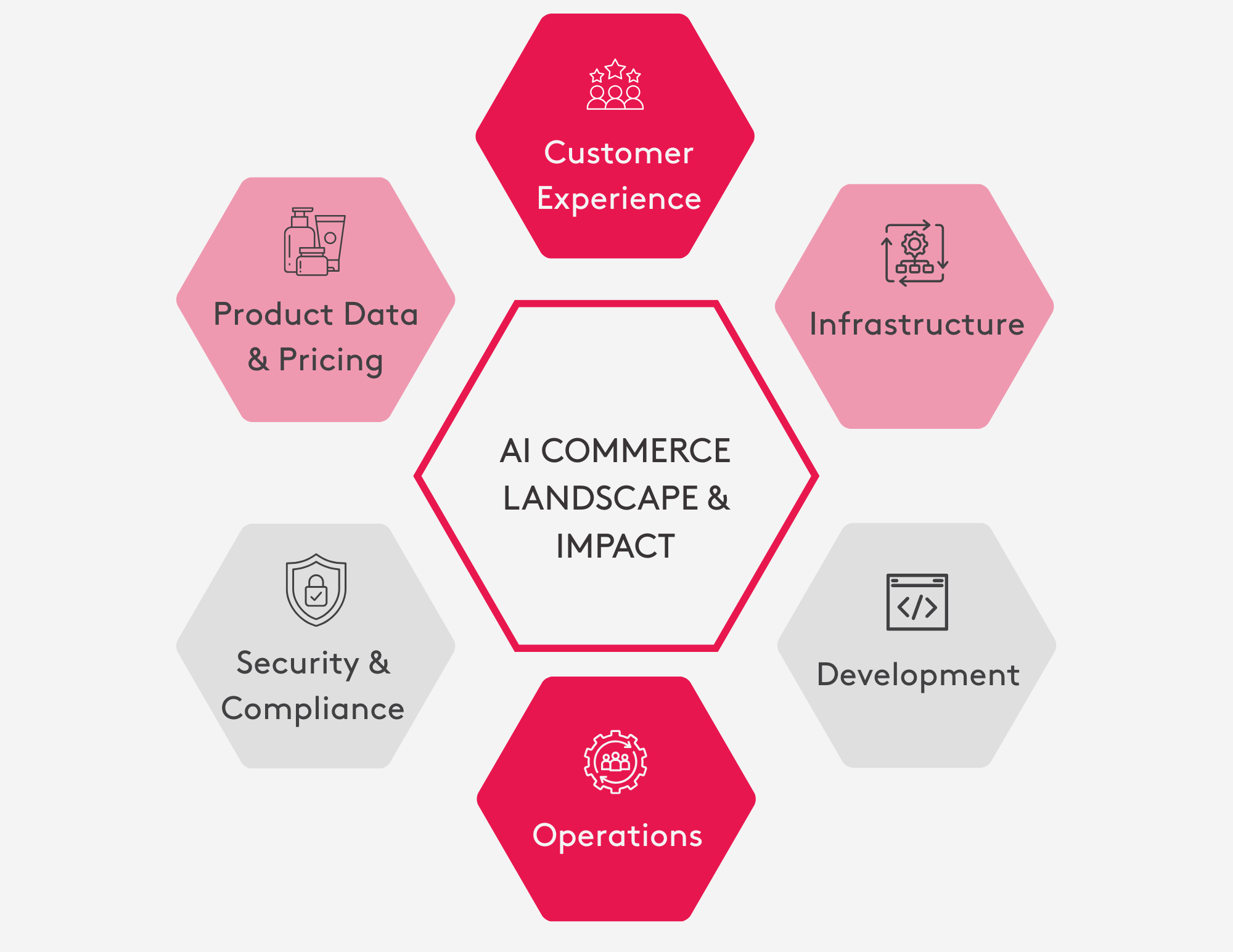
Unpacking the AI Commerce Landscape: The Full Stack Impact
AI Commerce Readiness demands integrated oversight because AI influences multiple domains simultaneously and changes the goal of your website. The success of your entire AI program will be determined by the weakest link in this interconnected chain:
Domain | Impact of AI Integration | Key Enterprise Focus |
Customer Experience | Automated assistance, personalized recommendations, predictive commerce. | Predictive Commerce |
Product Data | AI-driven data enrichment, attribute extraction, real-time translations. | Data Enrichment |
Pricing & Quoting | Dynamic pricing logic, contract pricing, highly accurate demand forecasting. | Dynamic Pricing |
Operations | Inventory prediction, automated order routing, replenishment optimization. | Supply Chain Optimization |
Security & Compliance | Auditability, data governance, secure use of AI-generated assets. | AI Governance |
Development | Accelerated coding, workflow orchestration, low-code systems. | Development Velocity |
Infrastructure | API-first architecture, agent-friendly data models, headless commerce. | Headless Architecture |
Why Enterprise AI Initiatives Fail (The Complexity Tax)
Enterprise commerce environments carry a "Complexity Tax," featuring structured pricing, complex inventory rules, and mission-critical ERP dependencies.
A recent MIT report showed that 95% of Generative AI pilots fail to produce measurable business impact; the failure is rarely the AI model itself; it is the organization's unpreparedness to integrate AI into this complex, high-stakes environment.
The most common failure points include: Poor Data Foundations, Legacy Architecture (unable to support real-time decisioning), and a crippling Lack of Governance and Auditability (leading to security vulnerabilities and technical debt).
AI Commerce Readiness Requires Cross-Functional Alignment
Unlike previous digital transformation efforts, successful AI adoption demands simultaneous, explicit alignment across business strategy, technology, operations, and compliance. AI Readiness is an organizational capability, not a technical milestone.
An AI-Ready Enterprise has achieved this alignment by establishing:
- A unified data strategy and centralized data foundations.
- Clear governance and compliance frameworks for managing AI risk.
- Modular, API-first infrastructure capable of supporting automation.
- Talent prepared to supervise and collaborate with AI (not be replaced by it).
- Leadership committed to change management and clear business outcomes.
Without this alignment, AI becomes fragmented, producing Shadow AI, inconsistent workflows, and ultimately, a competitive disadvantage.
The Readiness Gap: Assessing Your Current Position
Understanding where your organization sits on the readiness spectrum is the non-negotiable first step in building a successful strategy.
Readiness Category | Description | Primary Risk |
1. Experimenting Without Structure | Teams use Vibe Coding and AI tools independently without central oversight. | Inconsistent Outputs, Security Gaps, Shadow AI. |
2. Modern Systems, Missing Governance | Infrastructure (headless, API-first) is capable, but guardrails and audit policies are absent. | AI-Generated Code Risk, Compliance Failures. |
3. Legacy Systems Unable to Support AI | Data is siloed, systems are rigid, and infrastructure cannot support real-time intelligence workloads. | Stalled Projects, High Development Costs, Slower Innovation. |
AI Readiness is Now a Competitive Advantage
Achieving AI Commerce Readiness transforms the risk of adoption into a measurable, competitive differentiator.
Measurable Gains (Competitive Advantage) | Strategic Risks (Laggard Status) |
10 to 20% conversion rate improvement | Higher operational and technical costs |
Faster quoting and ordering cycles | Reduced customer loyalty and experience |
Accurate demand forecasting | Slower innovation and market responsiveness |
Lower development costs and reduced customer service load | Increased technical debt and talent churn |
AI Velocity Roadmap
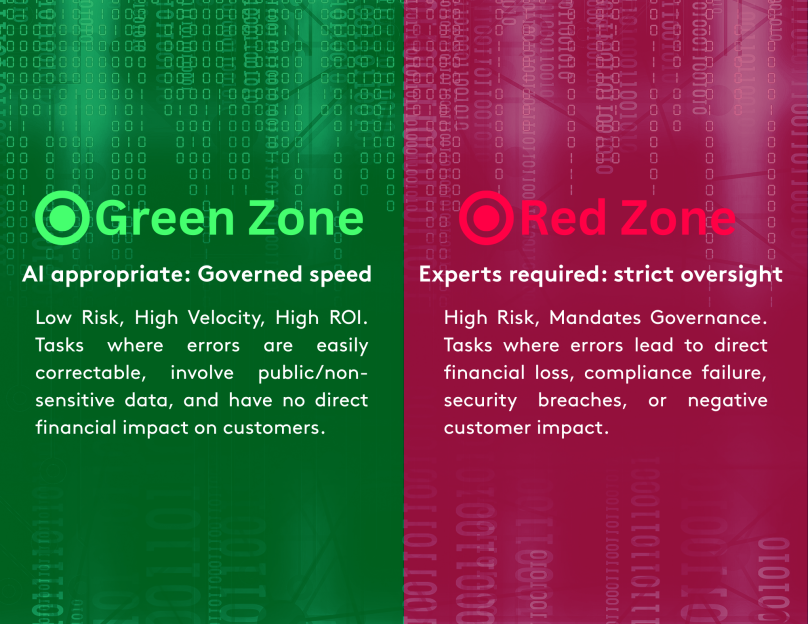
In a world where AI capabilities shift weekly, waiting 12 months to deploy is a competitive liability.
The solution is to decouple AI Deployment Speed from Organizational Governance Maturity. The roadmap is not about waiting; it is about establishing the governance framework necessary to allow for continuous, safe, and immediate deployment of Green Zone capabilities while building the complex foundations for Red Zone control.
As a reminder, our internal experience confirms that bypassing detailed user flow and requirements mapping guarantees a time increase in the long run.
Phase 1: Stabilization & Green Zone Activation (Days 1–90)
The goal here is rapid, governed time-to-value. This phase is about deploying AI features immediately in low-risk environments to demonstrate ROI and counter the perception that "nothing is happening" for a year. The rest of the time is spent establishing the necessary governance to avoid the "unstructured black box" that leads to long-term failure.
Quick Wins: Immediate, Low-Risk AI Deployment Examples
The most successful quick-win projects are those that impact the marketing, content, and customer service layers. These deployments are often achievable within 30-90 days using platform-native tools or secure, commercially available Generative AI (GenAI) solutions.
1. Automated Content Localization and Multilingual SEO
- Quick Win AI Deployment: Use an AI agent to translate and localize high-volume product descriptions, support articles, and FAQ content for new international markets.
- Enterprise Impact: This results in a Massive Visibility Boost. Translated sites gain significantly higher visibility in AI search results over untranslated pages, enabling rapid global reach without the upfront cost of hiring full teams of human translators. It accelerates market entry and organic traffic acquisition.
2. Product Data Enrichment and Taxonomy Generation
- Quick Win AI Deployment: Implement GenAI to automatically generate missing metadata, descriptive tags, or internal categories by analyzing existing product titles and technical specifications.
- Enterprise Impact: This leads to Improved Search and Findability. Fixing poor or inconsistent data quality is a critical factor in improving on-site search performance, which is a major purchase blocker. It also ensures cleaner data feeds, which is essential for accurate chatbot responses (improving RAG source quality).
3. Basic Customer Service Triage and Q&A
- Quick Win AI Deployment: Deploy an AI assistant to handle a high volume of Tier 1, repetitive customer service questions (e.g., "What is your return policy?" or "Where is my order?"). This should only be for general information retrieval, not core account logic.
- Enterprise Impact: This achieves Reduced Operational Costs and Faster Resolution. By offloading up to 60% of basic inquiries, human agents are freed to focus only on complex, high-value problem-solving, dramatically improving operational efficiency and reducing cost-to-serve.
4. Personalized Marketing Copy and Messaging
- Quick Win AI Deployment: Use GenAI to create hyper-personalized variants of email subject lines, push notifications, and ad copy for segmented audiences at scale.
- Enterprise Impact: This delivers Higher Conversion Rates and Engagement. Tailoring messaging based on demographic or behavioral data improves open rates, click-through rates, and overall campaign relevance, maximizing the efficiency of your marketing spend.
The Game Changer: The Platform-Native AI Advantage
The quickest and safest path to activating the four Green Zone Quick Wins above is when your e-commerce or digital experience platform offers these AI capabilities natively in the platform.
When your platform, such as Core dna, already integrates these tools: from SEO agents and data enrichment to chat support, it alleviates an entire layer of complexity from AI integration and adoption within your teams. This is the true acceleration point for the enterprise.
You bypass the security risk, integration complexity, API cost management, and governance overhead associated with stitching together multiple third-party AI solutions. The governance is inherited, and the superpower is immediate.
Strategic Roadmap Actions for Phase 1 (The Crucial 90 Days)
The ultimate success of these quick wins hinges on disciplined planning and governance maturity:
Objective | Key Actions | Velocity Rationale |
Rapid Discovery | Compressed 30-day Requirements Mapping: Map out user flows and functional requirements for high-priority, low-risk Green Zone features (e.g., chat support, translation). | Accelerates the start: Focuses planning intensely on immediate value features to prevent scope creep and delay. |
Immediate ROI Deployment | Activate platform-native AI agents (like Core dna's SEO or Translation) immediately. | Proves value: Delivers conversion/efficiency gains within the first 90 days, countering the "too slow" argument. |
Governance Baseline | Establish the initial Red Zone/Green Zone classification; Define auditability and compliance requirements. | Mitigates Shadow AI: Provides safe, sanctioned tools so employees don't need to bypass security. |
Phase 2: Governed Scale & Pipeline Integration (Months 4–6)
Phase 2: Governed Scale & Pipeline Integration (Months 4–6)
After successfully deploying high-ROI Green Zone Quick Wins in the first 90 days, Phase 2 marks the critical shift from proof-of-concept to systemic enterprise capability. The core mandate here is to ensure that as AI adoption scales, governance and security scale even faster.
This phase dedicates time to the necessary, time-consuming work of infrastructure integration and security pipeline building, which directly supports the autonomous ambitions of Phase 3.
2.1. Building Mandatory Security and QA Pipelines
Scaling AI without validation pipelines guarantees technical debt and security vulnerabilities. This is the stage where you automate the vetting of AI-generated assets, creating the necessary control for future Red Zone Deployment.
- Automated Code Validation: Implement continuous security scanning and structured code validation tools for any AI-assisted development. This pipeline automatically checks Vibe Coded outputs against internal enterprise coding standards, ensuring consistency and auditability before code is merged.
- Prompt Governance and Auditing: Establish a centralized repository for prompts used to generate content, code, or data. This ensures teams are using approved language and that outputs can be traced back to the input prompt, which is vital for compliance and debugging.
- Human-in-the-Loop QA: For high-stakes content and data, design clear human review checkpoints. The goal is supervision, not writing—AI generates the asset, and a trained human confirms its accuracy and tone.
2.2. Tackling the Enterprise Data Integration Challenge (Prerequisite for Autonomy)
High-value, complex AI use cases—like the Autonomous Deal Desk and Self-Healing Supply Chain, cannot function without real-time data from core legacy systems. This is often the slowest, yet most crucial, part of the roadmap.
- Unified Data Foundations: Finalize the strategy and begin the hard work of connecting the AI layer to disparate data sources: ERPs (for inventory), CRMs (for contract history and customer health), and supply chain management systems. This unified data access is the foundation required to execute the autonomous decision-making in Phase 3.
- API Standardization: Ensure that all data access points (APIs) are standardized and secure. AI models rely on clean, reliable APIs to execute transactions, preventing the kind of data mix-ups that could lead to an incorrect deal quote or a faulty supply reorder.
- Green Zone Scaling: Take the lessons and wins from Phase 1 and deploy those validated Green Zone workflows (like the AI content agents) across all relevant business units, maximizing their ROI across the organization.
2.3. The Capability Accelerator: Overcoming the B2B Skills Gap
Many B2B and traditional enterprises lack the specialized in-house AI development and MLOps teams necessary to build complex systems from scratch. This talent gap often causes development teams to be instinctively wary of ambitious AI projects, fearing an unmanageable increase in workload and complexity.
This is where platform integration becomes crucial. The success of projects like the Autonomous Deal Desk hinges on having an e-commerce platform that can support these ambitions without the enterprise needing to hire the equivalent of a full AI engineering team immediately.
- Platform Leverage: By utilizing a platform that natively integrates complex AI capabilities (e.g., dynamic pricing logic, custom quote generation, or supply chain insights), the enterprise achieves two things: speed and governance.
- Talent De-Risking: The platform handles the complexity of model maintenance, security, and data governance, allowing the existing in-house teams to focus on supervision and strategy rather than low-level AI development. This capability accelerator is often vital for achieving significant AI success within the first years of adoption.
2.4. Talent Maturity and Workflow Orchestration
AI success is less about models and more about people using them effectively. This phase addresses the required shift in enterprise talent and workflow design.
- Cross-Functional Training: Scale training beyond the initial pilot team. Train business users on prompt engineering and model supervision, and train developers on managing validation pipelines and managing the "black box" code structure.
- Establishing AI Stewardship: Assign explicit roles for AI governance and ethical oversight. These roles are responsible for monitoring model drift, ensuring bias mitigation, and upholding the security protocols built into the pipelines.
- Orchestrating New Workflows: Define and document new standard operating procedures (SOPs) where AI is integrated. This prevents the "Shadow AI" risk by formalizing the use of sanctioned AI tools in daily tasks, making AI collaboration the new default.
Phase 3: Autonomous Capability Building (Months 7–12)
Phase 3 is the culmination of the work done in the first six months. With validated pipelines (Phase 2) and proven quick wins (Phase 1), the organization can safely shift its focus to the most complex, high-ROI projects that involve autonomous decision-making and external-facing agent readiness.
The goal is to transition the enterprise from AI-Enabled to AI-Native, viewing AI as a core strategic differentiator rather than just an efficiency tool.
3.1. Achieving True Autonomous Commerce Capabilities
This stage relies entirely on the secure, unified data access and governance pipelines established in Phase 2. The focus shifts to systems where AI takes executive action without constant human intervention, transforming internal operations and external sales cycles.
- Autonomous Deal Desk & Contract Fulfillment: AI doesn't just suggest a price; it integrates with CRM and ERP to execute the entire sales negotiation and fulfillment loop—checking contract terms against current inventory, issuing an optimized quote, reserving stock, and generating compliance documentation instantly. This dramatically speeds up complex B2B sales cycles.
- Self-Healing Supply Chain & Proactive Replenishment: Deploy sophisticated AI models that monitor hundreds of real-time signals (global weather, social sentiment, competitive changes) to anticipate supply chain disruption. The AI then autonomously initiates a "Plan B"—re-routing existing orders to secondary fulfillment centers or initiating micro-replenishments before a stock-out occurs. This transforms inventory from a reactive process into a preventive capability.
- Autonomous Customer Success (Retention Agents): Implement AI agents that actively monitor customer health scores and engagement data. When a customer shows signs of churn risk, the agent proactively initiates a retention action—automatically issuing a targeted loyalty coupon, adjusting their product recommendation feed, or scheduling a human account manager check-in.
- Red Zone Pilot Deployment: Launch controlled projects that interact with core financial or security logic, using the automated Code Validation Pipelines to ensure every line of AI-generated logic is traceable, auditable, and secure.
3.2. Preparing for Agentic Commerce (The Next Evolution)
The most significant strategic challenge in this phase is preparing for the rise of the AI Buyer—autonomous agents that shop, compare, and transact on behalf of users. If your systems are not readable by agents, you simply become invisible.
- Generative Engine Optimization (GEO): Shift focus from traditional SEO (human readability) to GEO (machine readability). This means restructuring product, pricing, and policy data so it is fully machine-transactable via APIs, not just human-readable web pages.
- The Agent Readiness Checklist:Ensure your platform meets the core requirements for agent interaction:
- Real-time Inventory Feeds: Agents drop vendors that show out-of-stock items; constant, real-time inventory API access is mandatory.
- Machine-Readable Policies: Discounts, shipping options, and warranty terms must be structured so an agent can parse and compare the full value of your offer against competitors instantly.
- API-First Checkout: Ensure orders can be placed, updated, and fulfilled entirely through API-driven workflows without requiring a human click or browser session.
3.3. Long-Term Maturity and Future-Proofing
The final three months solidify the competitive advantage by embedding a culture of continuous AI maturity.
- Implementing Explainability and Auditability: Integrate observability tools that log and explain why an autonomous agent or model made a specific decision (e.g., why the price was adjusted, or why a specific product was recommended). This is key for regulatory compliance and trust.
- Establishing AI Innovation Forums: Create cross-functional groups dedicated to testing and integrating emerging AI capabilities. This ensures the enterprise can absorb new models and features (like new Agent-to-Agent communication protocols) as governed updates rather than disruptive, unsanctioned experiments.
- Success Measurement: Shift KPIs from focusing on deployment and usage (Phase 1 & 2) to focusing on core business outcomes: reduction in end-to-end delivery cycles, revenue growth from autonomous systems, and micro-ROI per agent (e.g., hours saved or errors prevented).
By the end of the 12-month AI Velocity Roadmap, the enterprise is not just using AI—it is AI-Native, ready to compete in a world where transactions are increasingly fast, autonomous, and governed.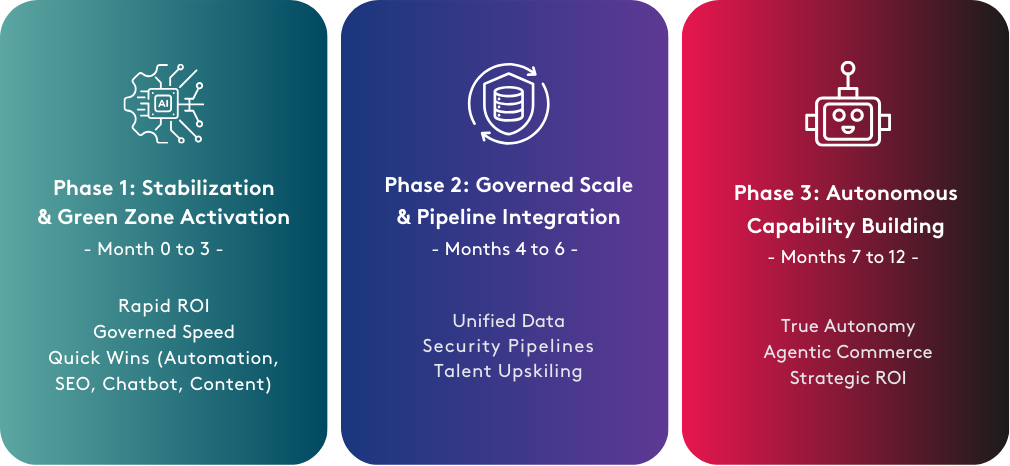
Vibe Coding vs. Enterprise Reality: The Governance Challenge
The fundamental tension driving the need for the AI Velocity Roadmap is the conflict between the speed of Vibe Coding and the necessity of enterprise structure. Vibe Coding using GenAI to rapidly prototype code is the key to competitive velocity, but without immediate governance, it is the fastest path to massive technical debt.
The Unstructured Black Box
Our internal experience confirms the risk: when entire applications are built by an LLM without architectural supervision, the result is an unstructured black box of inconsistent code. This ultimately increases project time, not decreases it, because developers must spend days or weeks debugging fundamental flaws. As our CTO noted: "when the whole thing was built by [the AI] and you have no idea what the structure was, [it's] very hard to understand what's going on."
This risk is compounded by the threat of Shadow AI, where employees bypass official security and compliance frameworks to deploy unsanctioned, high-risk applications.
The Nuance: AI as a Tool, Not a Developer
The strategic solution is to position AI as a powerful assistant, not an autonomous developer.
- Developer-Assisted Coding: The proper enterprise use is leveraging AI for small, repetitive tasks (like generating unit tests or refining existing functions). This maintains human oversight and architectural integrity.
- The Prototyping Role: Vibe-coded output is best used as a living wireframe for example a visual brief for the development team, rather than a starting codebase. The code itself is discarded, and the feature is built securely from scratch, avoiding structural disaster.
The AI Velocity Roadmap exists to contain this conflict, channeling the speed of Vibe Coding into low-risk Green Zone areas while protecting the core enterprise structure.
The Core dna Approach to AI Commerce: Orchestration as the Core
The greatest challenge in AI adoption is not the technology; it is the integration. Traditional platforms struggle because they are not designed to serve as a modular gateway for multiple, constantly evolving generative AI APIs.
The Core dna platform solves this by approaching AI as an Orchestration Challenge.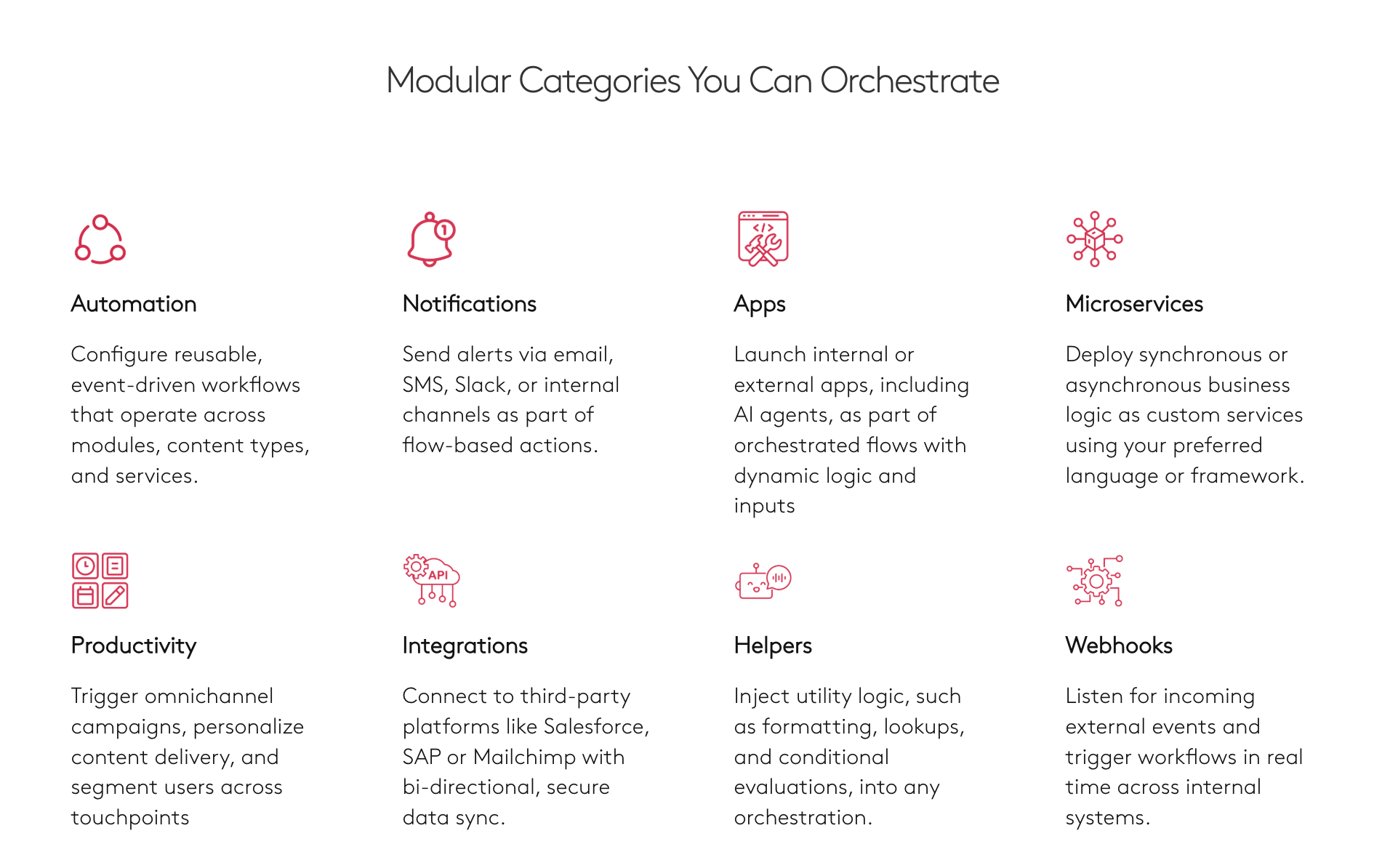
Orchestration, APIs, and Low-Code: The Integration Solution
Core dna's architecture is built on a modular system that combines the strength of a headless, API-first foundation with a powerful low-code enablement layer. This means:
- Plug-and-Play Integration: The platform acts as a high-powered API gateway, allowing clients to seamlessly and securely plug into various generative AI platforms (OpenAI, Gemini, etc.) without complex custom code or security gaps.
- Governed Vibe Coding: Features rapidly developed via Vibe Coding can be cleanly integrated via standardized APIs into the core platform, ensuring they operate within the existing security and governance structure (preventing the "unstructured black box" risk).
- Native Capability: Core dna provides native AI agents (as seen in Phase 1) that are already integrated into the commerce stack, giving enterprises immediate capabilities without adding another vendor layer.
Real-World Core dna AI Commerce Use Cases
This approach allows our clients to deploy sophisticated AI across their daily operations, turning complex ambition into governed reality:
- Multi-Site Content and SEO Duplication: Streamlining multilingual content creation and SEO optimization across dozens of sites from a single platform, eliminating manual copy-pasting and ensuring compliance.
- Integrated AI Assistant: Deploying an AI assistant directly integrated into the e-commerce engine, allowing it to access real-time inventory and customer data without requiring extra third-party chat platforms.
- AI Personalization at Scale: Achieving high-fidelity personalization and dynamic content generation, validated by specific ROI achieved in successful client implementations.
- Dynamic Pricing: Utilizing the platform's API access to integrate real-time pricing models that adjust based on demand, inventory, and external signals.
By having a platform designed for orchestration, enterprises alleviate the extra layer of complexity, security risk, and technical debt that haunts traditional AI integration efforts.
Risk Management, Security, and Governance: The Cost of Chaos
Risk management cannot be an afterthought in AI commerce; it must be the central tenet of the strategy. The unstructured nature of rapid AI development introduces three critical risks that can quickly turn initial speed into financial liability: Technical Debt, Security Vulnerabilities, and Compliance Gaps.
The Hidden Costs of Unstructured AI
the 2025 GenAI Code Security Report from the application security firm Veracode, indicates that up to 45% of AI-generated code contains security vulnerabilities.
. Compounding this, the unstructured outputs from Vibe Coding create massive, complex technical debt. Our internal debugging confirmed this reality: basic, critical functions like "maintaining conversation content" became a weeks-long problem because the initial AI-generated architecture was fundamentally flawed and impossible to audit. The time saved upfront is swiftly repaid tenfold in fixing such structural debt.
The Imperative of Auditability and Traceability
To safeguard core business systems and meet regulatory requirements (like GDPR), every action taken by an AI must be traceable and justifiable. This is solved by the governance layers defined in the roadmap:
- Code Validation Pipelines (Phase 2): Mandatory, automated security scanning and consistency checks on all AI-generated code before deployment.
- Prompt and Action Auditing: Ensuring that every autonomous decision (e.g., a pricing adjustment or a supply re-route) is logged and explained, creating a clear audit trail for compliance and trust.
- The Green Zone/Red Zone Model: Strictly controls which code can access sensitive data or core business logic, minimizing the surface area for high-impact security failure.
Ultimately, the goal of governance is to provide enterprise leaders with confidence that AI is operating within defined, secure, and compliant guardrails, preventing the catastrophic costs of a breach or systemic technical failure.
Future-Proofing for Agentic Commerce
The most profound shift AI will bring to commerce is the rise of the AI Buyer. These intelligent agents (e.g., from platforms like Perplexity, ChatGPT, or Gemini) will soon handle complex purchasing decisions on behalf of users: finding, comparing, negotiating, and transacting autonomously.
For the enterprise, the challenge changes from convincing a human shopper to convincing an AI agent.
The Agent Discoverability Imperative
If your systems are not optimized for machine-to-machine interaction, your business will become invisible to the AI Buyer. This requires a fundamental shift in how digital information is structured:
- From SEO to GEO: Traditional SEO (Search Engine Optimization) focuses on ranking for human clicks. The new focus must be Generative Engine Optimization (GEO), which ensures your product, pricing, and policy data is structured for AI models to accurately retrieve, summarize, and cite your brand within a conversational answer.
- API-First Transactability: Agents need to complete transactions quickly and securely without human intervention. This requires a platform that offers real-time, API-first access to inventory, shipping rules, and checkout—a core strength of Core dna's modular architecture.
The AI Velocity Roadmap is designed not just to fix today's problems but to implement the data foundations and governance pipelines required to safely engage with the autonomous commerce ecosystem of tomorrow.
The choice for enterprise leaders today is not if to adopt AI, but how fast and how safely. The speed of Vibe Coding is now a competitive necessity, but the risk of Shadow AI and the resulting unstructured black box of technical debt threatens to derail even the most ambitious initiatives.
The AI Velocity Roadmap is the strategic blueprint for solving this central dilemma. It ensures that quick, measurable ROI is delivered immediately (Phase 1) while simultaneously building the non-negotiable data and governance pipelines (Phase 2) required to safely achieve the transformative goals of Autonomous Commerce (Phase 3).
Summarize with