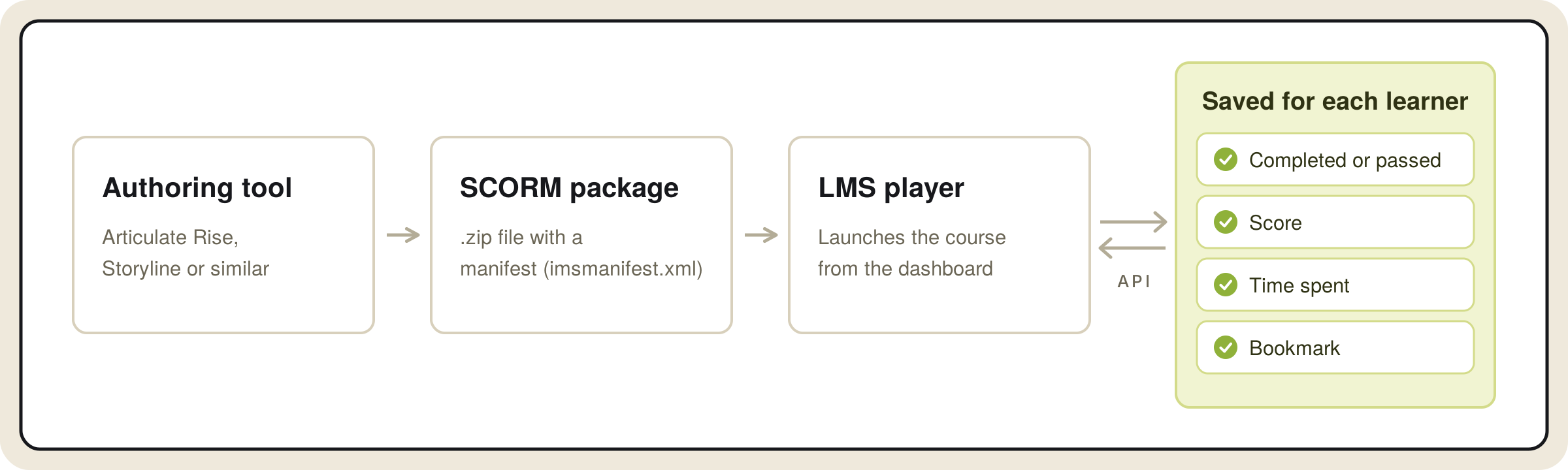
A SCORM LMS plays courses that were built somewhere else. Instructional designers create the course in an authoring tool such as Articulate Rise or Storyline, export it as a SCORM package, and the LMS launches it, saves the learner's place and records the result.
Most LMS platforms can do that much. The harder questions sit around the player: how learners find and buy courses, what happens when a course is updated, how certificates are issued, and which reports program teams and funders need.
This guide covers what SCORM is, how SCORM 1.2, SCORM 2004 and xAPI differ, what to check before you choose a SCORM LMS, and how YMCA Ignite runs its SCORM courses on Core dna next to its website.
What Is SCORM?
SCORM (Sharable Content Object Reference Model) is a set of technical standards for e-learning content, published by the Advanced Distributed Learning (ADL) Initiative, a US Department of Defense program. A SCORM course is a .zip package with a manifest file (imsmanifest.xml) that tells the LMS how to launch it.
When a learner opens the course, the LMS loads it in a player and the two talk through a JavaScript API. The course reports whether the learner completed or passed, their score, the time spent and a bookmark, so the learner can close the window and come back to the same place.
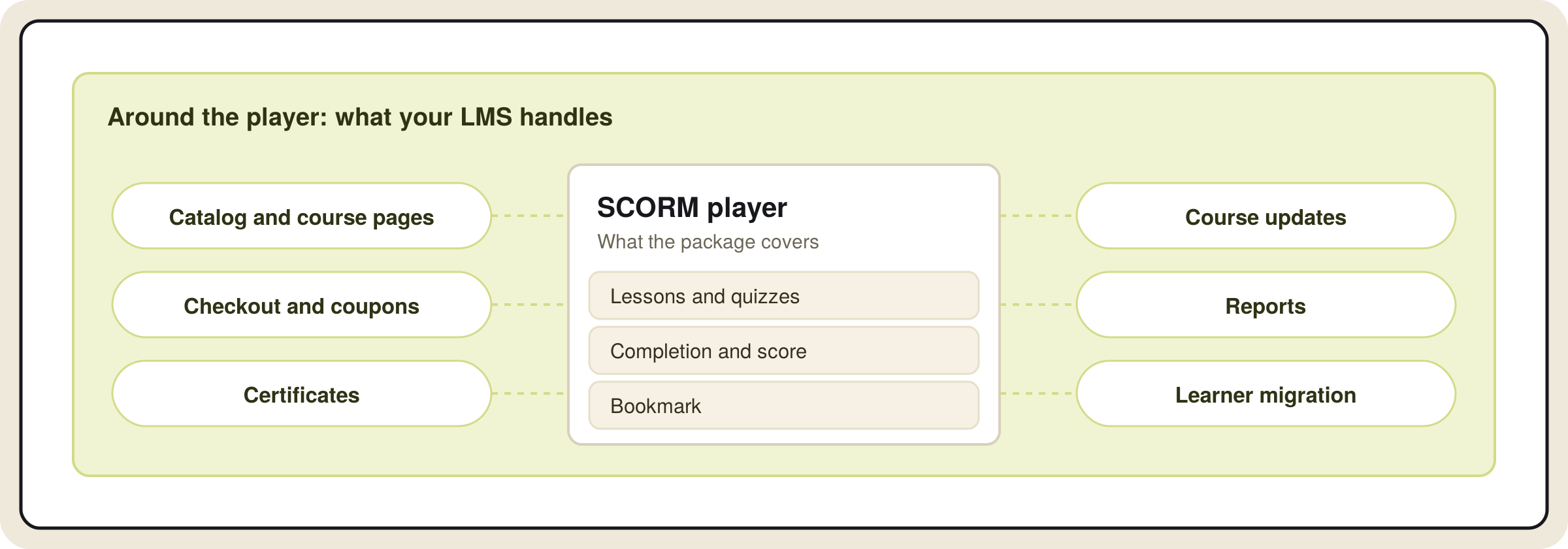
The standard covers what happens inside the course. Everything around it, from the course page and the checkout to certificates and reports, depends on the LMS.
SCORM 1.2, SCORM 2004 or xAPI?
| SCORM 1.2 | SCORM 2004 | xAPI | |
|---|---|---|---|
| What it tracks | Completion or pass status, score, time and a bookmark | Separate completion and pass statuses, score, time, a bookmark and question-level interactions | Statements about learning activity, inside or outside an LMS |
| Saved progress | Up to 4,096 characters | Up to 64,000 characters | Stored in a learning record store (LRS) |
| Module order | Not covered | Sequencing rules for the order of modules | Not part of the standard |
| Where the course runs | In the LMS player | In the LMS player | Anywhere, including apps, simulations and offline |
| Support | Almost every LMS and authoring tool | Most LMS platforms and authoring tools | Growing; needs an LRS |
Authoring tools such as Articulate Rise and Storyline can export all three. SCORM 1.2 is the safe default when a course tracks completion, a score and a pass mark. SCORM 2004 suits courses where modules run in a set order or long courses that save a lot of progress, and xAPI suits learning that happens outside the browser.
Core dna plays SCORM 1.2 for YMCA Ignite today and sets up SCORM 2004 and xAPI for programs that need them.
What Should You Check Before Choosing a SCORM LMS?
Every SCORM LMS plays packages. The differences show up around the player:
- Which SCORM versions does it play? Ask for SCORM 1.2 and 2004 at minimum, and xAPI if you track learning outside the browser.
- Does a learner resume where they stopped? Test it on a long course: close the window halfway, sign in on another device and reopen it.
- What happens when you update a course? Uploading a new version should keep every completion and certificate already issued.
- Can people find a course before they sign up? The catalog, program pages and course descriptions sit outside the player, so check whether your team can build them and whether search engines can read them.
- How are courses sold? Free and paid courses, coupons, bundles, tax and refunds that remove access should run in one checkout.
- How are certificates issued? Check templates, expiry dates, and whether learners can download a certificate or email it to an employer.
- Which reports do you need? List the reports program teams, funders and accreditors ask for, such as completions by date range or active learners per month.
- Can your learners and their history move across? Learner accounts, enrollments, completions and certificates from your current LMS.
How Does YMCA Ignite Run SCORM Courses on Core dna?
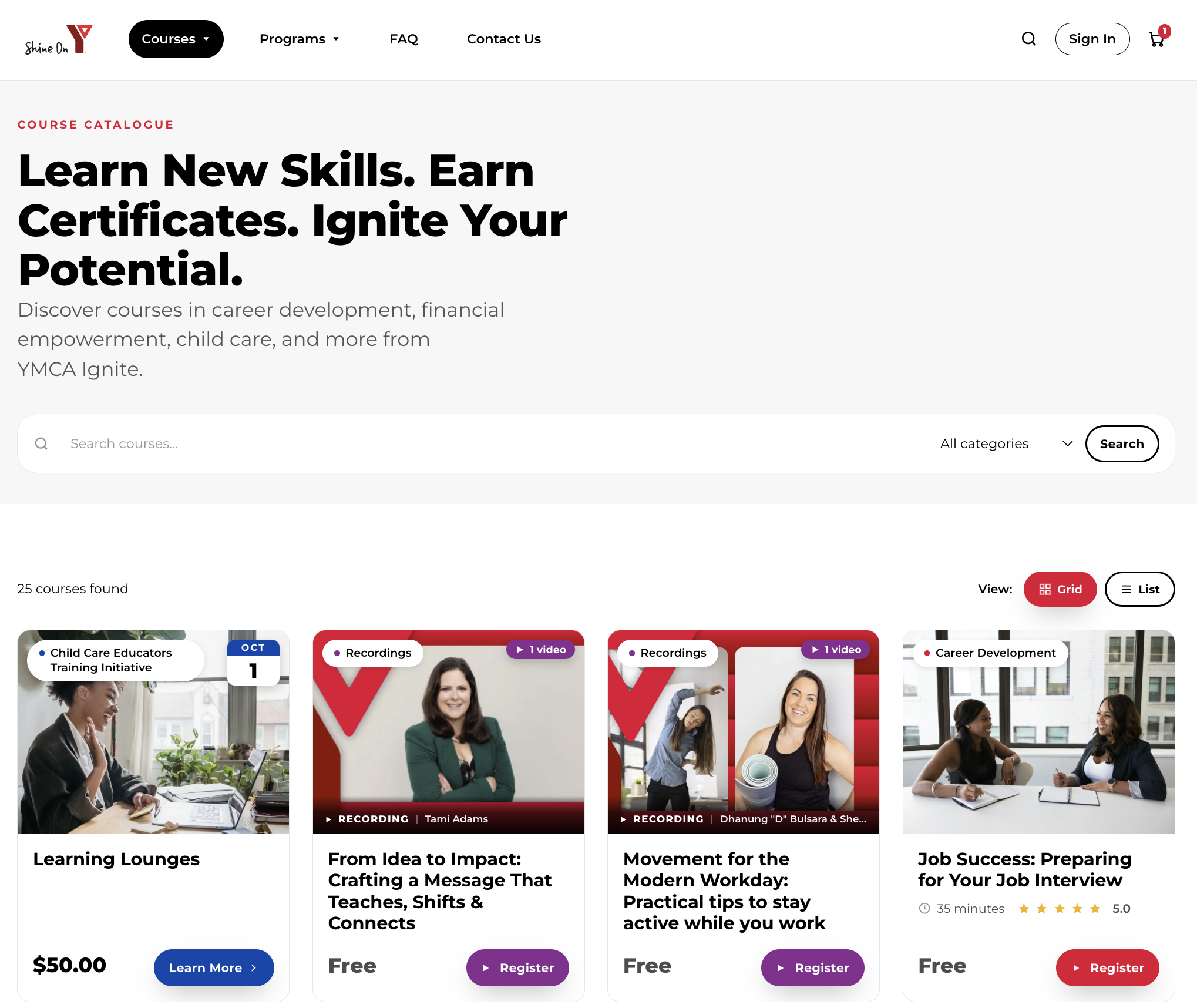
YMCA Ignite is the online learning platform of YMCA of Greater Toronto, with free and low-cost courses in career development, financial empowerment, entrepreneurship, health and well-being, and child care. YMCA reports more than 41,000 learners and 11,000 certificates issued since Ignite launched in 2023.
Ignite started on Absorb, a standalone LMS with its own design, admin and reporting, while YMCA's main website ran on Core dna. In 2026 YMCA moved Ignite onto the same Core dna setup as its website, in about six weeks from kickoff to launch:
- Courses moved as they were. YMCA exported its SCORM packages, courses and learner accounts from Absorb. Each package was loaded and linked to a course record, and learner accounts were imported at launch.
- Each course is also a product. A course record holds the content and tests, and a linked product holds the price and listing, so free and paid courses run through one checkout.
- Learners pick up where they stopped. Courses launch from the learner's dashboard, and status, score, time and bookmark are saved.
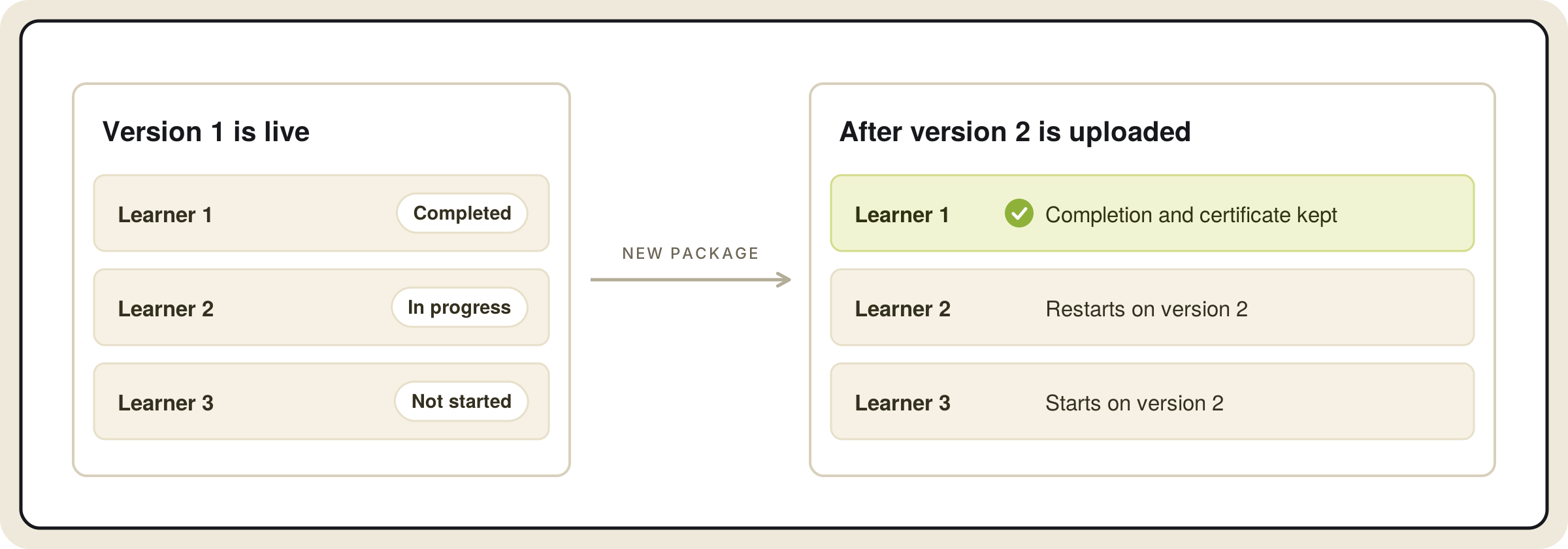
- Updates keep completions. A new package version restarts learners still in progress and keeps every completion.
- One catalog for every format. Self-paced SCORM courses, module curriculums that unlock in order, live webinars and recordings sit in the same catalog.
- Certificates learners can share. Learners download certificates from their account or email a copy to an employer.
- Reports for funders. Weekly and monthly enrollment reports and a monthly active-learner report are emailed to the team.
Read the full stories: how YMCA Ignite moved its SCORM LMS off Absorb in six weeks and how Ignite runs free and paid programs for funders.
SCORM Packages or Courses Built in the LMS?
SCORM suits courses your instructional designers already build in an authoring tool, or a library you're moving from another LMS. Courses built in the LMS itself suit content your own team edits often, where each lesson and question should be tracked and course pages should rank in search. Save a Life builds its courses that way on Core dna. Read how we built a custom LMS for Save a Life.
Both can run on one platform with the same enrollment, certificate and reporting records, so one catalog can mix SCORM courses and courses built in the LMS.
Is SCORM Still Worth Using?
SCORM 1.2 dates from 2001, and xAPI was published in 2013 to cover learning that happens outside a browser. More than ten years later, most course libraries and authoring tool exports are still SCORM, and most LMS platforms still list SCORM support first.
So should you plan to move away from it?
This is our take: keep the SCORM courses you have, and keep building them if your designers work in Rise or Storyline. Put your evaluation time into the parts SCORM doesn't cover: how learners find and buy courses, how certificates and renewals work, and whether the reports answer the questions your funders and program teams ask. Those were the parts YMCA moved onto the same platform as its website when it left Absorb.
See how courses, checkout and certificates run together on the Core dna LMS and eCommerce platform.
Yes. SCORM and HTML5 packages run inside the course structure, and a learner who closes a course picks up near where they stopped. YMCA Ignite runs its SCORM courses on Core dna after moving them from Absorb. Courses can also be authored in the platform as lessons, question banks and assessments, which makes credit types, versions and certificate rules reportable. The choice is made per catalog during discovery.
Yes. Members, orders, enrolments, completions and certificate records are mapped to Core dna, trial-migrated into staging and reconciled against the source before launch. Historical certificates can be regenerated from the migrated records, and redirects keep existing pages and rankings in place. Save a Life moved from WordPress, a standalone LMS and a separate store, and YMCA Ignite moved its SCORM courses and learners from Absorb.
Summarize with