FORMS & DATA CAPTURE

Forms that don't end at submit

Forms that don't end at submit
Every
customer on Core dna runs forms

Clark Rubber   I   YMCA   I   Randy's Worldwide   I   Frontier Touring   I   Save a Life

FOUR ENGINES what every form on Core dna runs on

Build, route, land, and govern every form.

Every form on Core dna runs through the same four engines.

01 Build the form

Twelve typed inputs on a drag-and-drop canvas.

Drag and drop 12 input types into the canvas: text, textarea, number, email, phone, select, checkbox, radio, date and time, file upload, slider, range. Break long forms into steps. Validate every field. Add captcha. Accept payment in the same submission.

02 Route by answer

Conditional logic that reads, hides, requires, and updates.

Conditional logic reads what the user typed or selected and acts on it: show or hide a field, reveal or skip a step, change a requirement, update a value, switch a CSS class. Conditions match by value, number, string, date, or pattern.

03 Land the record

Every submission becomes a record, an order, or a hook.

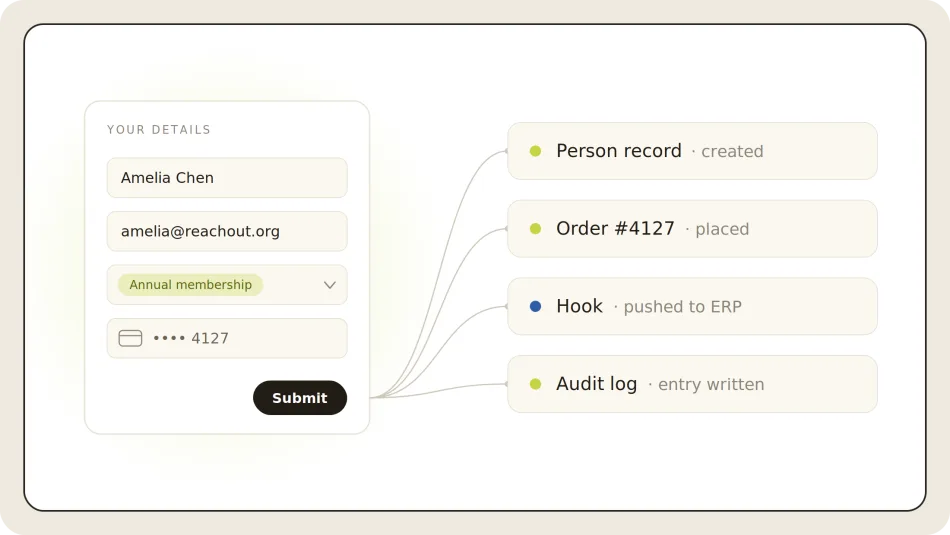
Every submission becomes a person record, a custom entity record, an order line, or a hook trigger. The form, the storefront, the customer database, and the hooks share the same platform, so submission and record are one operation.

04 Govern every form

Permissions, revisions, exports, and audit log.

Per-form permissions control who edits, who sees submissions, and who exports data. Revisions store every change with restore-active to roll back. Submission exports filter by field, date, and status. Every change writes to the audit log.

Break long forms into steps.


Add as many steps as the form needs. Drag fields between steps. Reorder steps by dragging. Each step gets its own heading and field group. The person filling the form sees one step at a time.

  • Steps with their own headings and field groups
  • Drag and drop to reorder fields across and within steps
  • One submission, one record - even across many steps
Image PLACEHOLDER
Image PLACEHOLDER


Accept payments via a form

Drop a payment element into any form. The customer record, the form data, and the charge all land in the same submission. Per-field validation runs first, captcha blocks bots, then the charge clears.


  • Per-field validation: required, format, range, pattern, custom
  • Captcha to block bots before submission
  • One-off and recurring charges in the same form
  • Invoice or order linked to the person record automatically


The rule shapes the requirement.

Conditional logic also sets requirements: which fields are required, which validation pattern applies, which CSS class renders. A tax ID becomes required only when the distributor path is active, and validates against the ABN or EIN pattern for the form's region.

  • Per-path field requirements: required, optional, hidden
  • Per-path validation patterns for regional IDs and custom formats
  • Per-path CSS classes for visual differentiation between paths
Image PLACEHOLDER
Image PLACEHOLDER


The submission triggers downstream actions.

A hook fires on submission, runs conditions, and acts. Send the confirmation email, generate the PDF receipt, push the record to the ERP, notify the dealer team in Slack, escalate to approval. The hook reads the same submission data the record already holds.

  • Conditional and looping hooks fire on every submission
  • Send mail, generate PDFs, push to ERP, notify Slack, escalate to approval
  • Every hook reads the same submission data the record already holds


Agents build the form. Agents read the submissions

Every form operation is exposed via MCP. An agent: Claude, ChatGPT, or a custom one, creates a form by prompt, lists submissions as they land, triggers follow-up flows. The agent reads the same submission data the record holds. No special API. No sync. No integration tax.

Agentic workflows
Image PLACEHOLDER
Image PLACEHOLDER

Submission and record are one operation.

The form, the storefront, the customer database, the hook engine, and the audit log run on the same platform, on the same data model, with the same governance.

Govern every form, every submission, every change.

Revisions

Every form change writes a new revision. View the full history, compare versions, and restore an older revision to active with one click. Live forms inherit the same versioning model as pages and products.

Permissions

Per-form permissions control who edits the form, who sees the submissions, and who exports the data. Permissions inherit from role and group, with form-level overrides.

Exports

Export submissions to PDF, CSV, or Excel. Filter by field value, submission date, or status. Export a single form, a date range, or every submission across the platform.

Audit log

Every form change, permission change, and submission action writes to the audit log. Filter the log by form, user, or date. Compliance and forensics share the same record.

USE CASES the universality of forms on Core dna

Every Core dna customer runs forms.

MEMBERSHIP ORGANISATIONS RENEWALS · APPLICATIONS · DONATIONS

Forms that keep members connected and renewed.

Renewals, applications, donations, event registrations, and gated content access for members.

Renewals Applications Donations Events
DISTRIBUTORS AND B2B DEALER APPLICATIONS · RFQS · WARRANTY

Forms that move B2B from enquiry to onboarded.

Dealer applications, RFQs, warranty claims, sample requests, and account opening for distributors and B2B buyers.

Dealer apps RFQs Warranty Samples
FRANCHISE NETWORKS LOCAL ENQUIRIES · LEADS · FRANCHISEE APPS

Forms that route to the right location, every time.

Local enquiries, location-based leads, franchisee applications, and supplier requests across every location.

Local enquiries Leads Franchisee apps Suppliers
MULTI-BRAND RETAIL SERVICE · REGISTRATION · RETURNS

Forms that serve every brand from one engine.

Customer service requests, product registration, gated content for trade buyers, and returns processing.

Service Registration Trade content Returns
LEARNING AND CERTIFICATION COURSES · CERTIFICATION · INTAKE

Forms that take learners from enrolled to certified.

Course registrations, certification applications, learner intake, and programme enrolment across every cohort.

Course reg Certification Intake Enrolment
NON-PROFIT AND CAUSE DONATIONS · VOLUNTEERS · PROGRAMMES

Forms that turn intent into action and donation.

Donations, volunteer sign-up, programme applications, beneficiary intake, and event registrations for cause-led organisations.

Donations Volunteers Programmes Beneficiaries

Connected to every record, every workflow, and every agent.

Customer records

Form fields write directly to the person record. The same record holds orders, subscriptions, addresses, and history.

Custom entities

Form submissions create or update records in any entity that models the business: donors, dealers, learners, applicants, claims.

Orders and invoices

A form with a payment element creates the order or invoice in the same submission. The form and the checkout share the same engine.

Hooks

Submission triggers run conditions, branches, and loops. Send mail, generate PDFs, push to ERP, notify Slack, escalate to approval.

Content and gated access

A form submission grants access to a gated page, course, or download. The CMS reads the person record's group membership to render the right content.

Search and discovery

Form submissions become searchable records on submission. The same Search engine indexes person records, custom entities, content, and products across every property.

Personalisation

Form answers feed personalisation rules. The same person record that holds the submission is read by the CMS and storefront to tailor what each customer sees next.

Agentic and MCP

Create, update, and list forms via any MCP client - Claude, ChatGPT, or a custom agent. Submissions become events the agent can route, summarise, or act on.

FAQ

Questions teams ask before they ship.

Yes. Field-to-record mapping writes the form data directly to the person record on submission. The form and the record share the same database, so the write is atomic.

Yes. Drop a payment element into the form to capture a charge in the same submission. The invoice or order is created when the form submits.

Conditional logic reads the answer the person typed or selected and acts on it. Actions include: show or hide a field, group, or step; change a field's requirement; update a field value; switch a CSS class; change the validation pattern. Conditions match by value, number, string, date, or pattern.

Yes. One form definition serves every property. Per-property requirements are set with conditional logic. Submissions land in the same database, tagged by property.

Yes. Every change writes a revision. Restore any revision to active with one click. The form's live behaviour reverts to that revision until the next change.

Submissions export to PDF, CSV, or Excel. Filter by field value, submission date, or status. Export from a single form or across every form on the platform.

Yes. Form submissions fire hooks. Hooks run conditions, loops, and branches. A submission can send mail, generate a PDF, push the record to an ERP, notify a team in Slack, or route to an approval workflow.

Yes. Core dna MCP exposes form create, update, list, and submission tools to any MCP client - Claude, ChatGPT, or a custom agent. An agent can build a form by prompt, then watch submissions as they land.

BRING YOUR HARDEST

Bring your hardest form requirement.

Multi-step, conditional, payment-enabled, multi-property, ERP-integrated. We build it with you on a working demo of your data model.