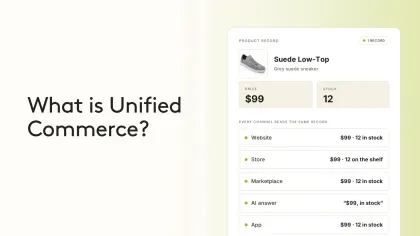

If you're a mid-market distributor managing dozens of customer accounts with different pricing arrangements, you've probably felt the squeeze of trying to get your B2B buying experience to work.
Let’s say you’re trying to manage 800 SKUs and 200 customer accounts. Each account has its own pricing arrangement. Some get volume discounts based on order frequency, while a handful have custom contract rates negotiated directly by the sales team, and one major account gets extended net-60 payment terms.
Your ERP is meant to house all data that impacts pricing variables, such as condition records, customer agreements, and tax regulations, but integrating that data comes with one of two challenges.
The combination of WordPress and WooCommerce or Magento isn’t meant to handle pricing complexity that comes with managing dozens of customer accounts, each with its own rates, terms, and catalog access. On the other hand, turning to an enterprise suite like Sitecore or Adobe and integrating Adobe Commerce and Salesforce Commerce Cloud carries licensing and implementation costs that only make sense for companies doing double or triple the revenue.
So most mid-market distributors end up somewhere in between, improvising, without a native pricing engine, and without a realistic path to one. When this type of conflict occurs, it's less a pricing problem and more a problem of selecting the wrong architecture. In this article, we’ll explain how to address that complexity with a unified platform like Core dna, designed to handle complex commerce and content needs.
Why B2B Pricing Is Genuinely Complex (And Getting More So)
B2B pricing is multi-dimensional in ways B2C pricing simply isn’t. In B2C, pricing is mostly a function of the product, and with some modifications by a promotional code or a sale period. In B2B, who the buyer is matters as much as what they’re buying, particularly for B2B distributors that need to cater to dual audiences.
Catering to Different Types and Tiers of Customers
A distributor serving hundreds of accounts might need to manage several distinct pricing models simultaneously. Volume and tiered pricing rewards buyers who order in larger quantities with a 15% discount, customer-specific contract rates for accounts that have negotiated terms directly with the sales team, and role-based pricing that distinguishes between dealers, distributors, and end consumers who all purchase from the same catalog but shouldn’t see the same prices.
Dealing with Scale
Additionally, when managing just a handful of accounts, sales teams can manage any exceptions themselves. When teams scale to hundreds of accounts, each one creates new configuration requirements, product lines, and pricing combinations that are difficult to handle.
This is where B2B pricing begins to get complex and leads to mistakes and pricing issues that can eat into margins, leading to disputes that cause buyers to lose confidence in the portal and consequently your brand.
The Platform Architecture Problem Nobody Talks About
For mid-market distributors, the root cause of this problem is the platform architecture options that they get presented with.
Fitting Square Pegs Into Round Holes
On one end, WordPress with WooCommerce and Shopify dominate adoption. However, these platforms were built for smaller ecommerce use cases and weren’t designed for B2B pricing complexity, so features like account-level pricing, contract rates, and net-terms billing aren’t native capabilities.
Instead, they require third-party plugins that don’t share the same data layer as the other tools in the existing stack, and can’t be properly integrated even with custom middleware. Consequently, distributors end up bolting pricing logic onto a platform built for a simpler transaction model.
Overpaying for Enterprise Suites
At the upper end, enterprise-grade platforms like Adobe Commerce can handle complex B2B pricing logic natively, including company accounts, share catalogs, contract pricing, and more.
However, with these platforms, high licensing fees and total cost of ownership can run into the hundreds of thousands of dollars per year, pricing most mid-market distributors out. Rather than investing in proper pricing automation software, most end up managing the complexity manually across disconnected systems.
Learn More: What B2B Commerce Features to Look For in a Platform
What a Built-In Pricing Engine Actually Does
A native pricing engine determines what each customer sees when they view a product page. It isn’t a plugin bolted onto checkout, but rather offers a rules-based logic layer that sits at the core of the platform, with access to your customer data, account configurations, content layer, and order history.
When that buyer is logged into your customer portal and lands on a product page, the pricing engine evaluates their account, including their customer group, contract terms, and order volume history, to automatically provide the correct price.
Core dna offers a native set of pricing capabilities built for exactly this kind of complexity:
Volume and tiered pricing set automatic price breaks at defined quantity thresholds.
Customer group pricing lets commerce teams assign different pricing structures to different account segments. For example, wholesale accounts see different rates than retail buyers, with no overlap or leakage between the two.
Contract pricing allows account-specific rates for individual customers who have negotiated custom terms.
Net-terms billing handles payment arrangements at the account level and reflects those terms at checkout, not just on the downstream invoice.
Customer-specific catalogs let you control not just what price a customer sees, but which products they see at all.
Unlike standalone pricing management software that requires integration into your commerce and content layers, Core dna’s pricing capabilities share the same data layer as everything else.
All of these capabilities live on the same platform as the CMS, the commerce engine, and the orchestration layer, allowing businesses to manage complex commerce requirements and deliver an engaging digital experience in one place.
What Unified Looks Like in Practice
RANDYS Worldwide
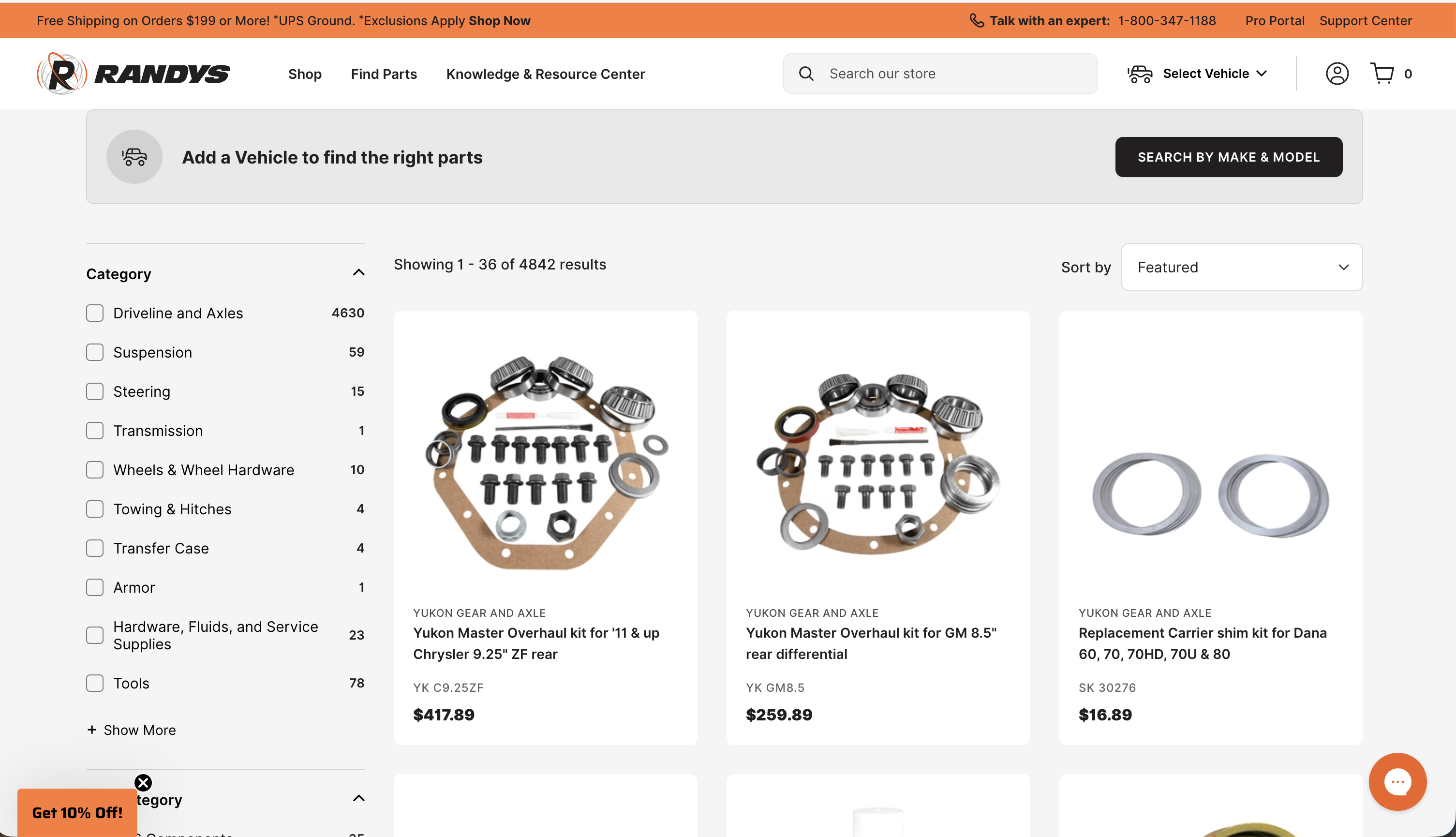
RANDY’S is a differential parts manufacturer and distributor that had grown significantly through acquisitions. When they came to Core dna, their previous setup — a custom-built WordPress site — had fundamentally failed them. The ERP integration wasn’t working properly, forcing customers to revert to phone orders for transactions that should have been self-service.
After moving to Core dna, RANDY’S built a B2B wholesale portal that lets customers access account-specific pricing, request quotes, check invoices, and track shipments all within the platform. This change led to their customer account page becoming the ninth-most-visited page on the entire site, and to online revenue growing from $250,000 to over $1 million.
The ERP integration that had broken under the previous setup also got resolved. Because Core dna’s API-first architecture connected cleanly with RANDYS’ Microsoft Dynamics GP and product data management systems, pricing data could be synchronized across the business without manual reconciliation between platforms.
Noah’s Park & Playgrounds
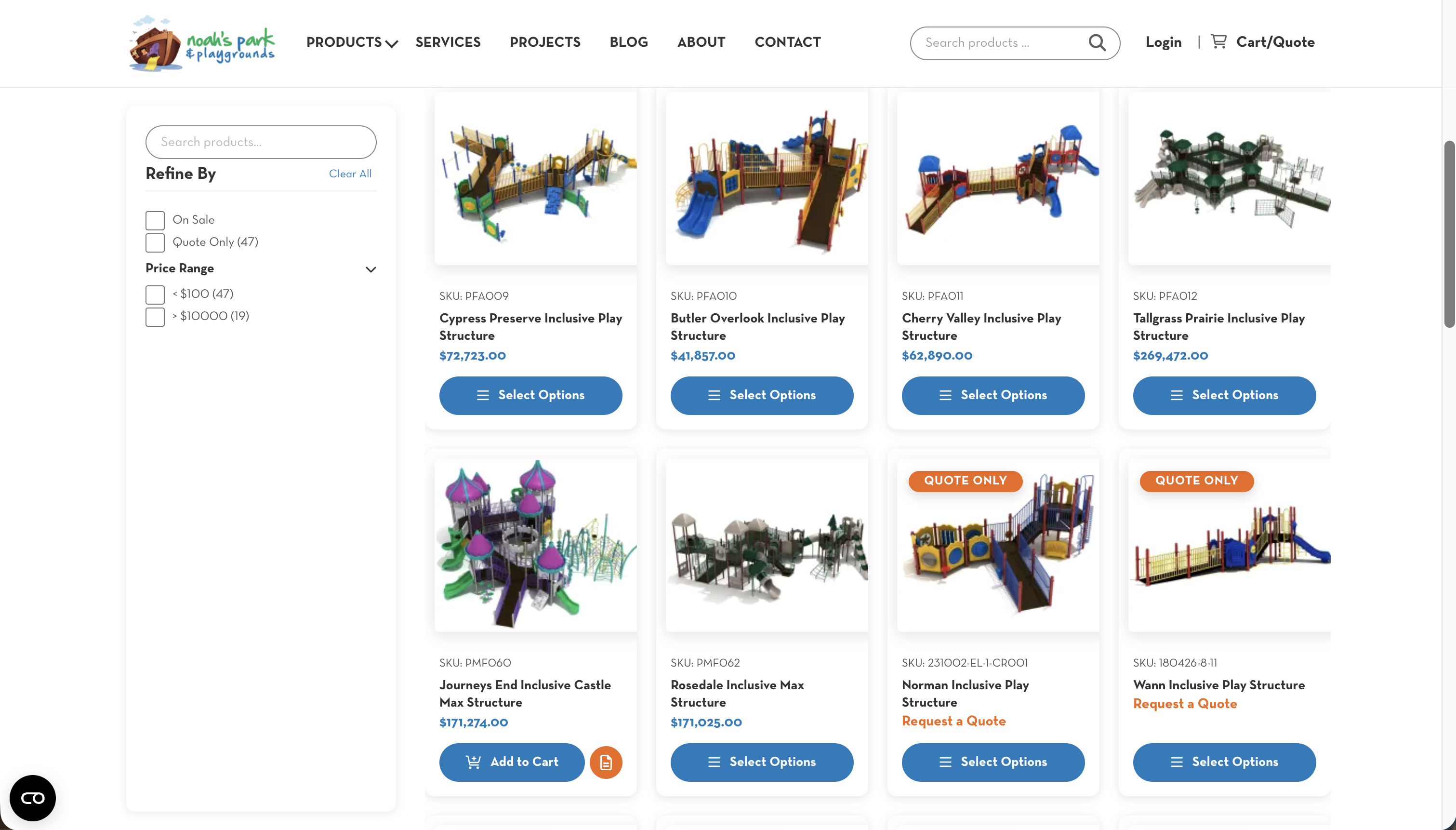
Noah’s Park & Playgrounds illustrates a different challenge in the same category: what happens when a business needs to support two fundamentally different sales motions without routing them through separate systems.
Noah’s sells commercial playground equipment to schools, city parks, religious organizations, and similar buyers. Some of their products have fixed prices and can be purchased directly from the catalog, while others require a design consultation and a formal quote before a price can be determined.
Rather than splitting those two experiences across separate tools, Noah’s Playground handles both through Core dna. Standard products transact through the normal ecommerce flow, but projects requiring custom pricing or site-specific design are routed through a quote request workflow.
What to Look for in B2B Pricing Software
If you’re evaluating pricing engine software or questioning whether your current platform can handle B2B complexity, these questions will tell you where the gaps are.
Does pricing connect to your content layer?
If a buyer sees a price on a product page and a different price at checkout, there’s a disconnect between your CMS and your commerce engine. That gap exists if they’re separate systems, but in a unified platform like Core dna that problem is solved natively.
Is the pricing engine native or a plugin?
A third-party plugin means you’re relying on an integration that can break, lag, or not have access to the customer data it needs. A native engine has access to everything the platform knows about the buyer.
Can it handle customer-specific rates at the account level?
While many commerce platforms can handle promo codes, that isn’t the same as complex B2B pricing. You need to configure distinct rates for individual accounts and ensure those rates persist each time the buyer logs in to their portal.
Does it sync with your ERP without a custom build?
Pricing data that resides in the ERP but must be manually reconciled with the commerce platform will always drift. Native ERP integration means updates propagate automatically, not on a schedule that someone has to manage.
What does a pricing rule change actually require?
If updating a customer’s contract rate means filing a developer ticket, you’ve turned a business configuration into a technical task. It should be manageable by any non-technical person who owns the account relationship.
Avoiding Patchwork Pricing Management
B2B pricing complexity doesn’t resolve itself as a business grows, but it often compounds. For mid-market companies that need to solve this challenge, trying to manage pricing logic when data and digital experiences are scattered across multiple platforms isn’t a viable solution.
Core dna is built for the gap that most mid-market distributors fall into. Able to handle genuine B2B pricing complexity, but without the enterprise TCO that makes platforms like Adobe Commerce impractical. One platform that provides native commerce, a headless CMS, a pricing engine, customer portals, and orchestration, rather than multiple systems stitched together.
Schedule a consultation to see how Core dna can help you launch faster, integrate less, and scale without complexity.
A pricing engine is one critical capability. For the full strategy and platform guidance, see our complete guide to B2B eCommerce.
Summarize with