
Can you run your whole website by describing what you want?
If you're still asking what kind of content you can make with AI, the conversation has moved on without you. That was the 2024 question, and it's largely settled: yes, AI can write the product description, draft the blog, spin up the email. Fine. It was never the hard part anyway.
Ask anyone running a real site what actually eats their week and it isn't making things. It's keeping everything running, updating it, fixing it, and holding it together across markets, brands and storefronts. That's the grind. So the question worth asking now is: can my team run the site by describing what we want, instead of clicking through admin screens to do it all by hand?
Different question, different kind of AI, different kind of platform. Here's what it actually takes.
The admin screen was the job
For twenty years, running a website meant a person living in an admin interface. Open the catalog, find the product, edit the field, save. Then do it again on the next storefront, and the one after that. The admin screen wasn't where you managed the work. It was the work. That's the part AI is quietly ending. When your site runs on one data model with an agent in front of it, you stop doing the clicking. Someone describes the change in plain language and the platform makes it happen, across every storefront, brand and location at once. A regional promo across 70 locations becomes a sentence, not seventy logins. The admin screen turns into the place you go to check it worked, not where you spend your day.
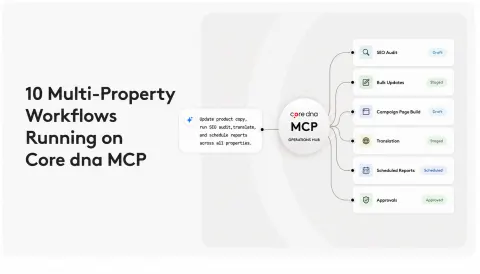
We pulled ten of the workflows our customers now run this way into from days to a sentence. They're not demos. They're things teams used to book a developer for.
Chatbot or agent? The difference is whether it can act
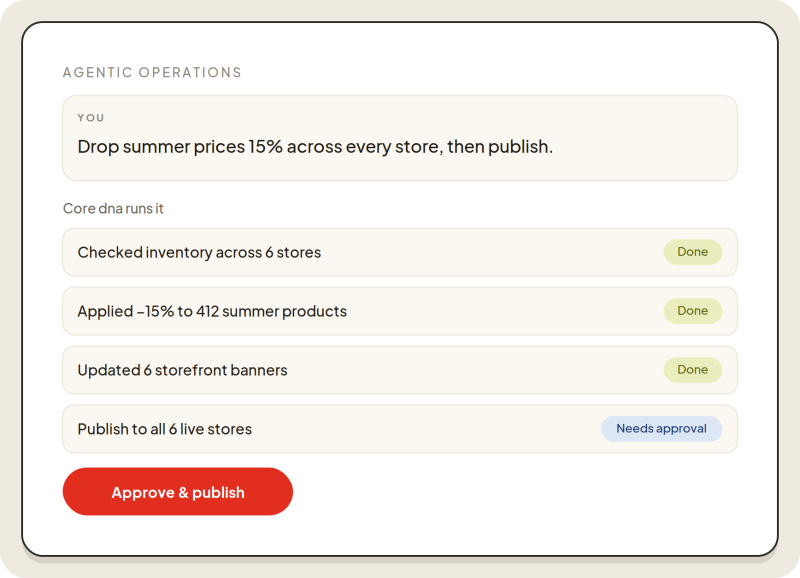
Here's the line worth drawing, because a lot of “AI” in this space sits on the wrong side of it. A chatbot answers. It can tell you how to change a price, or draft the copy for a banner. An agent does the thing: it changes the price, swaps the banner, updates the page, across the systems that actually hold them.
The way people describe the shift is that an agent takes a goal, works out the steps, and uses real tools to finish the job rather than handing you instructions. For that to be true on your site, the agent needs a way to reach in and act, not a chat window bolted to the front of a storefront it can't touch.
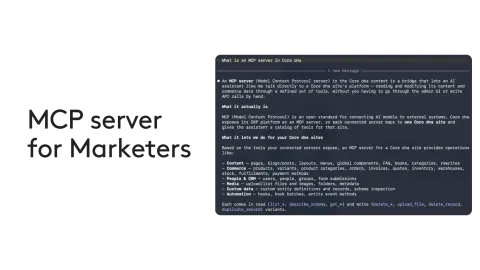
On Core dna that reach is a live MCP server with 80+ tools and 400+ APIs, plus orchestration that runs the multi-step work as one sequence: check stock, apply the right price, update the content, publish. Describe the outcome; the platform does the steps.
You shouldn't be the integration layer
Walk into most marketing or ecommerce teams and you'll find the same setup: an AI writing tool, an SEO tool, the CMS, the commerce platform, an analytics dashboard, a workflow app, and a person in the middle copying things between them. The AI is real, but it's running in silos, and the human is the integration layer holding it together.
That stitching is the actual cost now. The research is blunt about it: the overhead of running six to eight separate systems has become the main drag on returns, not whether you've adopted AI at all. Every new tool you add to fix one task adds another seam for someone to manage.
This is the case for a unified platform, not on principle, but because an agent can only run your operation end to end if the pieces it touches are actually one system. When content, commerce, customers and orchestration share one data model, there's no middleware to keep in sync and no human gluing tools together. The integration layer just isn't a job anymore.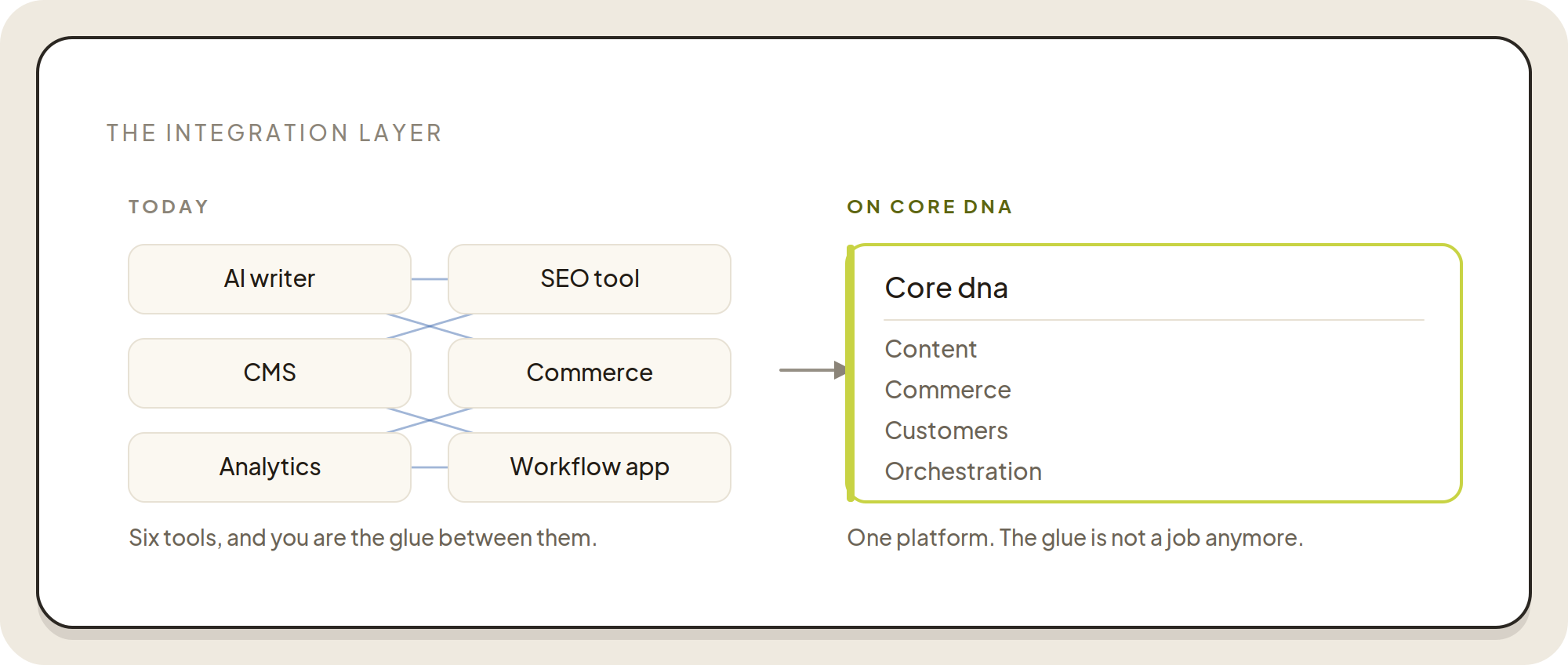
What it actually takes: one data model, and an agent that can write
“Describe it and it happens” sounds like a feature. It's really a consequence of architecture, and it only works when two things are true.
First, one data model. The product an agent reads, the price it sets, the content it edits and the customer it personalizes for have to be the same records, not synced copies living in different systems. The moment they're separate, the agent hits a seam and stops, or worse, acts on something already stale.
Second, an agent layer that can write, not just read. Plenty of tools can answer questions about your store. Far fewer can safely change it. That takes structured records the platform can model the way your business actually works, courses, dealers, members, locations, contract pricing, and an interface agents can act through. On Core dna that's the MCP server and orchestration sitting on top of the unified model, so a plain-language instruction turns into real changes across the system.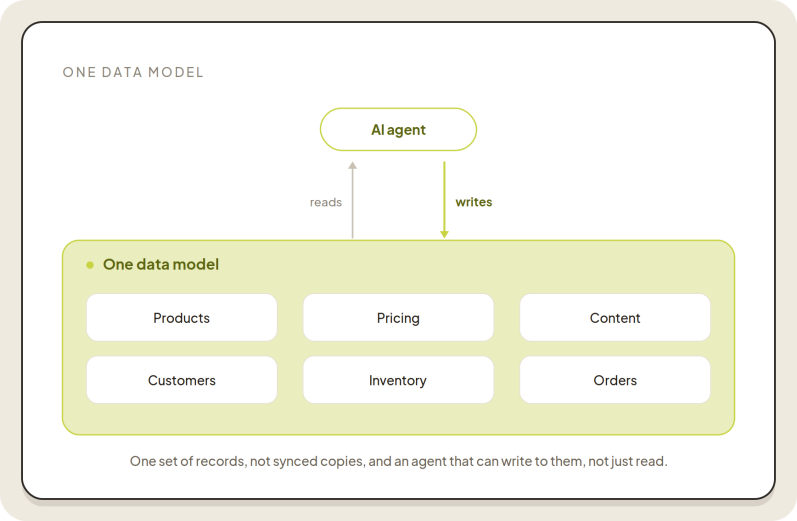
Without a developer in the loop
The quiet promise underneath all of this is the one teams care about most: doing it without raising a ticket. Right now, half the changes a marketer wants, a new section, a campaign across sites, a tweak to how a page behaves, wait in a queue behind a developer. That queue is where momentum goes to die.
The whole point of operating through AI is that the person who wants the change is the person who makes it. They describe it; it ships. A CMS built for marketers, not code means the team isn't blocked on engineering for everyday work, and the developers get their time back for the things that genuinely need them.
This is what “lean team, enterprise output” really means. Not a smaller team doing less. A small team running what used to take fifteen people and a backlog.
Across every market and property at once
One store is easy. The teams that feel this most are the ones running many: a network of storefronts, a set of regional sites, a franchise estate, brands in different markets. That's where doing things by hand stops scaling, because every change multiplies by the number of properties.
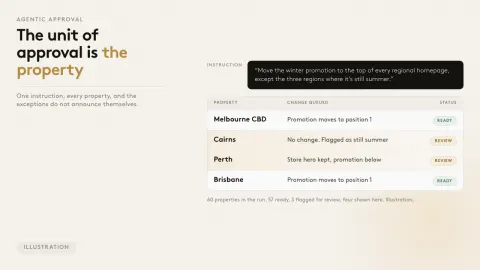
Operating through AI flips that. The same instruction propagates everywhere it should: update the promo across all locations, push a compliance change to every site, translate and localize a launch across markets, in one move instead of one per property. Save a Life ran exactly this kind of translation-and-localization work across hundreds of pages through an agentic workflow. Clark Rubber runs 70 franchises on one system, where a single change reaches all of them.
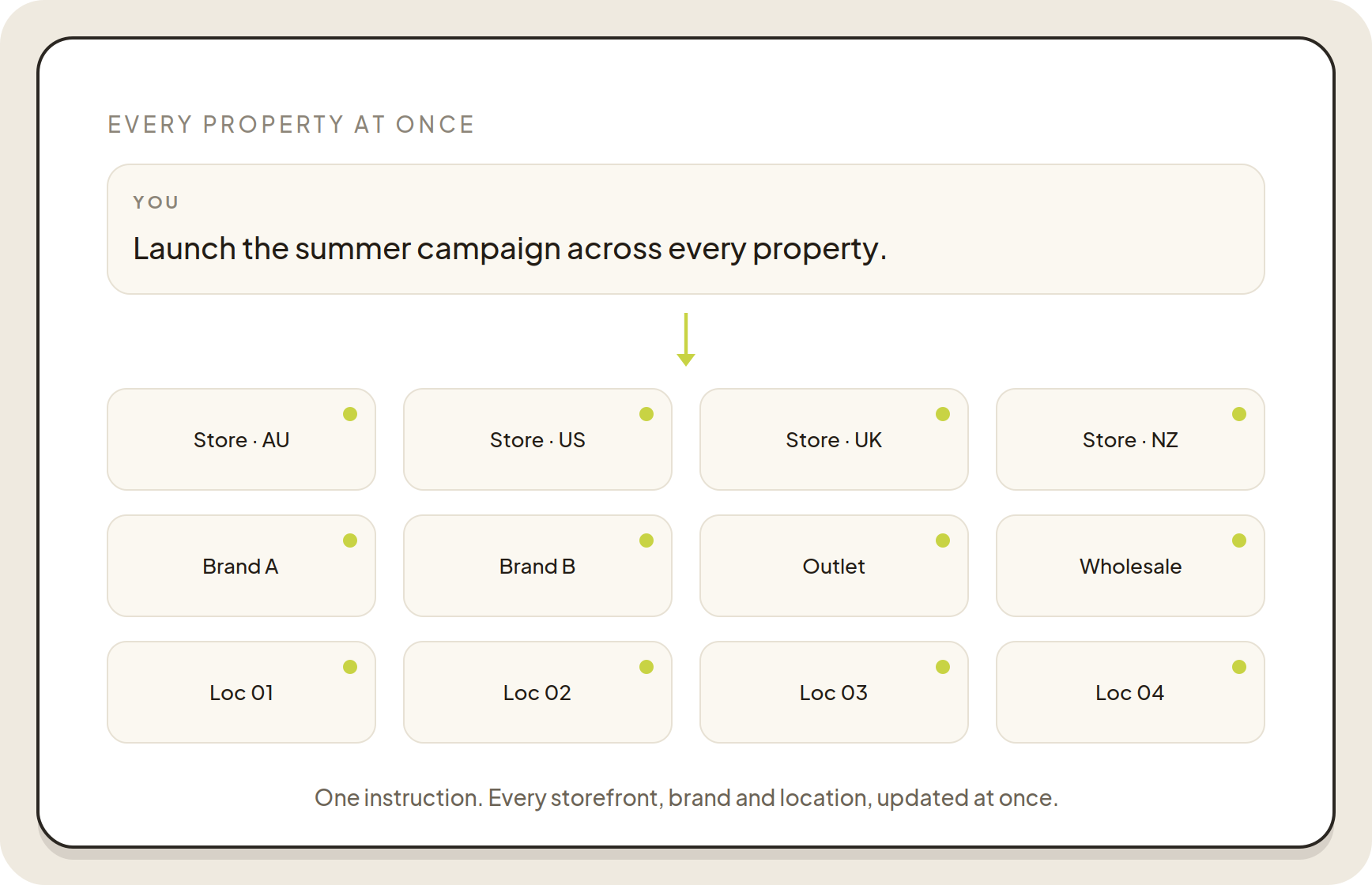
This is the multi-property operating model: your output scales with what you're managing, not with how many people you can hire to click through it. Multi-site management is the difference between a lean team that scales and one that drowns.
Control is what makes it safe to turn on
The reasonable first reaction to “an agent can change anything across all my sites” is alarm. Good. That instinct is exactly why governance isn't a footnote here, it's the thing that decides whether you can run any of this in production.
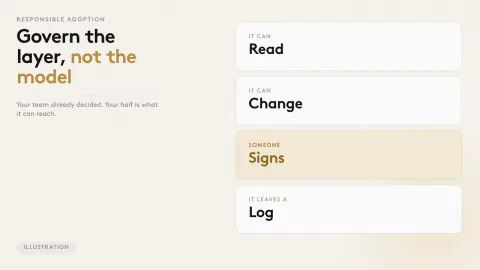
Being ready to operate through AI means being able to say what an agent is allowed to touch, who signs off before a change goes live, and how you undo it when it gets something wrong. On Core dna that's roles and permissions scoping what each agent and each person can change, brand governance keeping a fast change an on-brand change across every property, and approval, audit and rollback sitting on every agentic action. You can preview before anything ships, and roll back if it shouldn't have.
Move fast without those guardrails and you're one bad prompt from a mess across 70 sites. With them, speed is something you can actually trust. That's the whole point. (The enterprise AI agents: untangling the spaghetti goes deeper on governing agents at scale.)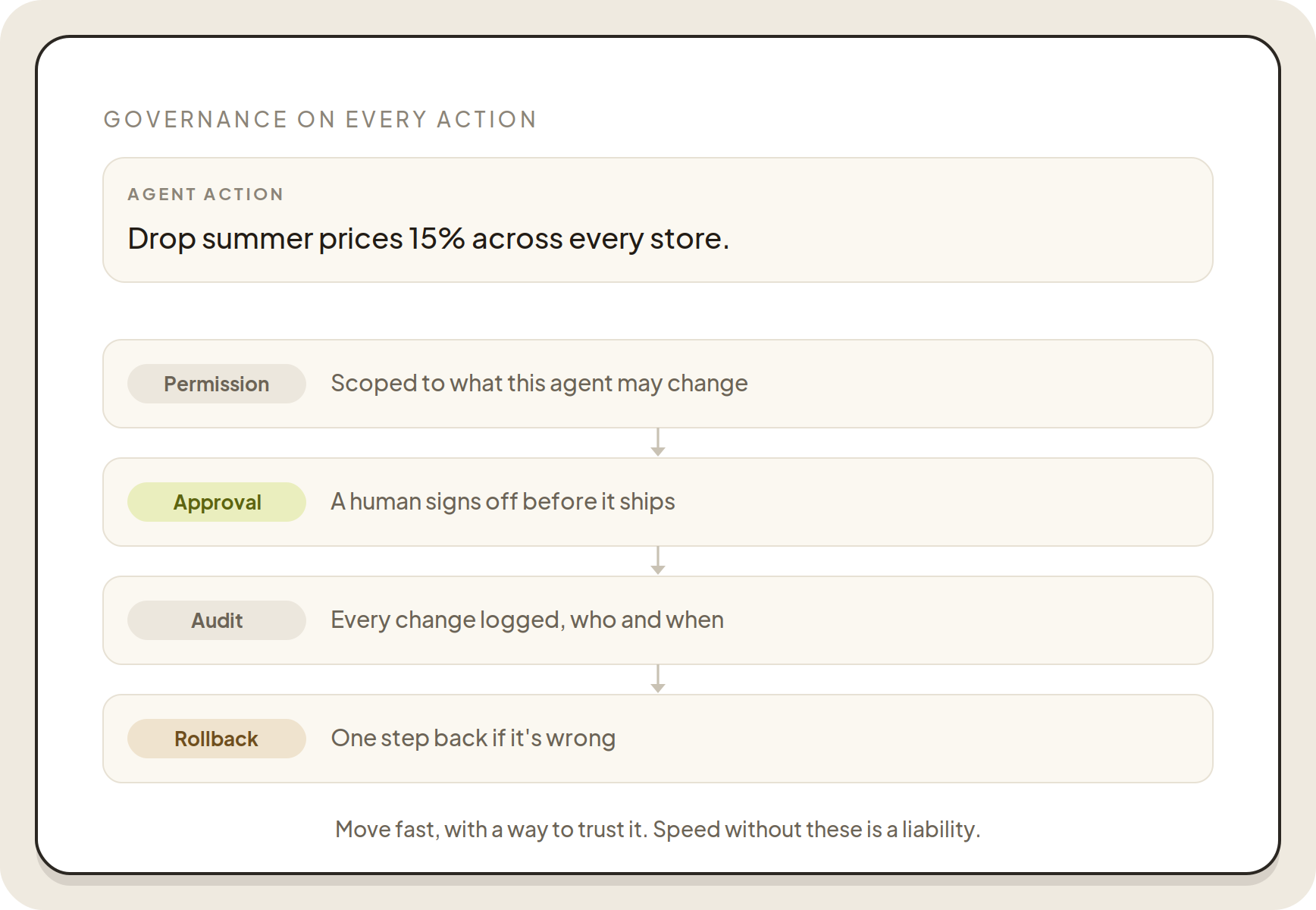
What teams now expect from an AI-run platform
Put it together and the expectations teams are bringing to platform decisions in 2026 look like this. The ones worth choosing treat these as one coordinated system, not a pile of tools that each do a slice.
| What teams expect | What it requires | How Core dna coordinates it |
|---|---|---|
| Describe a change, don't build it | Plain-language instructions that turn into real actions | Natural-language operations through a live MCP server, 80+ tools, 400+ APIs |
| AI that acts, not just suggests | An agent that can write across content and commerce, not a bolted-on chatbot | Orchestration runs the multi-step work as one sequence |
| One stack, not eight | A unified data model so there's no middleware to keep in sync | CMS, commerce, customers and orchestration on one data model |
| Ship without a developer | Marketers make everyday changes themselves | A CMS and components built for marketers, not code |
| Run every property at once | Changes that propagate across sites, brands and markets | Multi-site management from one place, with per-property overrides |
| Stay in control | Permissions, approval, audit, rollback, brand governance | Governance on every agentic action, with preview and rollback built in |
It's tempting to buy a tool for each row. But the second they're separate products stitched together, you're back to being the integration layer, and the agent hits a seam at every handoff. They only work as a set when they run off one data model.
The same foundation makes you sellable to AI agents
There's a payoff to all this that reaches past your own team. The structure that lets you operate your site through AI, clean data, one model, an MCP server, is the same structure external AI shopping agents need to transact with you.
As more buying happens through assistants like ChatGPT and Gemini, those agents don't browse your storefront. They read structured product data, check live pricing and inventory through APIs, and complete a purchase in code. A product described only in narrative copy, with no hard identifiers, is effectively invisible to them. The work you do to make your store machine-operable is the same work that makes it machine-buyable.
If that side of the shift is where your head is, we go deep on it in making your products discoverable by AI and on why AI commerce is changing the purpose of your website. The short version: operate-ready and sell-ready are the same readiness.
Frequently asked questions
What is an agentic CMS?
A CMS you operate by describing what you want rather than clicking through an admin. Instead of generating text for you to paste in, an agent takes the instruction and makes the change across your content and commerce, with a human approving before it goes live.
Can AI actually update my website, not just write content for it?
Yes, if the platform exposes its operations as tools an agent can call. With a live MCP server and orchestration, an agent can edit pages, change pricing, update a catalog and publish, rather than handing you copy to apply by hand.
Can I manage multiple sites or stores with AI?
That's where it pays off most. On one data model, a single instruction propagates across every storefront, brand, region or location at once, instead of repeating the change property by property.
Do I need a developer to make changes?
No. The point of operating through AI is that the person who wants the change makes it by describing it. Developers get their time back for work that genuinely needs engineering.
How do I keep control when AI can change my site?
Through governance built into the platform: permissions that scope what each agent and person can touch, approval before a change ships, and audit and rollback after. On Core dna these sit on every agentic action, so moving fast never means flying blind.
What's the difference between MCP and UCP?
MCP (Model Context Protocol) gives an agent structured access to tools, APIs and context across any system. UCP (Universal Commerce Protocol), which Google launched in January 2026, applies the same idea to commerce specifically. They're compatible, and a platform with an MCP server is well placed for both.
A practical starting point
Not sure where your platform stands? A few honest questions tell you fast:
- Can your team make a site-wide change by describing it, or does every change start with a ticket?
- How many separate tools sit between someone wanting a change and it actually happening?
- Is there approval, audit and rollback on changes, or are you trusting that nothing goes wrong?
- Can a marketer ship a campaign across every property without a developer?
- How long does the same change take across all your sites today, an hour, or a week?
The answers usually point at one of three things: a content problem, a tooling problem, or a platform problem. If it's the last one, the replatforming checklist maps what a move would actually involve before you commit.
The shift isn't that AI writes your content. It's that you stop operating your website by hand and start operating it by describing what you want. The teams who get there first won't be the biggest. They'll be the ones whose platform was built to be run this way, on one model, by agents, with the controls to trust it.
Summarize with