
Answer Engine Optimization (AEO) is the work of making your content easy for AI systems to lift a direct answer from. Generative Engine Optimization (GEO) is the work of making your brand a source those systems trust enough to cite when they write an answer. AEO and GEO are two parts of the same job, and both sit on top of SEO.
Updated October 2026. We first published this guide in January. Since then we have tracked our own AI visibility, checked what ChatGPT tells shoppers about 51 retailers against their live product pages, and watched Google and Bing start reporting on AI search. Some of our original advice held up and some of it did not, so this version is rebuilt around what we can now show.
The AEO and GEO Checklist
Eight things to do, in order. Each one is covered in detail below.
- Let AI crawlers in. Allow OAI-SearchBot, ChatGPT-User, Claude-SearchBot and PerplexityBot, and check that your bot protection doesn't block them.
- Serve key facts in the HTML. Prices, specs, dates and definitions, not only in JavaScript or images.
- Make your pages agree. One price, one name and one set of facts across your pages, feeds and listings.
- Lead every section with the answer. Two or three sentences that make sense on their own.
- Earn mentions beyond your site. Industry press, partners, Reddit, YouTube and LinkedIn.
- Publish your own data. Original figures, named experts and cited sources.
- Track citations by prompt. Use Search Console, Bing Webmaster Tools and a prompt tracker. Clicks alone undercount it.
- Re-test and refresh monthly. Answers change between runs, and citations fade in about 4.5 weeks.
SEO Isn't Dead, It's Just Not the Whole Job Anymore
Short answer: SEO is still the foundation. If a page can't be crawled, indexed and read, no AI system can cite it. What has changed is that a strong Google ranking no longer tells you whether AI assistants will use your page.
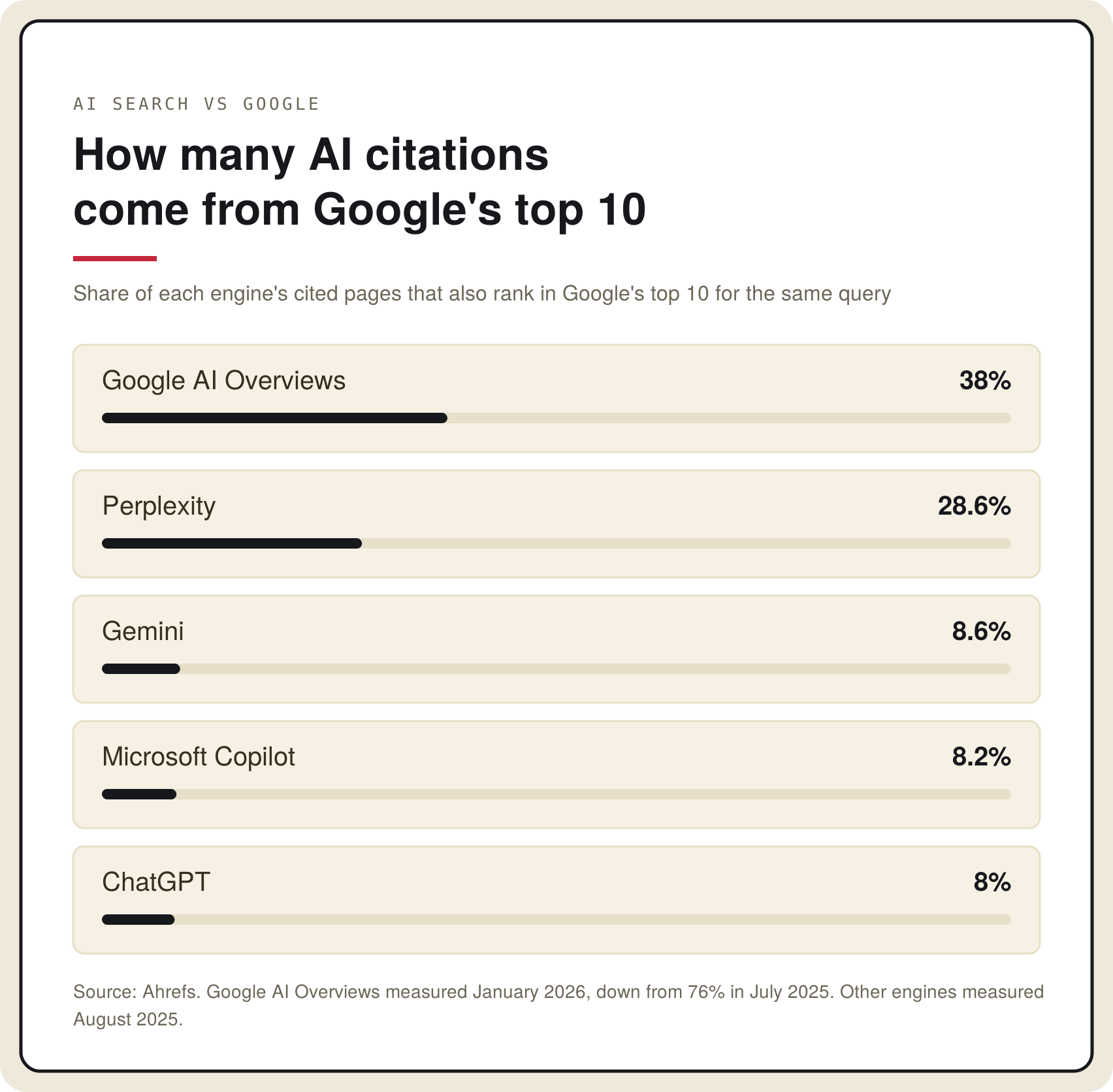
The overlap between the two has shrunk. Ahrefs found that only about 8% of ChatGPT's citations point to pages ranking in Google's top 10 for the same prompt. Perplexity was the closest standalone assistant, at about 29%. Even Google's own AI Overviews have moved away from the results page: in Ahrefs' January 2026 data, about 38% of AI Overview citations came from top-10 pages, down from about 76% in July 2025. We cover what drives the split in our AI visibility playbook.
Google's position is that nothing special is required. Its guidance says there are "no additional requirements to appear in AI Overviews or AI Mode, nor other special optimizations necessary". That holds for Google's own features. It doesn't cover ChatGPT, Claude, Perplexity or Copilot, which read the web through other indexes.
Keep the scale in proportion too. Conductor measured AI referrals at about 1% of website traffic across 1,215 enterprise domains in 2025. By clicks, AI is a small channel. Most of its effect lands before the click, in which brands get named and how they are described. That is why SEO stays the foundation, with AEO and GEO as the layer on top. For a side-by-side view, see how AI search optimization differs from SEO.
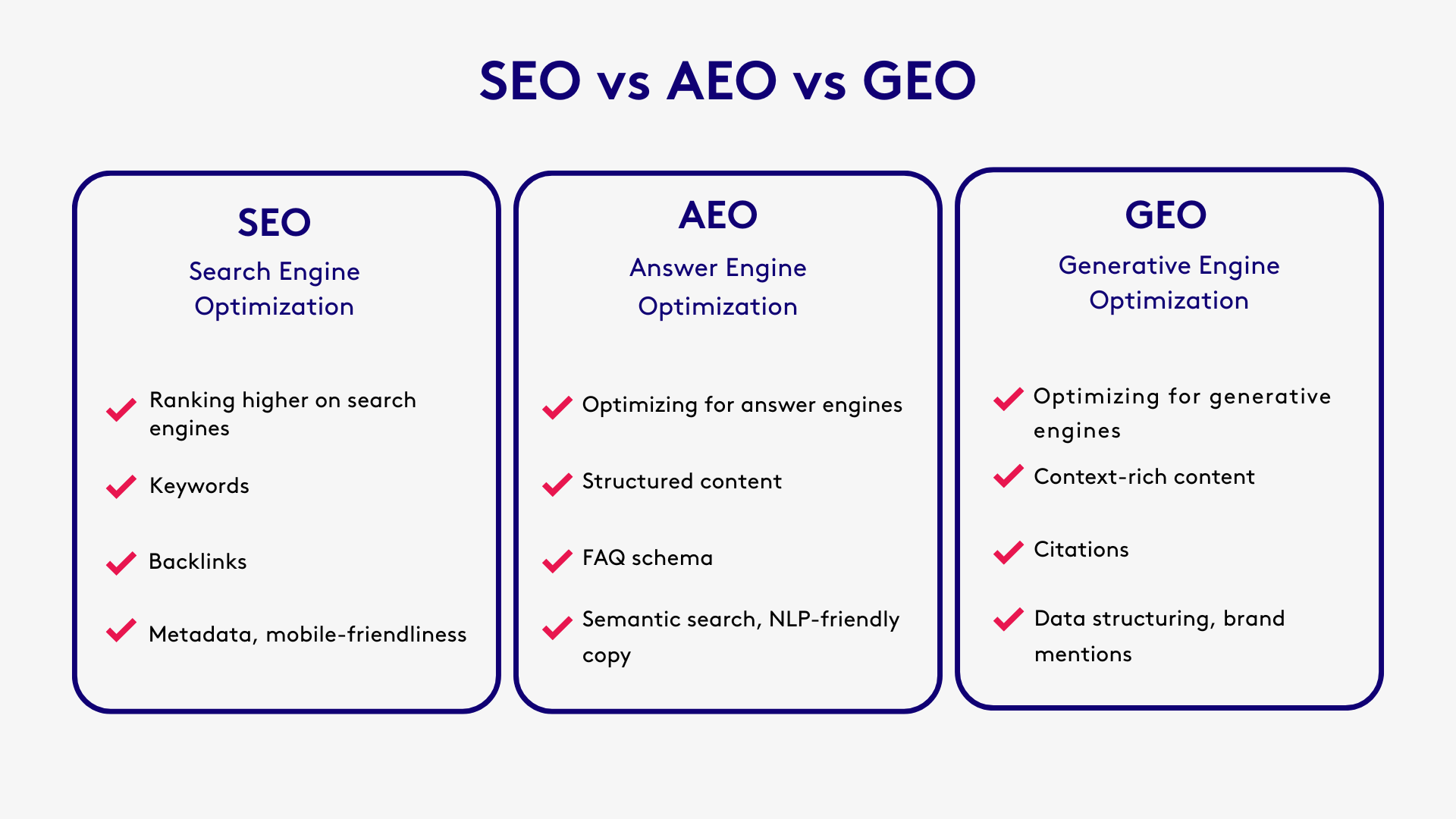
What AEO and GEO Actually Mean (without the jargon)
Answer Engine Optimization (AEO) makes your content easy for a machine to pull an answer from: a clear question, a direct answer, and nothing the system has to guess. You see the result in AI Overviews, voice answers and the summary at the top of an assistant's reply.
Generative Engine Optimization (GEO) is about being chosen as a source. When an assistant writes an answer from several pages, GEO decides whether your brand is one of the sources it cites, and how it describes you. The term comes from a 2023 Princeton-led research paper later published at KDD 2024.
The short version: AEO helps AI answer the question. GEO helps AI decide who to quote.
Is AEO the same as GEO?
No, but they overlap heavily and most of the work serves both. AEO is about the shape of your content. GEO is about your standing as a source, which depends on what the rest of the web says about you as well as on your own pages. You don't need separate teams or separate strategies for each.
Key Differences Between SEO / AEO / GEO at a Glance
Aspect | Traditional SEO | AEO | GEO |
Goal | Rank a page in search results | Get your content extracted as the answer | Get your brand cited and described accurately |
What gets used | The whole page | A passage or a single fact | Your brand, across many sources |
Main signals | Relevance, links, technical health | Clear structure, direct answers, readable HTML | Mentions across the web, consistency, original data |
Success metric | Rankings, traffic, clicks | Inclusion in answers and AI Overviews | Citation share, share of voice, sentiment |
Where it shows up | Google and Bing results | AI Overviews, AI Mode, voice answers | ChatGPT, Perplexity, Claude, Gemini, Copilot |
First-party reporting | Search Console, Bing Webmaster Tools | Search Console AI report (impressions only) | Bing AI Performance report for Copilot; third-party trackers for the rest |
How AI Pulls Your Content
In short: AI assistants don't read your page the way a person does. They run searches, fetch pages, split them into passages, and build an answer from the passages they trust most.
Most assistants use a form of retrieval-augmented generation. They search an index, pull back candidate pages, extract the passages that match the question, and generate an answer from those passages, usually with citations.
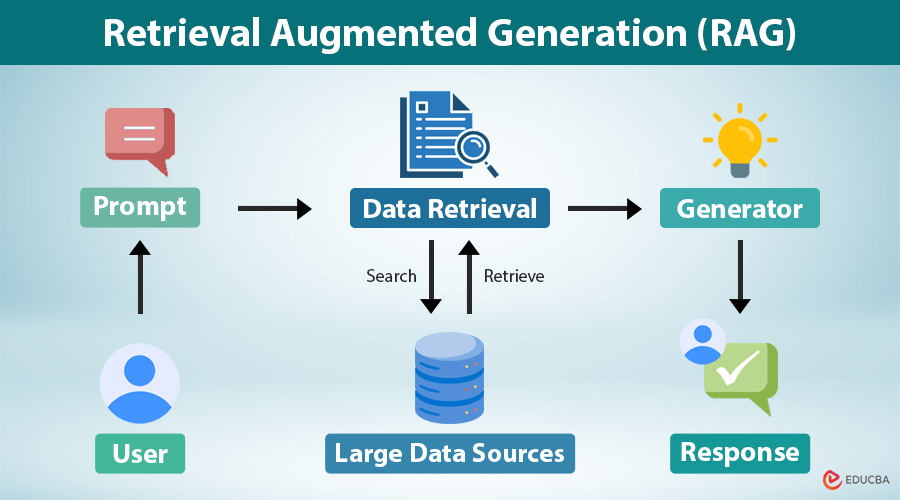
Each assistant reads the web through a different index
There is no single AI index, which is the main reason a Google ranking doesn't carry over. ChatGPT runs its own search crawler and also sends queries to partner search providers, Microsoft among them. Copilot reads Bing. Claude's web search has used Brave. Perplexity runs its own index. Google AI Overviews and AI Mode run on Google Search. A page can be strong in one and missing from another. For ChatGPT specifically, see how to rank in ChatGPT.
Answers are built from passages and sub-questions
Google says AI Overviews and AI Mode may use a "query fan-out" technique, issuing several related searches across subtopics to build one response. That is how a page outside the top 10 can still be cited: it answered one of the sub-questions well. It is also why each section of your page has to make sense on its own. The system may lift one passage and never read the rest. We cover this in more detail in how to rank in Google AI Overviews.
The opening of each section carries the most weight
Assistants lean on the first sentences after a heading. If your main point sits in the first two or three sentences of a section, it is more likely to be extracted. If it is buried in the fourth paragraph, it may never be seen.
So lead each section with a direct answer, then add nuance, examples and detail. A reader still gets the full explanation, and a retrieval system gets a clean passage to lift.
Structure tells the system what each section answers
Headings, lists and tables tell a model which topics a page covers and which section answers which question. A clear list of steps or a comparison table is easier to extract from than a block of prose covering the same ideas. Question-style headings help for the same reason: they match the way people phrase prompts.
Can AI read pages that depend on JavaScript?
Often not. A Vercel and MERJ analysis of AI crawler traffic found that the major AI crawlers, including OpenAI's, Anthropic's and Perplexity's, fetch raw HTML and don't execute JavaScript. Google's Gemini and AppleBot do render it.
Our own testing was less clear-cut. In our retail study, 12 retailers only exposed their product data after JavaScript ran, and three served a page that was close to empty before it did. ChatGPT still got 10 of the 12 prices right, and the two misses came from a sale page and a comparison site. At one retailer, though, where the price and the cart button only loaded with JavaScript, it appears to have read the page too early and told the shopper the product was out of stock.
The practical rule is to put prices, specs, dates and definitions in the HTML you serve. Pages can get by without it, but when it goes wrong, it costs the sale.
What We Learned Testing This Ourselves
Since January we have measured our own visibility and run a structured test of what ChatGPT tells shoppers about 51 of Australia's most-loved retailers. Five findings changed how we approach AEO and GEO.
1. Ranking and being clicked have come apart
Our Search Console data for September 2026 showed a sharp break below the top three. Our pages in positions 1 to 3 had a click-through rate of 3.45%. Pages in positions 4 to 10 had 0.065%. Of the 258 queries where we appeared on page one, 209 got no clicks at all.
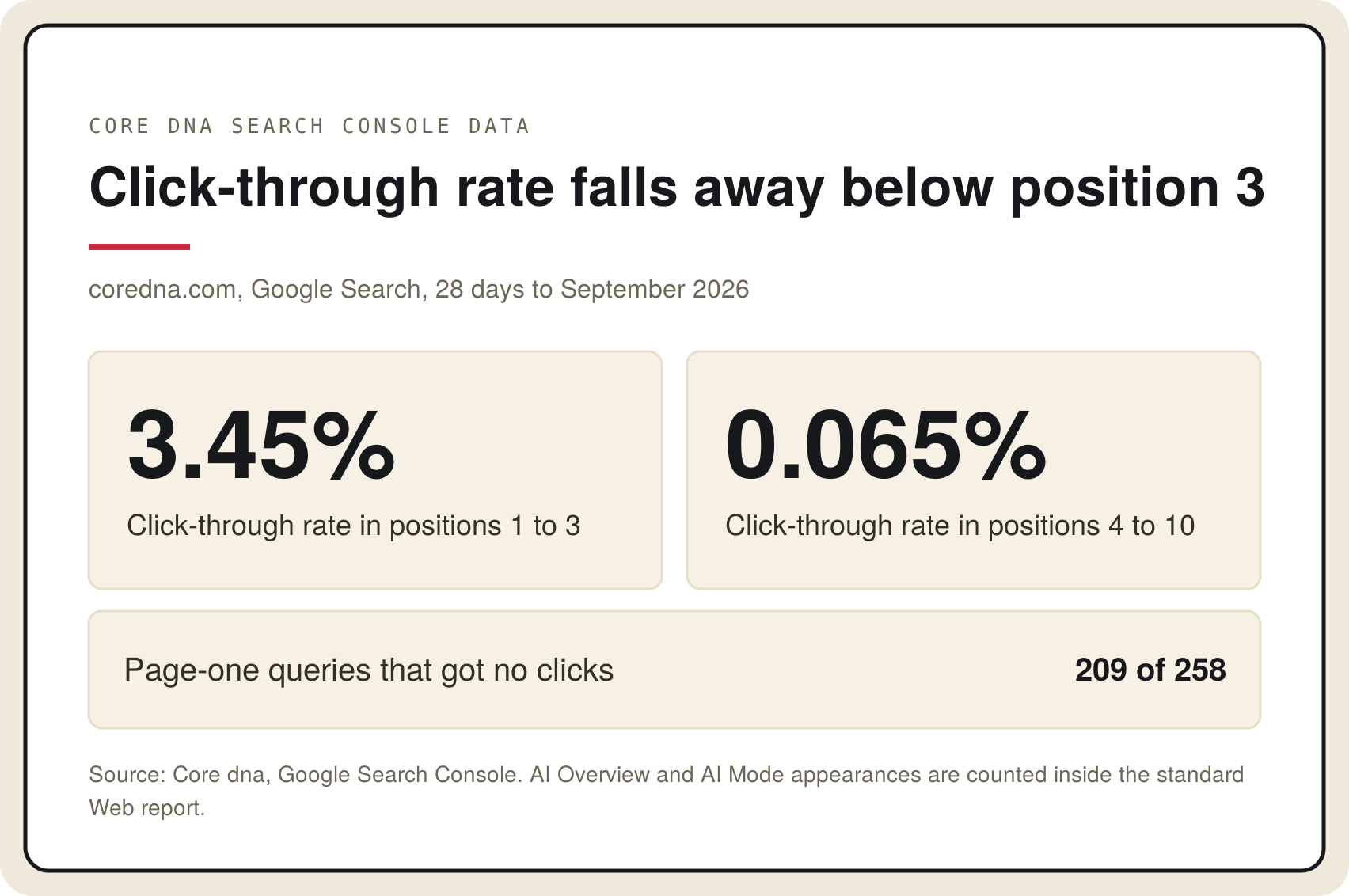
This guide is an example. By late September its average position across AEO and GEO searches was around 5, and fewer than 2 in every 100 impressions became a click. Google counts AI Overview and AI Mode appearances inside the standard Web performance report, so they can't be separated out there, but the pattern is consistent with AI answers absorbing the click.
For informational content, clicks undercount visibility. Track impressions, average position and citations alongside them.
2. A single visibility score hides where you're missing
When we analyzed the prompts we track in Promptwatch, the dashboard score didn't match what was happening prompt by prompt. Core dna appeared in 65% of tracked prompts and in the top three for 59%. Most of that strength came from specific, integration-style questions. On broad category questions we were much weaker.
Read results by prompt and by topic cluster. A healthy average can hide the questions where a buyer never sees you.
3. Valid schema didn't stop wrong answers
Between September 22 and 25, 2026, we asked ChatGPT the price and local stock of one product at retailers from Power Retail's index of Australia's most-loved retailers, and checked each answer against the live product page within minutes. ChatGPT got 43 of 51 prices right.
All six wrong prices came from retailers whose own product schema carried the correct number. Retailers with no product schema at all were answered correctly in all seven cases. Schema still helped with detail, such as stock by size, but on its own it didn't protect accuracy.
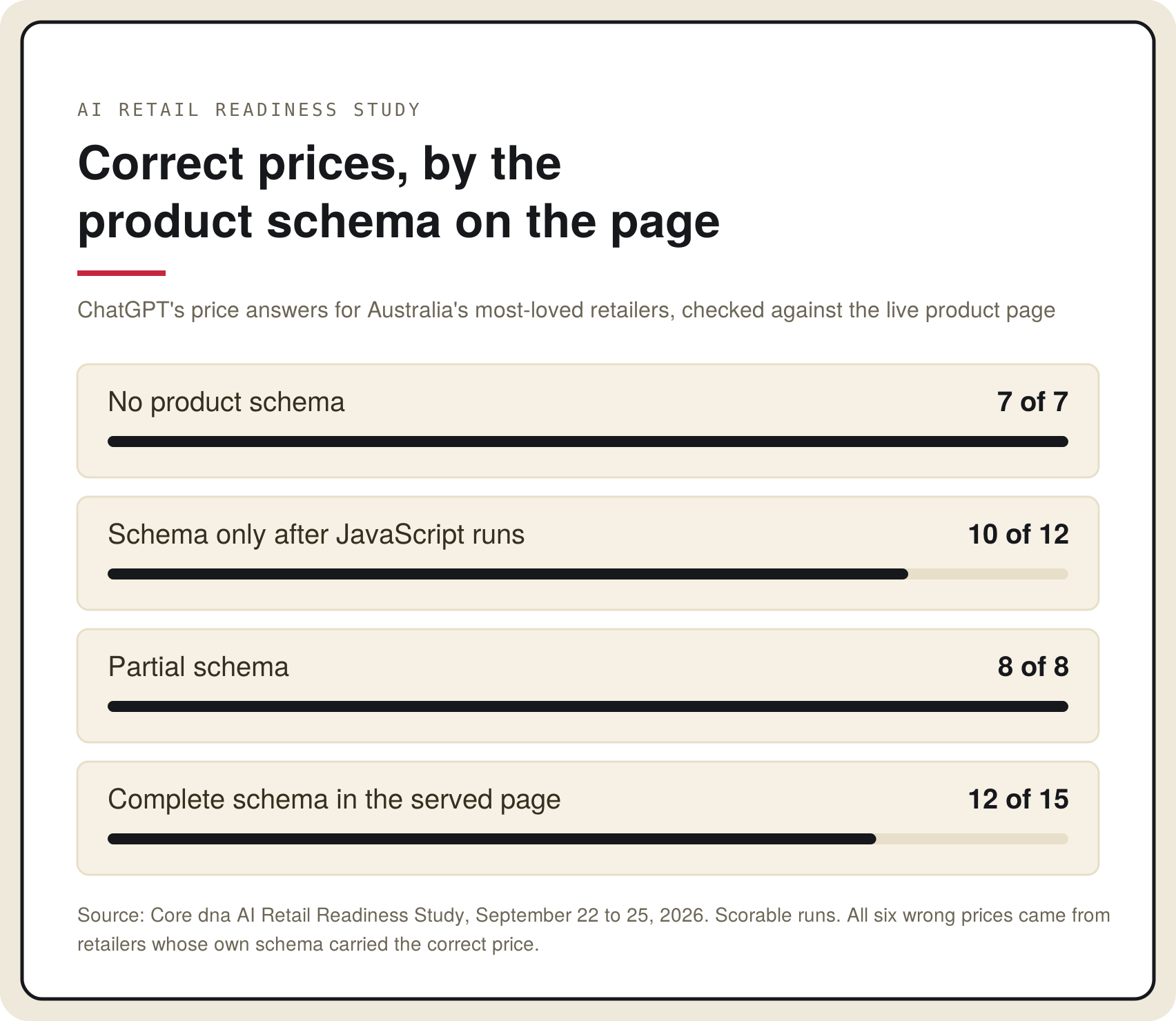
4. The wrong answers came from the retailers' other pages
None of the wrong prices came from the product page. They came from the retailer's own sale, range and collection pages, or from price-comparison sites that still showed the price from before a sale. When a comparison site, a sister brand or an overseas store stood in for the product page, none of those answers gave a correct Australian price.
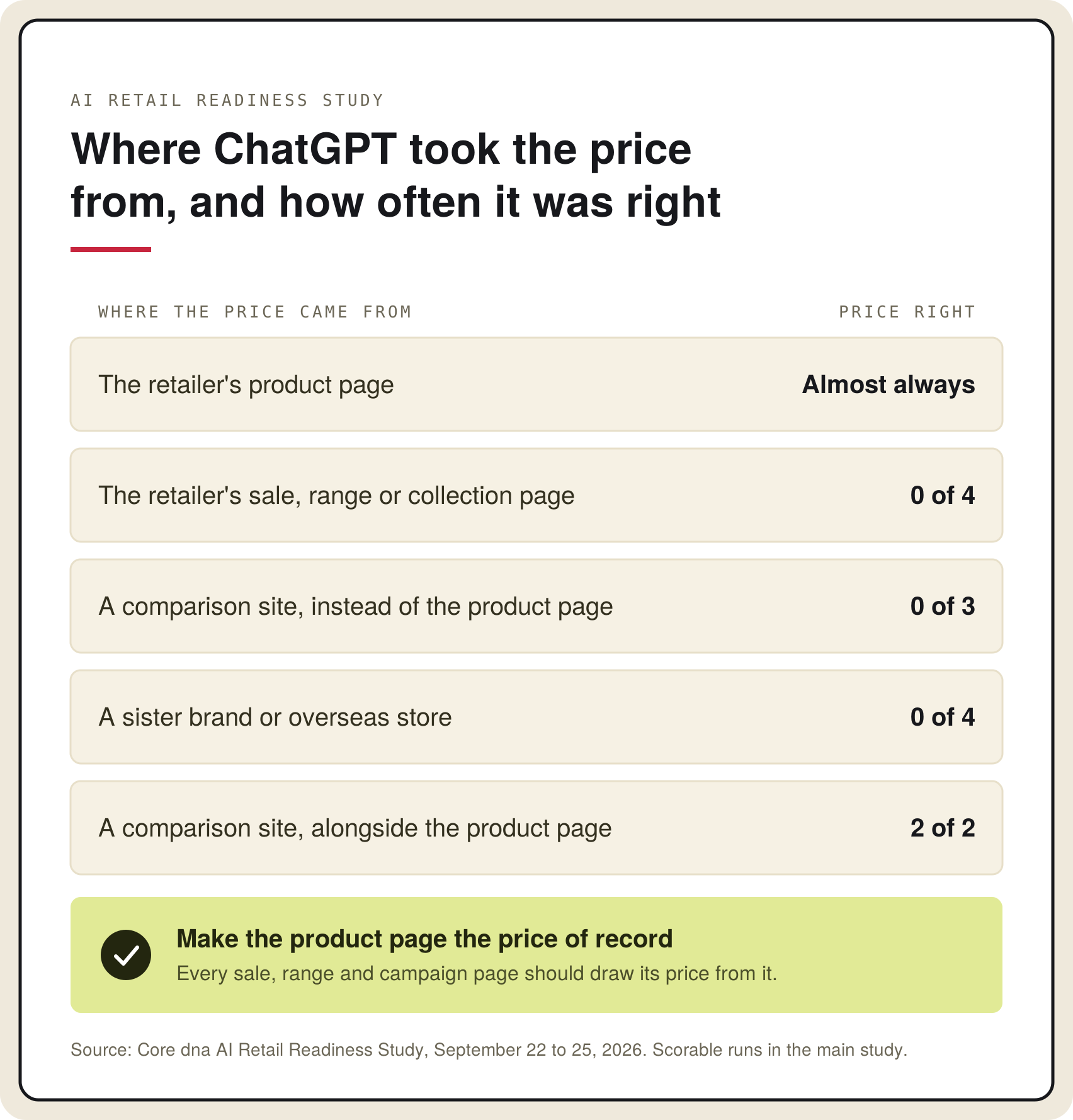
For AEO and GEO, your site has to agree with itself: one price of record, one definition and one set of facts, repeated consistently on every page that mentions them. We go deeper on building that single record in product feed optimization for AI shopping.
5. The same question can get a different answer tomorrow
When we asked the same question twice, two of four retailers got a different answer. Logged out, one retailer's price was wrong on one run and right on the next. Citations also fade. A Stacker study of more than 3 million citation events put the median citation half-life at about 4.5 weeks. A single test tells you what happened once.
Core AEO and GEO Optimization Strategies
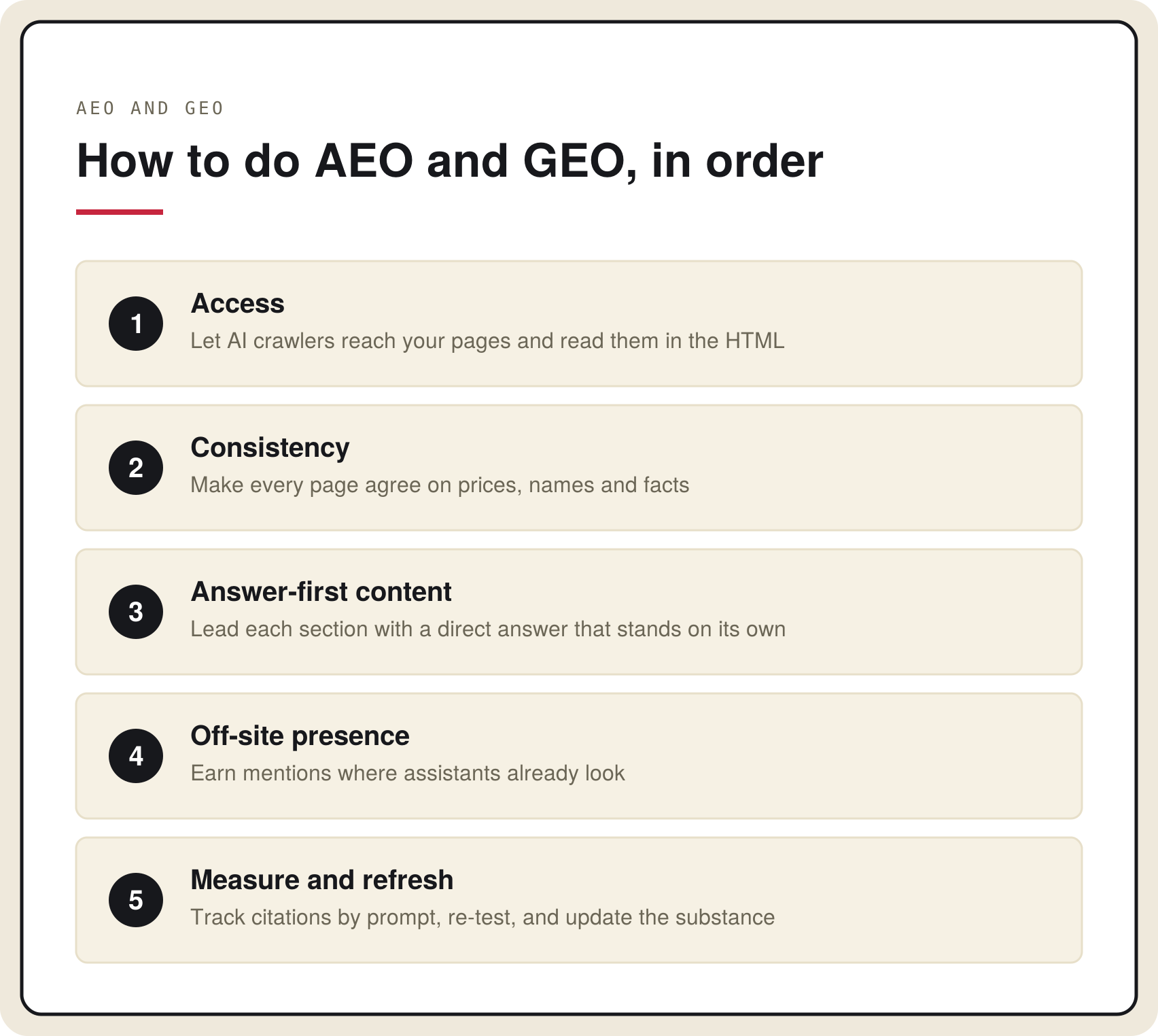
How to do AEO and GEO: make sure AI systems can reach and read your pages, make your pages agree with each other, write each section answer-first, build your presence beyond your own site, then measure by prompt and refresh what matters. Work in that order. Polishing content a crawler can't read gets you nothing.
1. Make sure AI systems can reach and read your pages
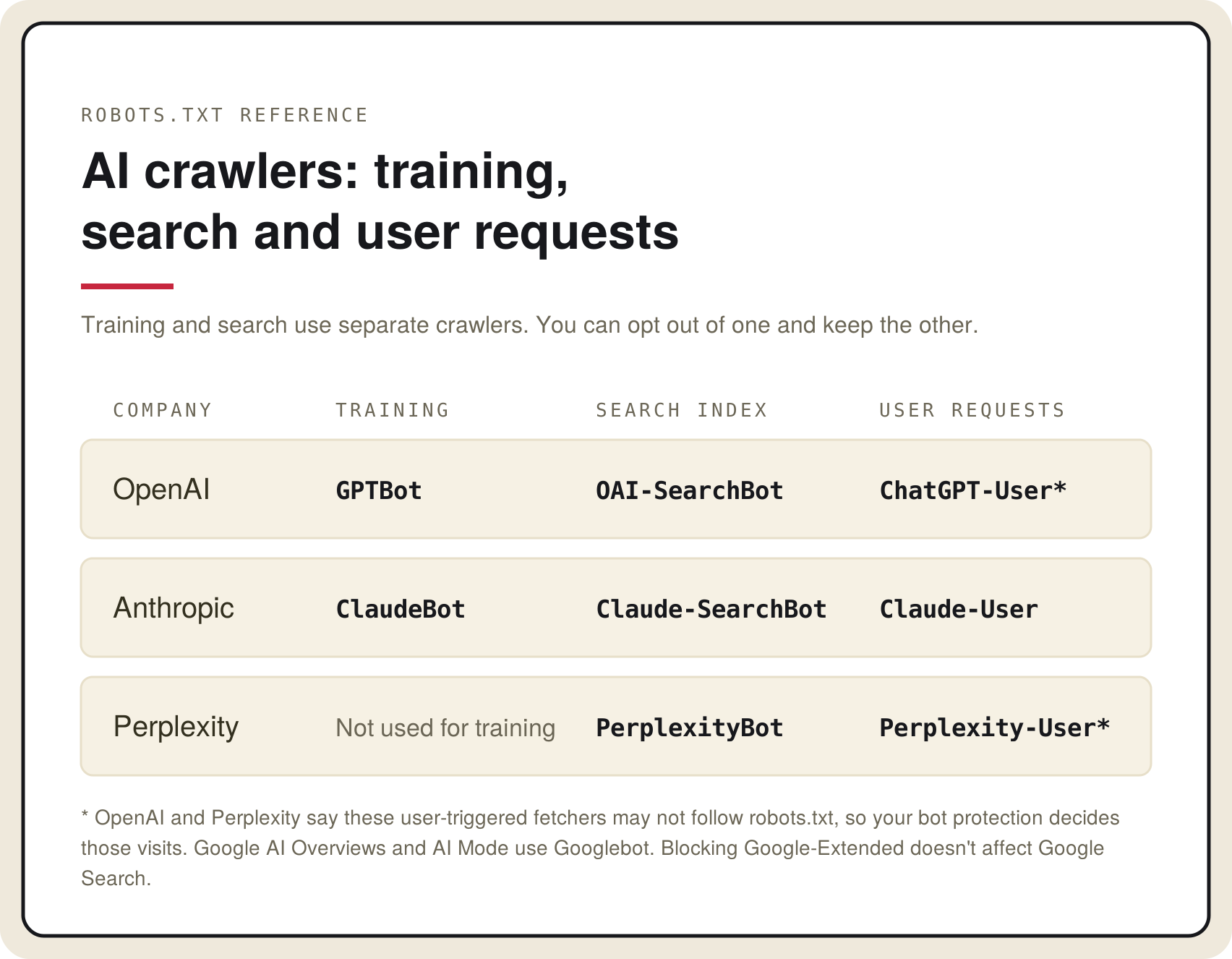
Why it matters: If an assistant can't fetch your page, it will answer from someone else's. In our retail test, access was decided by the retailers' security tools. Only 11 of the 68 retailers we checked named any AI crawler in robots.txt, and no failure traced back to robots.txt.
- Decide your crawler policy on purpose. Training crawlers and search crawlers have different effects. OpenAI says sites that opt out of OAI-SearchBot "will not be shown in ChatGPT search answers", while GPTBot controls whether content may be used for training. You can block GPTBot and still allow OAI-SearchBot. Anthropic (ClaudeBot, Claude-SearchBot, Claude-User) and Perplexity (PerplexityBot, Perplexity-User) separate their agents in a similar way.
- Check your bot protection. OpenAI notes that for ChatGPT-User, which fetches pages when a person asks a question, "robots.txt rules may not apply". Your WAF and bot-management rules decide whether those visits succeed, so review them for verified AI agents.
- Serve critical facts in the HTML. Prices, specs, dates and definitions belong in the page as served, not only in JavaScript widgets or images.
- Use Bing Webmaster Tools and IndexNow. Copilot reads Bing's index, and Microsoft is among ChatGPT's search partners. IndexNow pushes new and changed URLs to Bing and other participating engines as soon as they publish. Google doesn't use it.
- Treat llms.txt as optional. Google says you don't need AI text files to appear in its AI features, and no major assistant has confirmed reading llms.txt for search answers. Our llms.txt guide covers when it's still worth publishing.
- Keep crawling clean. Fix broken links and 404s, keep sitemaps current, and keep response times fast.
2. Make your pages agree with each other
Why it matters: Assistants read across your site. When a sale page, a category page and a product page disagree, the assistant has to pick one, and it doesn't always pick the product page.
- Keep one price, one product name and one set of specs as the record, and have every page that shows them draw from it. Avoid building a separate catalogue for each AI channel, since the versions drift apart. We explain why in do you need a separate product feed for ChatGPT?
- Update or redirect campaign pages when a promotion ends.
- Use the same company description, definitions and figures across your site, social profiles, listings and press.
- When an offer has conditions, state them next to the price in plain text: who qualifies, what it costs, when it ends. In our test, a single sale price carried through to the answer. Stacked offers, such as a sale plus a member price plus a multibuy, were often dropped or mixed up.
Where schema fits. Structured data still helps search engines, merchant listings and assistants read detail. Use Article or BlogPosting, Organization, Product and BreadcrumbList where they apply, and make sure the markup matches what the page shows. Two things have changed since we first wrote this guide. Google stopped showing FAQ rich results on May 7, 2026, and HowTo rich results were retired in 2023. Google also says no special schema is needed to appear in AI Overviews or AI Mode.
3. Create answer-first content
Why it matters: Assistants extract passages, and the first sentences after a heading carry the most weight. Lead with the clearest possible answer, then add explanation, examples and nuance.
- Open each section with a direct answer of two or three sentences.
- Write each section so it makes sense lifted out on its own.
- Use headings that match how people ask the question.
- State specific figures early, in the sentence they support.
- Name products, people and companies explicitly and consistently, so a model attributes facts to the right entity.
- Keep question-and-answer sections where they help the reader. They help retrieval too, though they no longer earn a rich result in Google.
4. Build consensus across platforms
Why it matters: Much of GEO happens off your own site. Across 75,000 brands, Ahrefs found that branded web mentions correlated with AI Overview visibility at 0.664, against 0.218 for backlinks. That is a correlation, not proof of cause, but it points the same way as everything else we have seen: models register that you are mentioned, and by whom. For the ChatGPT side, see how to get cited by ChatGPT.
- Earn mentions, linked or not, in industry publications, analyst coverage, partner sites and credible roundups.
- Show up where assistants already cite: Reddit, YouTube, LinkedIn and well-sourced reference sites. Spread your presence across several of them, because any one platform can lose favor quickly.
- Claim and maintain the business listings and directory profiles that assistants draw on.
- Publish original data that others will repeat. Repetition across trusted sources is what makes a claim durable.
5. Use comparisons and lists with clear criteria
Why it matters: Comparison tables and ranked lists are easy for AI to summarize, and they match how people ask: "best X for Y", "X vs Y". The advantage is narrowing for lists made mainly to be cited. Seer Interactive measured a 30% month-on-month drop in listicle citations in AI search in 2026.
- Build comparisons around stated criteria.
- Use tables for side-by-side detail.
- Include alternatives fairly, and say who each option suits.
- Skip "best of" lists that rank your own product first.
6. Show real experience (E-E-A-T)
Why it matters: AI systems are built to favor sources they can trust. The Princeton-led GEO study found that adding quotations, statistics and cited sources lifted visibility in generated answers by up to 40% for some methods and domains, while keyword stuffing didn't help.
- Use first-hand examples and your own data.
- Show author names, roles and bios.
- Quote people with relevant expertise.
- Cite primary sources and link to them.
- Avoid mass-producing thin AI-written pages. Google's spam policies now name "attempting to manipulate generative AI responses in Google Search" as spam, and using generative AI to produce many pages without adding value counts as scaled content abuse.
7. Refresh what matters, on a schedule
Why it matters: Citations fade. With a median half-life of about 4.5 weeks, a page that was cited last quarter may not be cited now. A refresh has to change the substance. Changing the year in a title, with nothing else updated, isn't a refresh.
- Update figures, examples and screenshots when they change.
- Add a section when something material happens in your field.
- Review your most valuable pages monthly and re-test the prompts they should answer.
- Show the update date on the page.
8. Measure success without relying on clicks
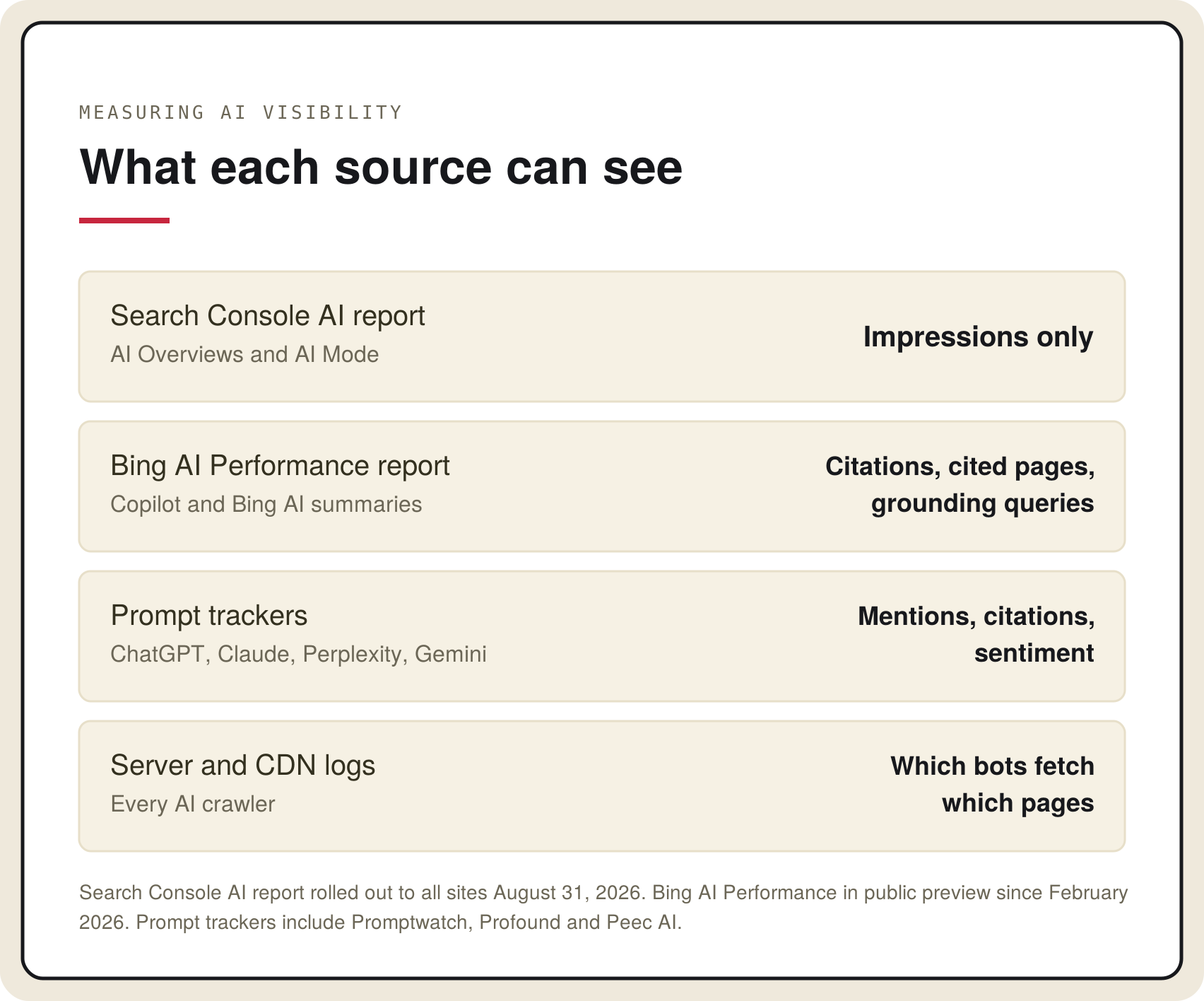
Why it matters: Clicks undercount AI visibility, and first-party tools only show part of it. Measure across three layers:
- Crawl: which AI bots fetch your pages, and whether they hit errors or blocks. Source: server and CDN logs.
- Citation: how often you are named or linked as a source, for which prompts, and against which competitors.
- Recommendation and sentiment: what the answer says about you, and whether it is accurate. This is the layer closest to revenue.
Google's generative AI performance report in Search Console, rolled out to all sites on August 31, 2026, shows impressions in AI Overviews and AI Mode, with no clicks, click-through rate or queries. Bing's AI Performance report, in public preview since February 2026, goes further for Copilot and Bing's AI summaries, with citation counts, cited pages and the grounding queries behind them. Neither covers ChatGPT, Claude or Perplexity. For those you need a dedicated tracker such as Promptwatch, Profound or Peec AI.
Three habits from our own tracking:
- Read results by prompt and by topic cluster, since a dashboard average can hide the questions where you are missing.
- Run the same prompts on several days, signed in and logged out, and record the sources cited as well as whether you were mentioned.
- Look at what appears around the answer. In our retail test, 26 of 37 logged-out ChatGPT answers carried a paid ad, five of them for the same product from another seller. See what ChatGPT ads mean for merchants.
Business signals still count: AI referral traffic in GA4, conversions from those visits, growth in branded search and assisted conversions. Many people see your brand in an AI answer and come back later through another channel. For a step-by-step method, see how to measure AI visibility.
9. Know the platform nuances
The fundamentals hold everywhere, but each platform reads the web differently.
Platform | Where it gets answers | What to do about it |
ChatGPT | Its own search crawler (OAI-SearchBot) plus partner search providers. About 8% of its citations match Google's top 10. | Allow OAI-SearchBot and ChatGPT-User, serve content in HTML, and verify your site in Bing Webmaster Tools. |
Google AI Overviews and AI Mode | Google Search, with query fan-out across related sub-questions. About 38% of AI Overview citations come from the top 10. | Keep SEO strong and cover the related questions around your topic. |
Perplexity | Its own index. About 29% of its citations match Google's top 10, the closest of the standalone assistants. | Allow PerplexityBot, keep content current, and cite verifiable sources. |
Claude | Web search reported to run on Brave, plus Anthropic's own crawlers. | Allow Claude-SearchBot and Claude-User, and keep pages structured and server-rendered. |
Microsoft Copilot | Bing's index. | Use Bing Webmaster Tools and IndexNow, and watch the AI Performance report. |
Gemini | Google's infrastructure, which renders JavaScript. | Strengthen entity and brand signals across Google properties. |
The takeaway: don't build a separate strategy for each platform. Get the foundation right, then check where you are missing and why. For engine-by-engine tactics, see how to boost AI visibility in search algorithms.
AEO and GEO for eCommerce and Multi-Location Businesses
For a retailer, AEO and GEO come down to product truth: whether an assistant can find the current price, availability and offer for a product, and whether it takes them from your page. Our retail study points to a short list of fixes, and most of them sit at platform level.
- Make the product page the price of record. Every sale, category and campaign page should draw its price from the same source, and expired campaign pages should be updated or redirected.
- Keep offers simple and explicit. A single sale price travels into the answer. Member prices, multibuys and codes stacked on top often don't.
- Publish store-level availability in a form machines can read. ChatGPT declined 41 of 48 stock questions, because stock only appeared after a postcode, store or size was chosen. Where retailers said nothing, delivery apps and shopping centre sites answered for them.
- Make the right country's store the one machines land on. When the local page was blocked or thin, answers used an overseas storefront and quoted another currency. Use country-specific URLs, hreflang and local currency in your schema.
- Update comparison and shopping feeds the day a sale starts. When a comparison site stood in for the product page, the price was wrong every time we could check it, often because it still showed the price from before the sale.
If your products are missing from answers entirely, start with why ChatGPT can't find your products. The same product data is also what assistants will need as they move from answering questions to completing purchases, which we cover in how to make your products discoverable for agentic commerce.
If you run several brands, sites or locations, treat this as a platform decision. In our study, three brands from the same retail group published the same schema pattern and behaved the same way, because they share a platform. A flaw on a shared template reaches every brand at once, and so does a fix. Multi-location businesses face the same thing: each location needs its own crawlable page with its address, hours, services and availability in the HTML, and those details have to match your business listings. Core dna runs content and commerce for many brands and locations on one platform, so a fix to a shared template applies everywhere. See how that works for multi-brand retail and multi-location operators.
For the catalogue side, read our guide to product feed optimization for AI shopping, then run the 15 copy-and-paste prompts to see what ChatGPT can find about your products.
See how one platform keeps prices, content and product data consistent across every brand, store and page.
Frequently Asked Questions
Is AEO the same as GEO?
No. AEO (Answer Engine Optimization) makes your content easy for AI to extract a direct answer from. GEO (Generative Engine Optimization) makes your brand a source AI trusts enough to cite when it generates an answer. AEO helps AI answer the question; GEO helps AI decide who to quote. Most of the work serves both.
What do AEO and GEO stand for?
AEO stands for Answer Engine Optimization. GEO stands for Generative Engine Optimization, a term that comes from a 2023 Princeton-led research paper. You will also see the same work called AI search optimization or AI visibility.
Which matters more for eCommerce, AEO or GEO?
For eCommerce, start with AEO. Product questions have factual answers, such as price, stock, specs and delivery, and if an assistant can't extract those accurately from your pages, brand trust won't fix the answer. GEO carries more weight on category questions such as "best running shoes for flat feet", where the assistant chooses which brands to recommend. Our guide to product feed optimization for AI shopping covers the product data side.
Does SEO still matter for AEO and GEO?
Yes. A page that can't be crawled, indexed and read can't be cited, and Google says AI Overviews and AI Mode need no special optimization beyond SEO best practice. A Google ranking doesn't carry over to ChatGPT or Claude, which use other indexes, so SEO alone isn't enough. See how AI search optimization differs from SEO.
How do you do AEO and GEO?
Work in this order: make sure AI systems can reach and read your pages, make your pages consistent with each other, write each section answer-first, build mentions beyond your own site, then measure by prompt and refresh what matters.
Does schema markup help with AEO and GEO?
It helps machines read detail, and it should always match what the page shows. It isn't a shortcut. Google says no special schema is needed for AI Overviews or AI Mode, FAQ rich results stopped appearing in May 2026, and in our retail test all six wrong prices came from retailers whose schema had the right number. The errors came from other pages that disagreed with the product page.
Do you need an llms.txt file?
It's optional. Google says you don't need AI text files to appear in its AI features, and no major assistant has confirmed reading llms.txt for search answers. It is cheap to publish and some coding assistants and agents use it. We cover the evidence in llms.txt: do you need it, and does it actually work?
How fast do AEO and GEO results appear?
It varies by platform, and we haven't seen reliable evidence for a general timeline. Assistants that search the web live can cite a page soon after it is crawled, but citations also fade, with a median half-life of about 4.5 weeks in one large study. Plan for ongoing work and re-test regularly.
How often should I update content for AI visibility?
Review your most important pages monthly and re-test the prompts they should answer. Update when the substance changes: new figures, new examples, a new section. Changing the year in a title is not an update.
How do I measure AEO and GEO success?
Track three layers: crawl (which AI bots fetch your pages), citation (how often you are named or linked, by prompt) and recommendation (what the answer says about you). Use Search Console's AI report for impressions, Bing Webmaster Tools for Copilot citations, and a prompt tracker for ChatGPT, Claude and Perplexity. Clicks on their own undercount it.
How should multi-location businesses approach AEO and GEO?
Give every location its own crawlable page with its address, hours, services and availability in the HTML, and keep those details identical to your business listings. Don't pre-select a store for visitors who haven't chosen one. Run every location from one platform, so a fix to the shared template reaches all of them.
AEO and GEO extend SEO to a world where AI systems sit between your content and your audience, deciding what gets surfaced, what gets trusted and what gets left out. The teams that do well make their content easy to reach, easy to read and consistent wherever it appears, then check what the answers actually say, more than once.
Core dna serves fully server-rendered HTML with structured content, and built-in IndexNow support pushes new and updated pages the moment they publish, so they are readable by AI crawlers by default. See how it works on our content management platform, or read how teams run multi-property workflows on Core dna MCP.
Summarize with