
Short answer: test the channel, but fix your product data first. On 18 August, OpenAI announced that ChatGPT Ads was expanding to 31 European countries, the largest geographic jump since the February launch. Tens of thousands of marketers have now run ads on the platform. Named retailers including Best Buy, Lowe's, Newegg and Vistaprint are live. This is no longer a pilot you can safely ignore.
It is also not yet a channel that will move your quarter. Below is what actually shipped, the one design decision most coverage has missed, and four things worth doing in the next 90 days.
ChatGPT Ads At A Glance
What a merchant needs to know before running a test.
Source: OpenAI help centre and developer documentation, August 2026.
What Actually Shipped
OpenAI began testing ads in ChatGPT in the US in February 2026 and opened self-serve access in the spring, reaching nine markets by August. The European expansion then added 31 more in a single wave, initially through OpenAI's Ads Solutions team and agency and technology partners, with self-serve access following later.
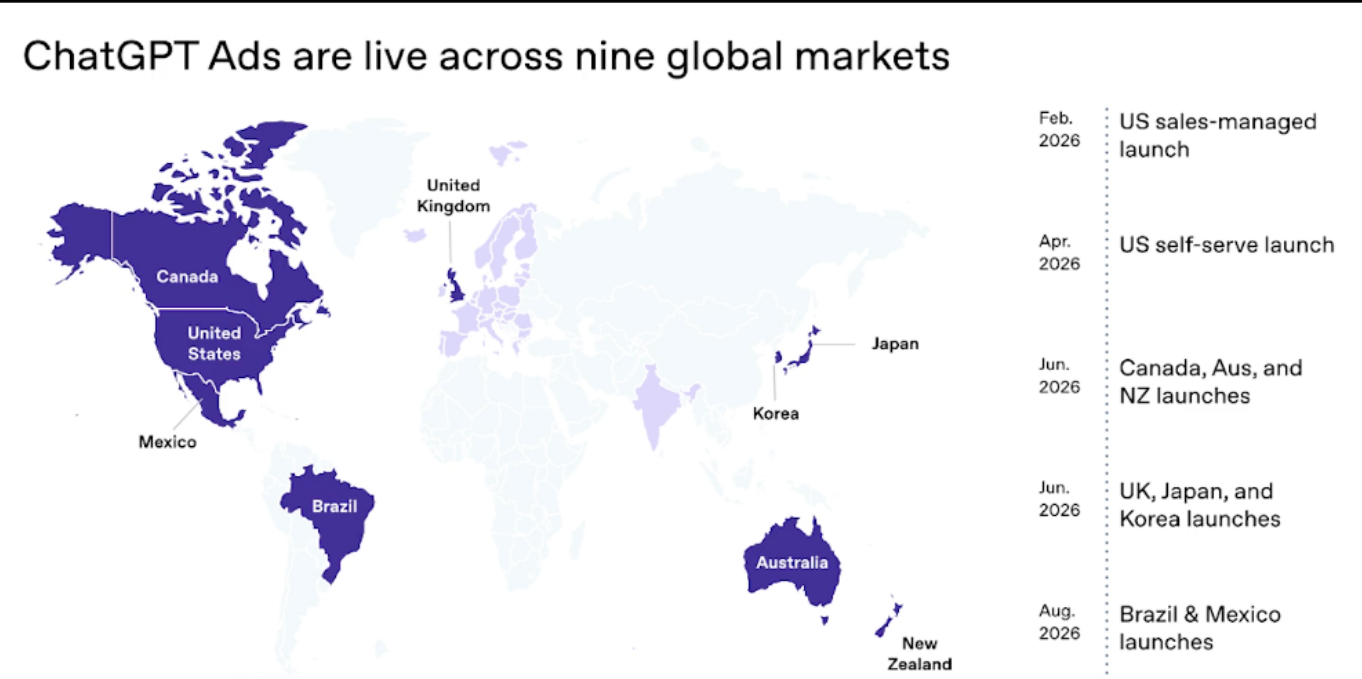 Who sees them, according to OpenAI's own documentation: users on the Free and Go plans only, aged 18 and over, and both logged-in and logged-out users. Plus, Pro, Business, Enterprise and Education remain ad-free. Ads render below the response, labelled as sponsored, and OpenAI is emphatic that they run on separate systems from the chat model and cannot shape or reorder an answer. They are also blocked near health, mental health, political and other sensitive conversations, which is as much a brand-safety feature for advertisers as a user protection.
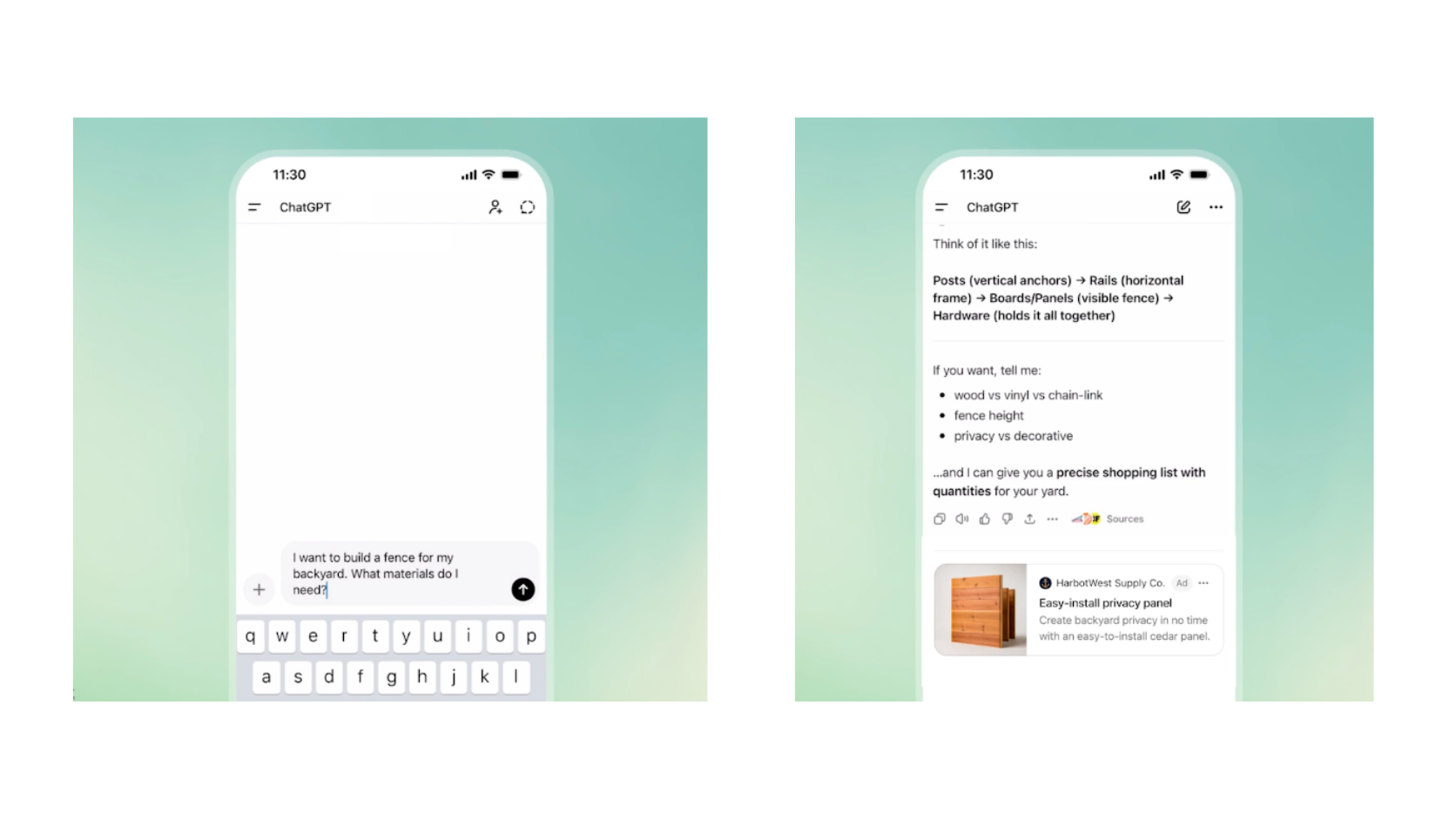
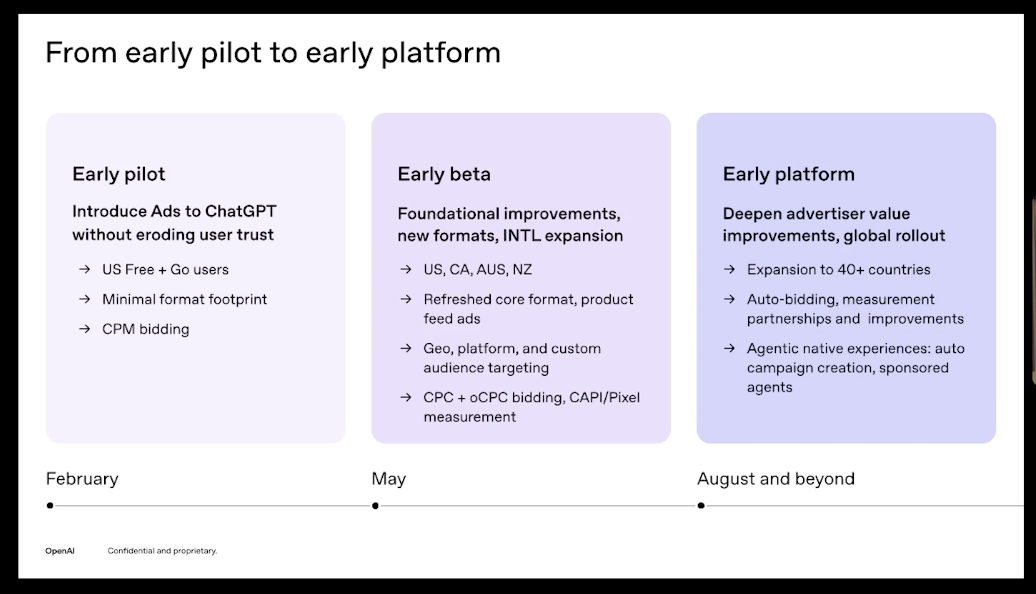
OpenAI splits its own progress into three phases, and the one now underway is the one to watch. The early platform phase is about advertiser value: expansion past 40 countries, auto-bidding, measurement partnerships, and what OpenAI calls agentic native experiences, meaning automatic campaign creation and sponsored agents.
Four developments matter more right now than the launch itself.
Product Feed Ads Arrived In June
This is the important one. You upload your product catalogue and OpenAI builds ad units from it, featuring, in its own description, "product images, titles, stars, prices, sales prices, and your brand." It supports Google-compatible product data feeds, so the file you already send to Google Merchant Center is largely reusable. OpenAI recommends validating with a sample of around 100 items, then refreshing at least daily. Items expire after two weeks, which is the detail to internalise: a stale feed means your ads stop. That makes the refresh an operational job rather than a marketing one, and a good argument for scheduled orchestration rather than a recurring reminder in someone's calendar.
Real Targeting Controls Landed
You can now upload your own customer and prospect lists as custom audiences, geo-target down to country, state, DMA and zip in the US, and choose which surfaces you appear on across iOS app, Android app and web. Bidding covers CPM, CPC and, since August, conversion-optimised CPC. Minimum daily budget in the US is $25, and OpenAI is running a $500 credit for new advertisers who spend $500.
Getting Started Got Much Easier, And Is About To Get Stranger
OpenAI is rolling out onboarding that takes one input, your website URL, and generates a complete first campaign in under a minute, all editable before launch. Further out it has demonstrated an Ads Manager agent that runs inside ChatGPT itself, briefed conversationally, that builds and optimises the campaign for you. The stated goal is that you never have to learn what an ad group is. For lean teams that is a real unlock. It also means your competitors' barrier to entry is about to drop to roughly zero, which will show up in auction prices.
In-Chat Checkout Got Walked Back
In March, OpenAI deprioritised Instant Checkout and pushed transactions toward merchant-run apps inside ChatGPT. Walmart's EVP of AI acceleration called the results disappointing, "with conversion rates three times lower for the selection sold directly inside the chatbot than those that require clicking out." Etsy said it did not drive large volume but that ChatGPT was a valuable discovery tool. The practical translation: discover in AI, buy on your site. Which puts the weight back on your own checkout experience, not the assistant's.
Almost Total Reach, Almost No Control
Ads serve the Free and Go plans. Go is not a free tier: it costs $8 a month, and OpenAI's pricing page carries the line "This plan may include ads" against it. No other tier does. Paying OpenAI does not make you ad-free. Paying OpenAI more does.
That leaves almost everybody. OpenAI reported more than 900 million weekly active users against 50 million subscribers in February 2026, and told eMarketer that 85% of its US users are eligible to see ads. The free tier is not a poverty filter either: Bank of America went through its own customers' transactions and found only 3% of US households pay for any AI service at all, so removing the payers shifts the income profile of everyone left by well under a percentage point.
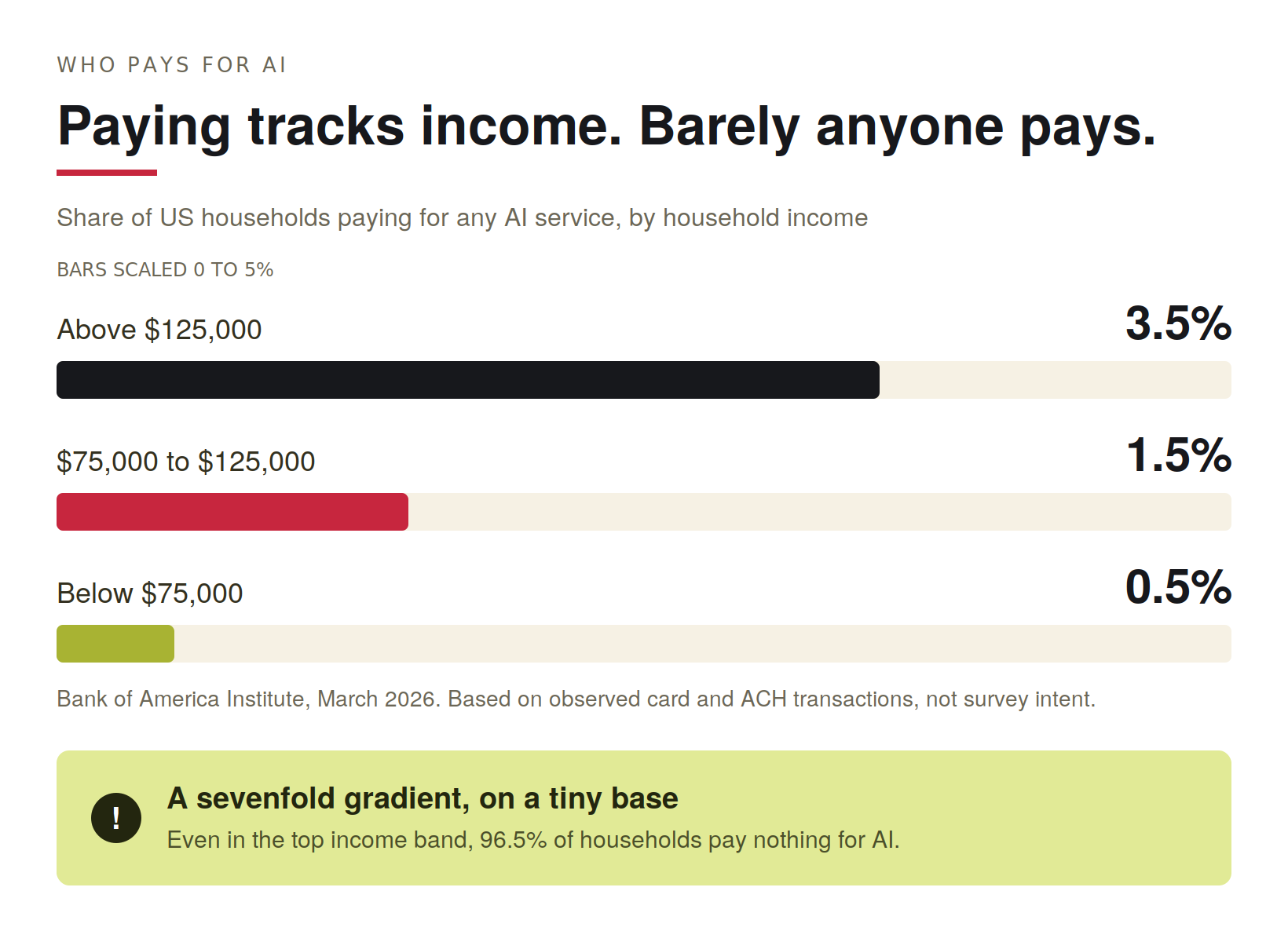
So audience size is not the interesting question. What matters is that near-total reach arrives with three constraints attached, and each one breaks a habit.
You cannot buy frequency. Fewer than 20% of eligible US users are shown an ad on a given day. Reach is nearly universal, impressions are rationed, which is close to the inverse of the problem most media buyers spend their careers solving. Plan for coverage, not for weight, and do not expect to buy your way to share of voice.
You cannot choose who. There is no demographic targeting at all. And the only published audit of delivery found ads skewing toward lower-income accounts, with the odds of seeing one falling roughly 2% for every additional $1,000 of ZIP-code median income. Hold it loosely, since the accounts were synthetic, income was inferred from postcode and the result is borderline significant, but it is the only measurement anyone has. Your single corrective lever is first-party list inclusion and exclusion, which is why that item below carries more weight than its length suggests.
You cannot pick the moment. Ad load rises sharply with commercial intent: that same audit saw ads on 5.6% of interactions across a broad prompt mix, while a vendor study weighted toward shopping queries saw over 50%. But the ad follows the person rather than the prompt, so the impression itself can land in a conversation with nothing to do with your category. Creative has to stand on its own.
Almost total reach, no frequency control, no audience control. That is an unusual combination, and right now it is underpriced, because the market is reading the last two constraints as reasons to stay out rather than as the cost of getting in early.
The Design Decision Most Coverage Has Missed
ChatGPT ads are not contextual ads. This is the part worth reading twice.
Be precise about what that means, because the section above said ads show up when the conversation is commercial, and the two facts sit alongside each other rather than against each other. The conversation decides whether an ad fires. The person's accumulated intent decides what the ad is for. Two separate systems, and only the first one resembles anything you have bought before.
Speaking at an ad solutions webinar in August, OpenAI's ads product team described the platform as returning ads "relevant to the person and not strictly just the prompt." The example they gave is instructive: a user spends a few days narrowing down a minivan purchase, fails to find one in their price range, and moves on. Two weeks later, mid-conversation about a weekend trip to Tahoe, they see an ad from a nearby dealership with that exact model, trim and colour in budget. The current conversation is about Tahoe. The ad is about the minivan.
The conversation is about the trip. The ad is about the minivan.
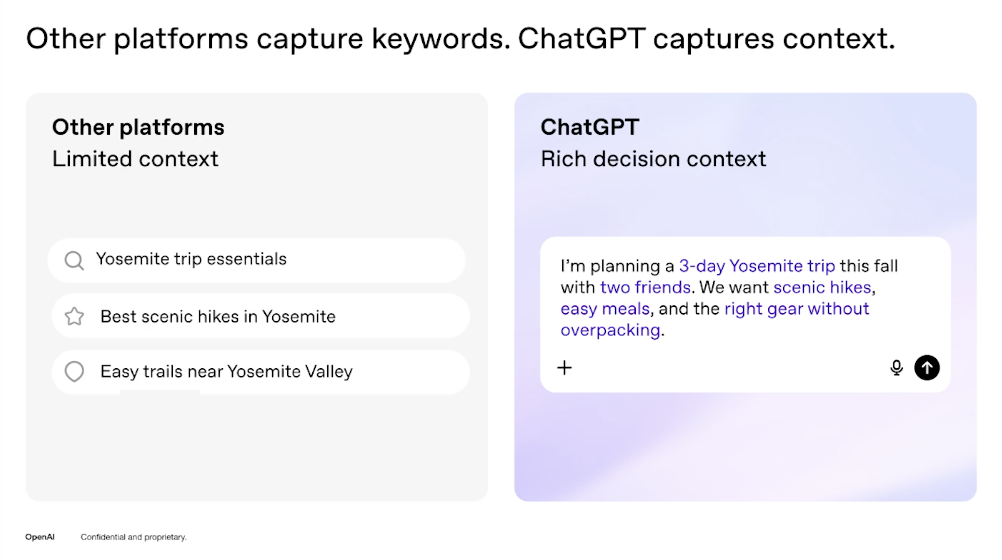
The reason this works is the shape of the input. A search box gets a keyword. ChatGPT gets the whole brief: who you are travelling with, what you are trying to achieve, what your constraints are. OpenAI's own comparison sets three separate Yosemite searches against one sentence that carries the trip length, the group size, the activities and the budget worry in a single breath. Every one of those is a targeting signal that a keyword never captures.
OpenAI calls the effect collapsing the consideration layer: six stages of a hiking boot purchase that used to be spread across review sites, forums, retailer pages and a friend's opinion, compressed into one conversation a brand can contribute to at any point.
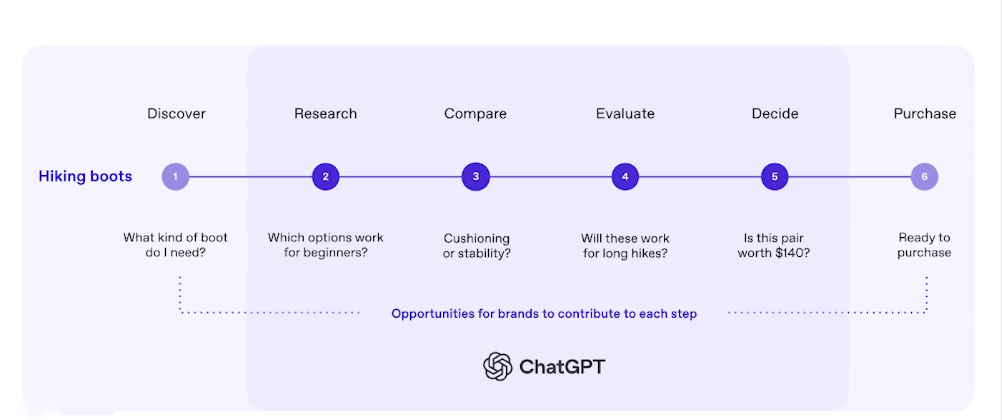
That is closer to retargeting against an intent graph than to keyword or contextual matching, and it has three consequences.
First, your ad has to work out of context. It may surface in a conversation with nothing to do with your category, which puts unusual weight on a very small creative unit.
Second, the consideration window compresses, then persists. Research that took weeks now happens in one conversation. But the intent signal outlives that conversation.
Third, attribution gets harder. A click arriving two weeks after the research, from a conversation about something else, will not resemble anything in your existing channel model.
The Numbers, Honestly
Two bodies of evidence point in opposite directions, and both are worth knowing.
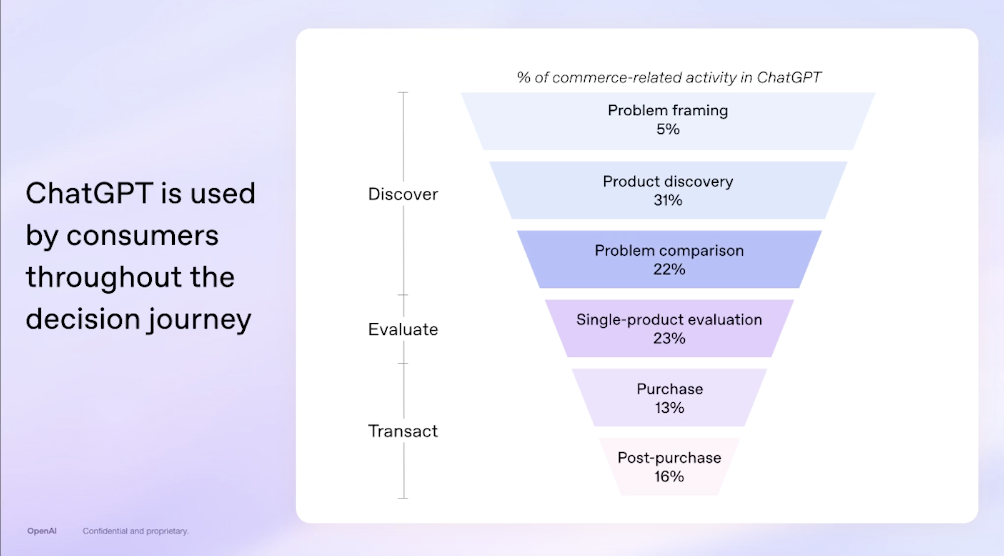
Start with where ChatGPT actually sits in a purchase. OpenAI's own breakdown of commerce-related activity on the platform puts product discovery at 31%, single-product evaluation at 23% and product comparison at 22%, against 13% for purchase itself. Treat those as indicative rather than exact, since the categories it lists add up to more than 100%, but the shape is the point: the heaviest use is in the middle of the funnel, where consideration happens, not at the transaction. Which is precisely where a product feed ad can do something useful, and precisely where attribution is hardest.
The encouraging side. Adobe, analysing over a trillion visits to US retail sites, put AI-referred traffic up 138% year on year in May 2026 and roughly 14x above its October 2024 baseline. That traffic converted 54% better than non-AI traffic and delivered 53% higher revenue per visit, a reversal from a year earlier when it converted about half as well. Shopify's Q1 2026 first-party data agrees: AI-referred orders up nearly 13x, 14% higher average order value, conversion roughly 50% above organic search on product detail pages.
On advertising specifically, OpenAI has begun putting names to results. Newegg reported 3x return on ad spend across campaigns over a 28-day period, and 7x during its two-week Fantastech Sale. The most useful of the quotes it published came from Garima Singh, Senior Manager of Paid AI Media at VistaPrint, who said "the majority of traffic ChatGPT drove was new visitors," which is a claim about incrementality rather than volume.
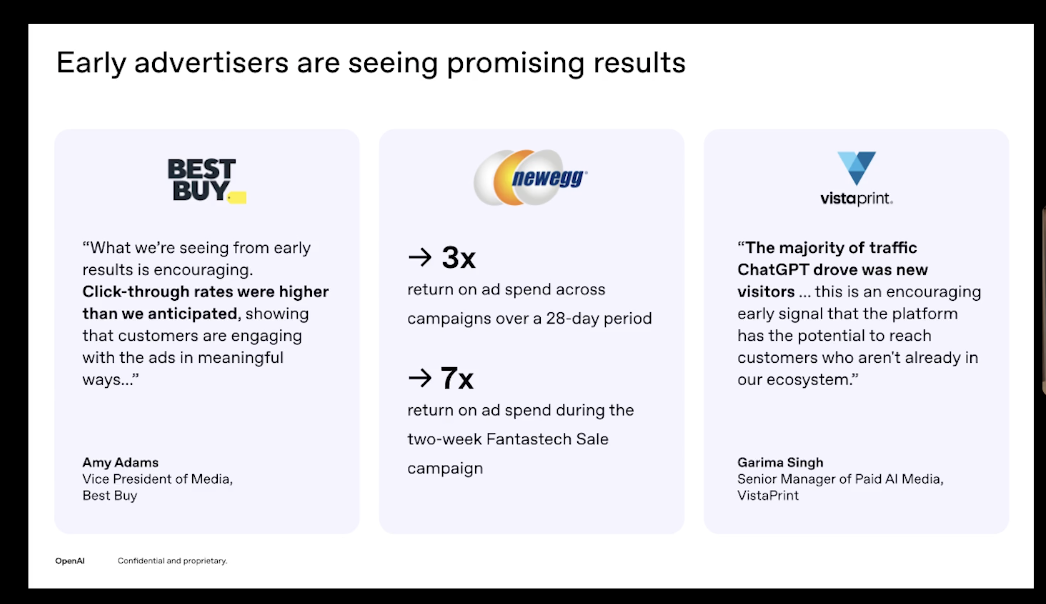
The sceptical side. Those figures were presented by OpenAI at its own sales webinar, with no methodology attached, and they are the wins rather than the average. eMarketer's August assessment was that the ad infrastructure remains basic next to Google and Meta, with underdeveloped performance insights, and advised advertisers to press for real ROAS proof. Its forecast still puts the entire US standalone-chatbot ad market below $1 billion in 2026, against OpenAI's $2.5 billion US projection. On the organic side, Contentsquare put AI-referred traffic at 0.2% of total visits in 2025; that figure is dated in a fast-growing channel, but Shopify is still blunt that organic search refers more sessions than all AI platforms combined.
One widely quoted criticism deserves a closer look, because it is usually read backwards. An SE Ranking study of 50,006 commercial prompts found 14.35% of ads scored no more semantically related to their own query than to a randomly paired one. On the design described above, some share of those are the system working exactly as intended: an ad matched to the person rather than the prompt is supposed to look unrelated to the prompt. The real problem is that a semantic-similarity test cannot tell a well-targeted intent-graph ad from a badly targeted one, and neither can you. Until OpenAI reports on the intent match rather than the query match, roughly one ad in seven is unauditable from the outside. That is a transparency gap, not a relevance failure, and it is the version of this criticism worth taking to a media meeting.
There is also a shopper-side risk that will never show up in a performance dashboard. Asked in January 2026, 63% of US adults said ads appearing in AI search results would make them trust those results less. If that holds, part of the cost of being in the answer is paid in how the answer itself is received, and no advertiser gets a report on that. It is also the stated reason Perplexity walked away from advertising entirely.
Read that as a channel that has graduated from experiment to genuine test line, with intent quality that looks excellent and measurement that does not yet let you prove it.
Fix These Three Before You Spend
Entry cost is low right now, $25 a day minimum in the US plus a $500 credit. But before you fund anything:
- Audit your feed attributes. Material, colour, size, gender, age group, GTIN, review count, star rating. You cannot be matched on an attribute you have not published, and the same data drives both your ads and your organic recommendations.
- Fix product page machine-readability. Adobe scores retail product pages at 66%, the worst of any template type, and that is the page AI assistants most need to parse.
- Close the attribution gap. Roughly 70% of AI-origin traffic lands in analytics as Direct. Run OpenAI's pixel and Conversions API together, and widen your lookback window.
The same work pays off in Google AI Mode, Copilot and Rufus, which is why it is worth doing whatever happens to ChatGPT ads.
Four Things To Do Now
1. Treat Your Product Feed As The Ranking Asset, Not Just An Ad Input
The checklist above covers the feed hygiene. Here is the part that is easy to miss: the same file decides your organic visibility, and two of the signals it feeds are not marketing decisions at all.
OpenAI says product selection draws on "structured metadata from first-party and third-party providers (e.g., price, product description) and other third-party content," and that when ranking merchants for a product it weighs "availability, price, quality, and whether they are the maker or primary seller."
Note what two of those four are. Availability and price are operational outputs, not marketing copy, and they are only ever as accurate as the systems behind them. That is the moment order and inventory accuracy and centralised pricing across storefronts stop being back-office concerns and start deciding whether you get recommended at all. No ranking algorithm is documented, so be sceptical of anyone selling you ChatGPT ranking factors, but the direction is not in dispute: a shopper asking for "a machine-washable wool coat for a winter wedding" is describing attributes, and you cannot be matched on one you have not published.
The page side of this is a platform property rather than a content task, which is the awkward part for marketing teams. Complete Product and Offer schema, specs and reviews server-rendered rather than JavaScript-injected, a deliberate decision on OAI-SearchBot and GPTBot in robots.txt, and a view on whether llms.txt belongs in your setup. You cannot write your way out of a client-side-rendered product page, which is why SEO and AEO optimisation belongs in the platform rather than in a plugin.
2. Use Your First-Party Lists As The Targeting Layer You Do Not Otherwise Get
Custom audiences landed in July 2026 and are the most underrated part of the release. You can upload email and phone lists, include or exclude them at campaign level, and adjust bids on matched users. Three things worth doing on day one: suppress existing customers so you are not paying to reacquire people who already buy from you, bid up on your high-value cohorts, and build a lapsed-buyer list for reactivation.
Given the delivery skew and the complete absence of demographic targeting, this is the only lever that shapes who actually sees you. It is the difference between buying reach and buying an audience.
3. Size The Test Properly And Instrument It
At $25 a day plus the $500 credit, entry cost is trivial. Run feed campaigns against high-intent, well-attributed categories, hold a control, and judge on first-party conversion data rather than platform reporting.
Instrument it before you launch, not after. Run OpenAI's pixel and Conversions API together, preserving the oppref click reference so events deduplicate, and expect platform totals to disagree with your analytics: OpenAI concedes this and notes reported conversions may include modelled estimates. Allow for the 24 to 48 hour attribution lag, the two-week feed expiry, and a lookback window wider than you would normally set, given that the click can arrive weeks after the research. Test creative that stands alone, since it may appear beside an unrelated conversation.
4. Do Not Build A ChatGPT Strategy. Build A Machine-Readable Commerce Strategy
Google said in May 2026 that AI Mode had passed one billion monthly users, with queries more than doubling every quarter since launch, and ads now appear on 29.45% of commercial AI Mode queries. Microsoft has pushed Copilot Checkout catalogue coverage past 500,000 merchants. Amazon made sponsored prompt placements in Rufus generally available in the US in March. Perplexity abandoned advertising altogether, citing user trust. The platforms will keep changing their minds. Your feed quality, schema coverage and conversion experience transfer across all of them.
The Point
OpenAI has made your product catalogue the input to both paid placement and organic recommendation, and it publishes a spec telling you what good looks like. It has also told you, plainly, that it is building an intent graph and matching ads to people rather than prompts.
Merchants who treat that as a data-quality project will be ready when the volume arrives, and will show up better in Google, Copilot and Rufus in the meantime. Merchants who treat it purely as a media buy will run a thin test against an immature format, get a disappointing number, and conclude, wrongly, that there was nothing here.
If you are running this across several brands, regions or storefronts, the hard part is not the ad account. It is keeping one accurate, attribute-complete catalogue behind all of them. That is the problem Core dna is built for in multi-brand retail, and it is worth a look before the next platform changes its mind again.
If ChatGPT is going to read your catalogue, it may as well help you build the site around it. Inside enterprise guardrails.
Summarize with