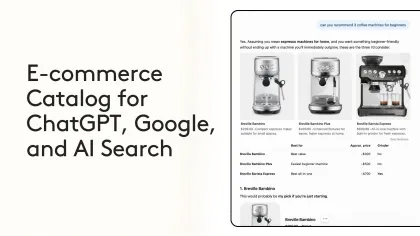

Sorry, we have bad news.
You can't control what ChatGPT tells shoppers about your prices, and nothing you publish guarantees the answer. What you can control is most of what the answer is built from.
Ahead of Black Friday, we ran a test to see whether brands can trust AI answers like ChatGPT's with their prices and products. It's a question worth answering before the biggest sale of the year: 1 in 5 Australian online shoppers already use AI tools when shopping, and 57% of those who don't say they may start within the next year, according to research by Commerce and PayPal Australia.
On 7 October 2026 we asked ChatGPT where 20 popular Black Friday products were cheapest, twice each, and checked every answer against the retailer's own website.
It changed its answer for 14 of the 20, and when it recommended one of Australia's most-loved retailers, the price was wrong in 15 of 24 cases, even though the retailers' own pages were almost always right. The wrong numbers came from sites that copy retailers' prices and fall behind them.
How we ran the test
This is the second part of Core dna's AI Retail Readiness Study. In September we asked ChatGPT for the price of one product on the websites of 51 Australian retailers, and it got 43 right (read the September findings). That showed ChatGPT can read a product page. It didn't show what happens when a shopper asks the question they actually ask before a sale, so this time we asked that.
- The question: "Where is the cheapest place to buy the [product] in Australia right now?"
- The products: 20 products Australians buy over Black Friday, fixed before we asked anything, across gaming, audio, tech, appliances, barbecues, beauty and gifts.
- The set-up: each product asked twice, in two new chats, from an Australian connection on a free ChatGPT account with memory turned off. Most people use the free version: OpenAI reported more than 50 million paying consumer subscribers and 900 million weekly users in February 2026 (Digital Information World).
- The check: the same day, we opened the store and price each answer recommended, along with the main competitors for that product category.
- The retailers: we compared the answers against the 70 retailers in Power Retail's Most Loved Retailers Report 2025, the same sample as September, to see how the best-known names fared.
Nine recommendations named stores we couldn't open or didn't reach. They're left out of the counts, not counted as right or wrong.
Which retailers ChatGPT sends shoppers to
The answers are dominated by Australia's best-known retailers. 39 of the 40 answers named at least one of the 70 retailers in Power Retail's report, and 22 different ones appeared across the study. 25 of the 40 answers recommended one of them as the cheapest place to buy.
| Retailer | Answers that named it (of 40) | Answers that recommended it |
|---|---|---|
| JB Hi-Fi | 20 | 1 |
| Big W | 17 | 5 |
| Officeworks | 13 | 7 |
| The Good Guys | 12 | 1 |
| Myer | 12 | 3 |
| Harvey Norman | 7 | 1 |
| Kogan | 6 | 4 |
| Chemist Warehouse | 4 | 2 |
The gap between those two columns is the number to watch. JB Hi-Fi appeared in half the answers and was the recommended store once. Officeworks appeared in 13 and was recommended in seven. Only the recommendation sends the shopper to your site, so a mention in the comparison is a weaker result than it looks in a visibility report.
The other 15 recommendations went to stores outside the 70, including Amazon Australia and a long tail of smaller online and specialist stores. Some stores with the lowest price we found were left out altogether. Amazon Australia had the Garmin Forerunner 265 at $499, and neither Garmin answer mentioned it. Target had the PlayStation 5 Digital Edition at $849, the lowest price we checked, and the one answer that listed Target recommended a different store.
For 14 of the 20 products, asking the same question a second time, minutes later, returned a different store or a different price. Only six held: the Switch 2 Pro Controller, Google TV Streamer, Garmin Forerunner 265, Weber Q2000N, Estée Lauder serum and LEGO Orchid. Two of those six gave the same wrong price both times.
The Kindle Paperwhite shows how far an answer can move. We asked a third time and got a third store.
| Ask | Store recommended | ChatGPT said | The store was charging |
|---|---|---|---|
| First | Officeworks | $257 | $297 |
| Second | Myer | $259 | $369 |
| Third | JB Hi-Fi | $259 | $369 |
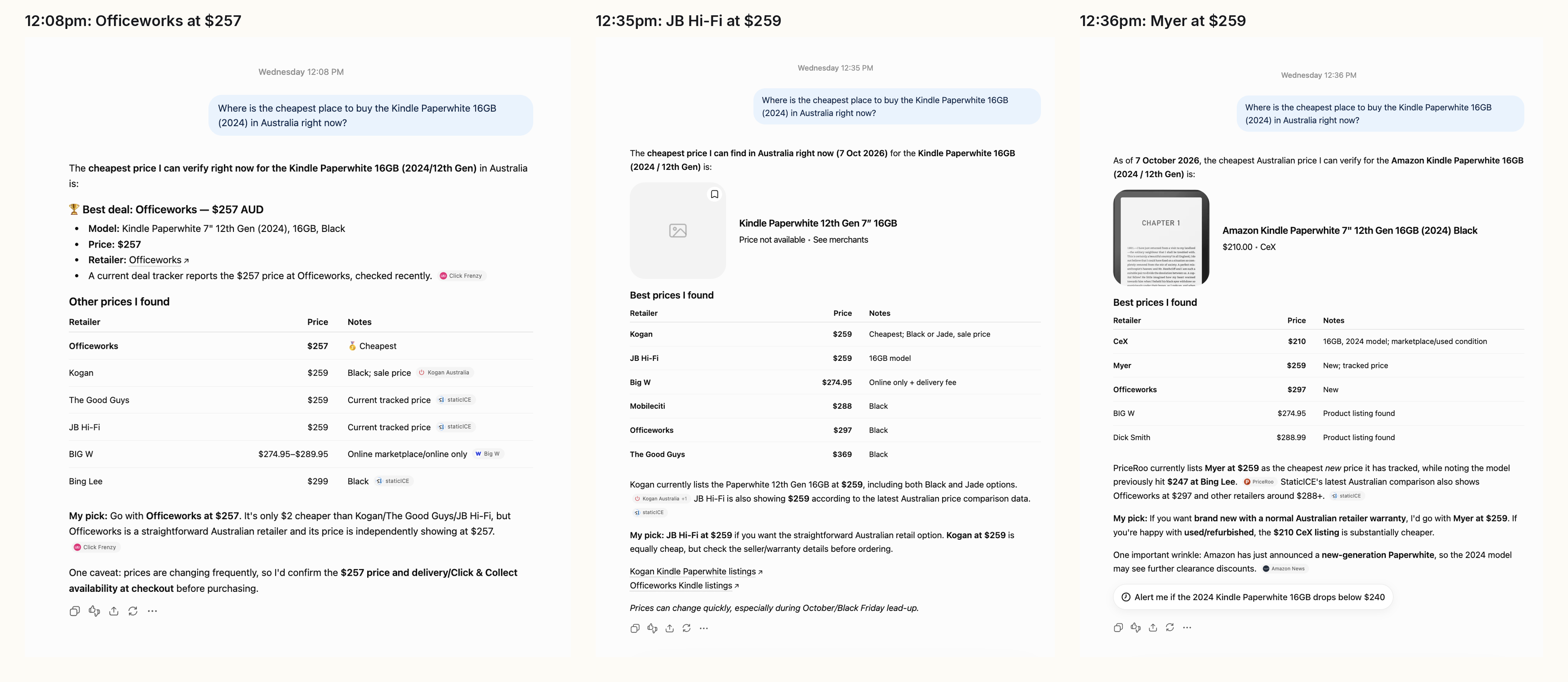
That's why one check isn't enough. A rank tracker checks one result and records it. A shopper who asks ChatGPT gets one of several possible answers, so your numbers need to come from many asks of the same question.
When ChatGPT recommended a top retailer, the price was usually wrong
In the 24 recommendations of a top-70 retailer we could check, the price was wrong 15 times. In 14 of the 15, the retailer's own page showed the product at a different price. In the other, the store ChatGPT named, Big W, doesn't sell the product itself, and only marketplace sellers on its site do.
These are the same retailers ChatGPT priced correctly in September. Officeworks, Big W, Myer, JB Hi-Fi, Harvey Norman, David Jones and Chemist Warehouse all got the right price when we asked about their own product page, and all were misquoted at least once when we asked where to buy. The Weber Q2000N barbecue shows the difference on one product. In September, asked for its price at BCF, ChatGPT gave the exact sale price, the end date and the product code. In October, asked where it was cheapest, it named Myer at $458.15, twice, and Myer was charging $539.
| Product | ChatGPT recommended | The store was charging | Lowest price we found |
|---|---|---|---|
| Garmin Forerunner 265 | Kogan, $479 (both answers) | $797 | Amazon Australia, $499 |
| Dyson V8 Advanced | David Jones, $377 | $649 | Harvey Norman, $499 |
| Kindle Paperwhite 16GB | Myer, $259 | $369 | Kogan, $269 |
| Ninja Foodi Dual Zone AF300 | JB Hi-Fi, $127 | $249 | Amazon Australia, $239 |
| Meta Quest 3S 128GB | Harvey Norman, $478 | $568 | Amazon Australia and Harvey Norman, $568 |
| Weber Q2000N | Myer, $458.15 (both answers) | $539 | Myer and BCF, $539 |
Every wrong recommendation was too low. In each case, ChatGPT quoted a lower price than the store was charging. That follows from the question. When the sources disagree and the shopper asks for the cheapest, the lowest number wins, and the lowest number is usually the out-of-date one: an expired sale, a members' price or a different model.
Stores it didn't recommend were listed above their real price. JB Hi-Fi was selling the JBL Flip 7 on sale for $149, and both answers listed it at $179, the price from before the sale. JB Hi-Fi's Breville Barista Express was listed at $699 while it was on sale for $649.
Following the recommendation would have cost a shopper up to $298 more than the cheapest price we found, on the Garmin. Most shoppers will click through and see the real price before they pay. If you're the recommended store, that means a visit from someone expecting a price you don't charge. If you're left out, or listed above your real price, it means no visit at all.
We can't see inside ChatGPT, but the answers usually show their sources, and the wrong prices follow them. The retailers' own pages were right in almost every case we checked. The answers took their numbers from somewhere else.
| Where the number came from | What we saw |
|---|---|
| Price-comparison sites | staticICE, BuyWisely, PriceRoo and Getprice were cited across the answers. One recommended a Ninja air fryer at $169 from BuyWisely data it said was last updated on 9 September, four weeks earlier. |
| Deal trackers and deal articles | Click Frenzy and a News.com.au deal story were cited for prices. The Meta Quest 3S was recommended at Harvey Norman for $478 from a PriceRoo deal seen on 30 September, and Harvey Norman was charging $568. |
| Members' prices | Kogan First and EB Games PLUS prices were quoted as the price, with no mention that they need a paid membership. |
| Marketplace sellers | Big W was recommended for Sony headphones it doesn't sell itself, only marketplace sellers on its site do. |
| The wrong product | The AirTag 4 pack recommended at UMart for $129 was the first-generation model. We asked for the second generation. |
| Two prices in one answer | CeraVe at Chemist Warehouse was $16.99 in the text and $27.99 on the product card in the same answer. |
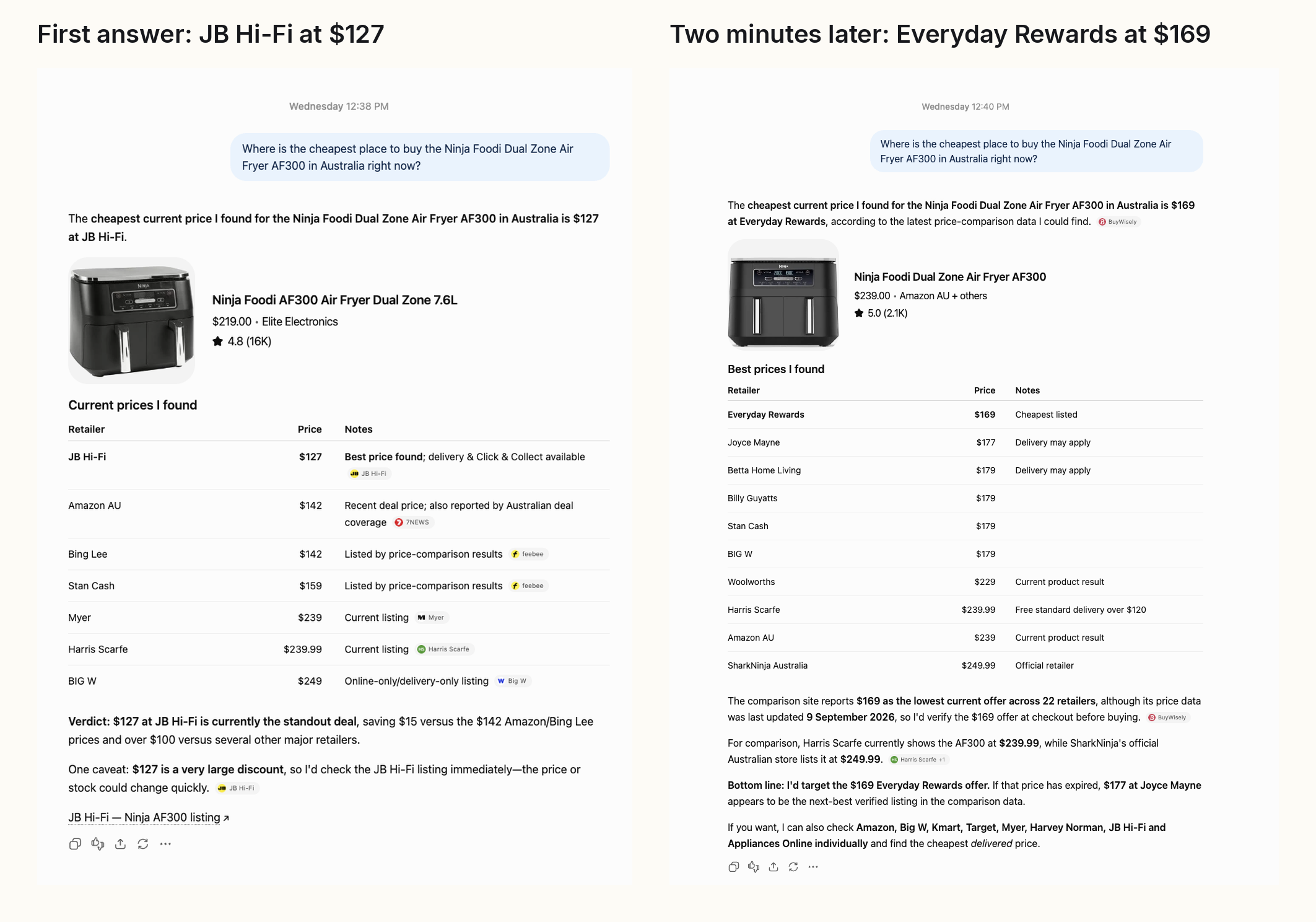
September pointed the same way. When ChatGPT was asked about a single retailer and took the price from a comparison site in place of the product page, the price was wrong every time we could check it.
The Sony WH-1000XM6 in ChatGPT and in Google
The Sony WH-1000XM6 headphones show how much the source matters. On 7 October we asked ChatGPT twice where they were cheapest, and asked Google the same question.
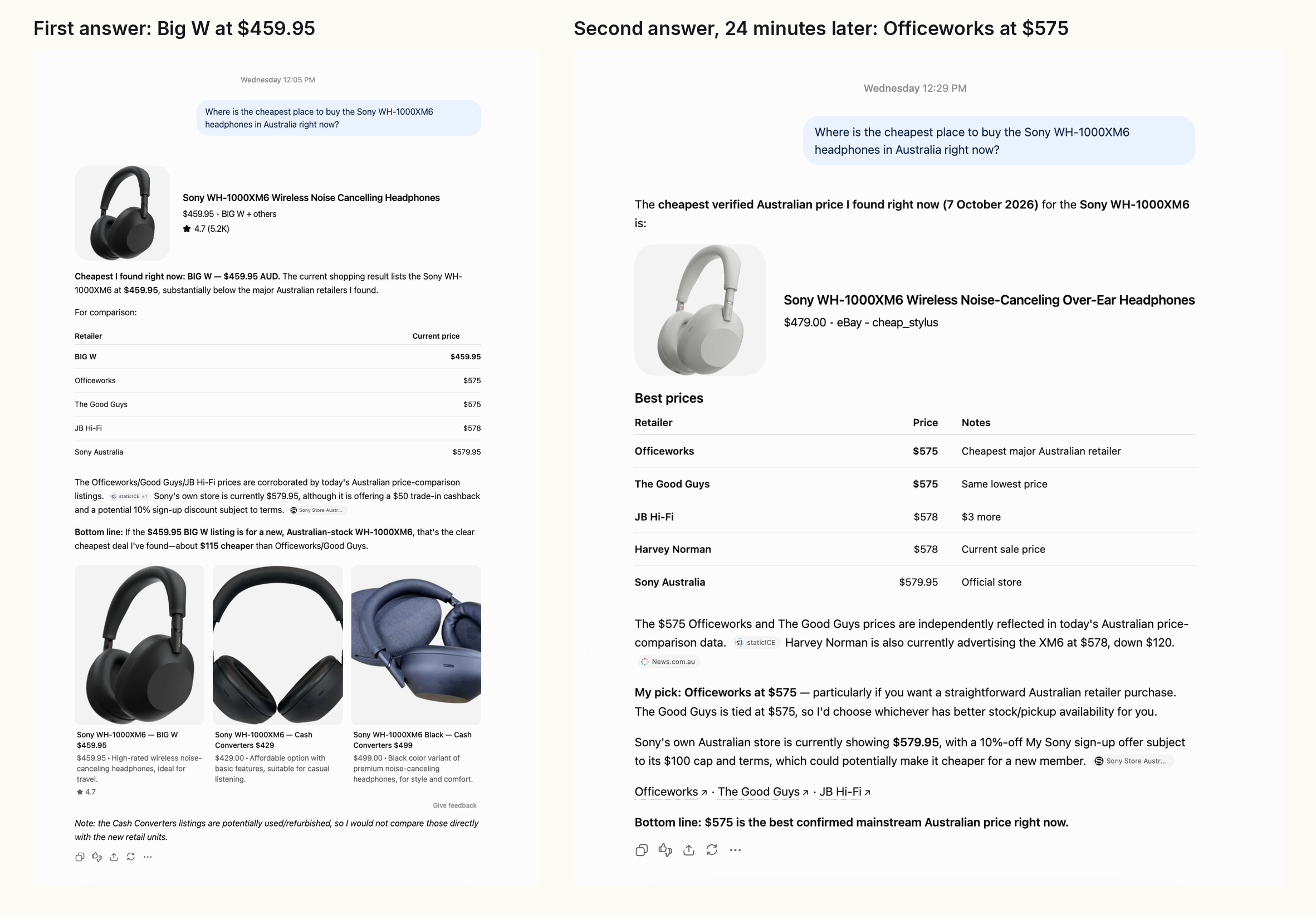
- ChatGPT, first answer: Big W at $459.95. Big W doesn't sell these headphones itself. Marketplace sellers on its site do, and the cheapest was $474.95 plus delivery when we checked.
- ChatGPT, second answer: Officeworks at $575, with JB Hi-Fi and Harvey Norman at $578, citing a News.com.au deal story. That day Officeworks was charging $697, and JB Hi-Fi and Harvey Norman $698.
- Google's AI Overview: "online discount retailers like Kogan and Getprice aggregators", from around $489, with The Good Guys, JB Hi-Fi and Sony's own store between $575 and $579.95. The only source card it showed was Getprice, a price-comparison site.
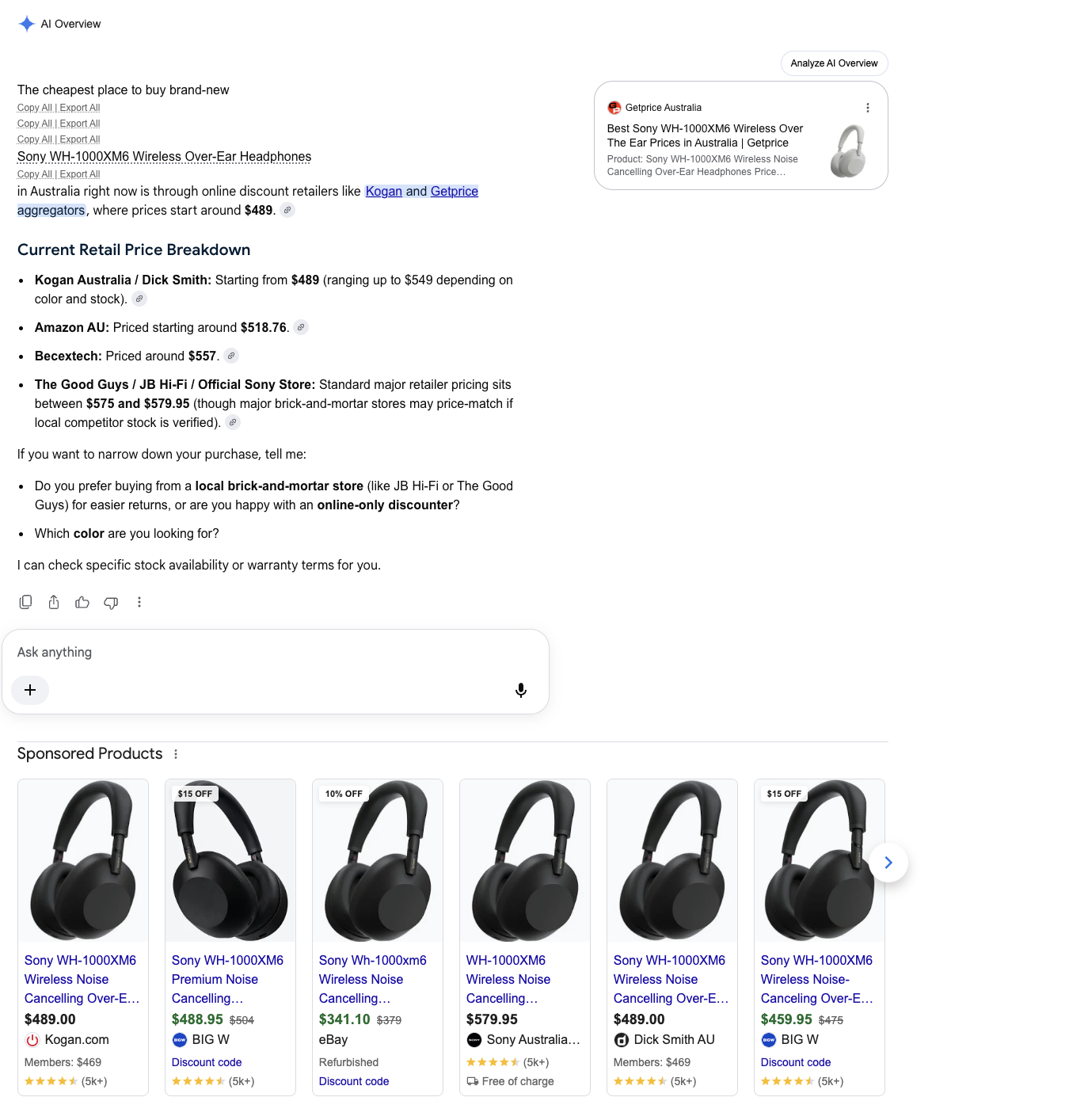
Directly under Google's AI Overview, the sponsored product listings showed prices from retailers' own product feeds: Kogan and Dick Smith at $489 ($469 for members), Sony Australia at $579.95, and two Big W listings at $488.95 and $459.95, each $15 off with a discount code. The AI Overview mentioned Kogan and Dick Smith and left Big W out.
The $459.95 Big W listing matches the price ChatGPT gave in its first answer. $474.95 less a $15 code is $459.95, so the number ChatGPT presented as Big W's price appears to be a marketplace seller's price after a discount code, and the answer mentioned neither condition. Both assistants also put JB Hi-Fi in the $575 to $579 range on a day it was charging $698.
So for one pair of headphones, on one day, a shopper could have been told the cheapest place was Big W, Officeworks or Kogan, depending on which assistant they asked and which answer they got. Each answer leaned on a different source: a marketplace listing, a deal article, a comparison site. One search on Google isn't a study, and we'll test Google with the same 20 products in Black Friday week. It does show the problem isn't limited to ChatGPT. An AI answer is only as current as the source it picks, and you don't get to choose which source that is.
What this means for your Black Friday marketing
Shoppers use the answer to decide where to go, then buy on the retailer's own site. Only 4% want AI involved at checkout, according to the same Commerce and PayPal Australia research, so your site is where they find out whether the answer was right.
Your sale price may not be the price in the answer
Sale prices reach your own site first. Comparison sites, deal trackers and marketplace listings catch up later, and some hold onto old prices for weeks. In September, product pages running a promotion were wrong more than twice as often as pages without one, eight of 38 against two of 25. Black Friday puts most of a range on promotion, changes prices daily and ends offers at short notice, so the gap between your price and the answer's price is likely to be widest in the week that matters most.
A wrong price costs you in two ways
If ChatGPT names you at a price you don't charge, the shopper arrives expecting it. That turns into a price-match request, a live chat complaint or an abandoned cart, and the shopper blames you as much as the chatbot. If it lists you above your real price, or leaves you out, the shopper never visits, and the loss doesn't show up in your analytics at all.
Members' offers leak into public answers
If you run member pricing over Black Friday, expect some answers to present it as the price everyone pays, as they did with Kogan First and EB Games PLUS in our test.
Your paid listing and the AI answer can disagree
In the Google example, the sponsored listings came from retailers' own product feeds, and the AI Overview above them leaned on a comparison site. You can be paying to show your price in the ad while the answer at the top of the page quotes a different one, or leaves you out.
What to do before Black Friday
AI answers behave like earned media. You can't buy or write the result, but you can shape the sources it draws on and measure what it says. Start with the measuring, because it tells you which sources to fix.
Measure four things
| Measure | What it tells you | How to count it |
|---|---|---|
| Named rate | How often you appear in the answer at all | Answers that mention you, divided by answers asked |
| Recommended rate | How often you are the store the shopper is sent to | Answers that recommend you, divided by answers asked |
| Price accuracy | Whether the answer quotes what you actually charge | Correct prices quoted for you, divided by all prices quoted for you |
| Source mix | Where the answer got your price | The source cited next to your price: your site, a comparison site, a deal article or a marketplace |
Pick 10 to 20 hero products for the sale. Ask ChatGPT and Google where each one is cheapest, three times each in new chats, on a free account, and record the four measures. Do it weekly until the sale and daily in sale week. Our 15 copy-and-paste prompts are a ready-made starting set, and How do you measure AI visibility? covers tracking over time.
The named rate on its own can mislead. In our test JB Hi-Fi was named in 20 of 40 answers and recommended in one, and when it was listed, its sale prices were often shown at the price from before the sale.
Your Black Friday timeline
| When | What | Who |
|---|---|---|
| Now (October) | Run a baseline on your hero products using the four measures. List every site the answers cite for your prices. | Marketing |
| Early November | Brief deals to publishers with end dates and member conditions. Put feed and comparison-listing updates into the promotion calendar, each with an owner. Check that any bot protection planned for peak still lets AI agents reach product pages. | Marketing with eCommerce |
| From 20 November | Brief customer service and store teams on AI-quoted prices and your price-match policy. Re-run the baseline. | Marketing with service teams |
| Launch day | Once sale prices are live, check your feeds, comparison listings and AI answers for your hero products. | eCommerce and marketing |
| Mid-week to Cyber Monday (30 November) | Re-run the questions every day. Fix any source still showing an old price or a members' price as the public price. | Marketing |
| After the sale | Check that expired deals and sale prices are gone everywhere they were published. | Marketing with eCommerce |
What marketing controls
- Member and code prices. On the page, in feeds and in any deal you brief to publishers, the condition goes next to the price. Kogan First and EB Games PLUS prices were quoted in our test as the price everyone pays.
- End dates on every deal you brief out. Deal articles and trackers keep quoting a sale after it finishes. A dated offer is easier for a reader, and for anything summarising the page, to recognise as expired.
- Marketplace listings. If you sell through a marketplace, make the seller name and any conditions clear in the listing and the feed. ChatGPT presented a marketplace seller's price as Big W's own.
- Your front line. Expect "ChatGPT said it was cheaper" in chat, in store and in price-match requests, and agree the policy before the sale starts.
What marketing can influence, with the eCommerce team
- Comparison sites. If you supply a feed to a comparison or shopping site, find out how often it pulls the feed, and make sure sale prices reach it the moment they go live. If you don't supply one, check what those sites show for your hero products on launch day, because they're quoting you anyway.
- Feed timing. Every sale start and end date in the promotion calendar should include the moment your feeds and comparison listings change. Product Feed Optimization for AI Shopping covers the data work behind it, and Do I need a separate product feed for ChatGPT? answers the most common question about it.
- Product naming. Model, generation and variant belong in the title and the product data. The AirTag answer recommended the first-generation pack to a shopper who asked for the second generation.
- Access to your pages. In September, one reason ChatGPT turned to third-party sources was that it couldn't use the retailer's own page. If bot protection is tightened for peak, check it still lets verified AI agents through to product pages.
What nobody controls
Which source an answer picks, whether the answer changes when someone asks again, and whether an AI Overview uses your feed or a comparison site. That's why the measuring has to continue through sale week.
For why ChatGPT quotes the wrong price in the first place, and what the September study found about product pages, schema and stock, read We checked what ChatGPT tells shoppers about 51 retailers.
All of this depends on the price being the same everywhere it's published: the product page, the feeds, the comparison listings and the emails. That's an operational question as much as a marketing one, and it's how Core dna's eCommerce platform is built, with one source that the site, the storefronts and the feeds all read from. For groups running several brands, it's a platform decision.
ChatGPT and Black Friday prices: FAQ
On 7 October 2026 Core dna asked ChatGPT where 20 popular Black Friday products were cheapest in Australia, twice each. 39 of the 40 answers named at least one of the 70 retailers in Power Retail's Most Loved Retailers Report 2025, and 25 recommended one of them as the cheapest place to buy. Officeworks was recommended in seven answers, Big W in five and Kogan in four.
Being named and being recommended were different results. JB Hi-Fi appeared in 20 of the 40 answers and was the recommended store in one. When ChatGPT did recommend one of the 70, the price it gave was wrong in 15 of the 24 cases we could check. The full results are in our October findings.
When Core dna asked ChatGPT where products were cheapest, the answers cited price-comparison sites such as staticICE, BuyWisely, PriceRoo and Getprice, deal trackers such as Click Frenzy, and news deal articles. One answer used comparison data it said was last updated four weeks earlier. These sources lag behind the retailer's own site, especially when a sale starts or ends.
Asked about a single retailer's product page, ChatGPT is far more accurate: it gave the right price for 43 of 51 retailers in our September test. The problem shows up when it has to compare stores. See our September findings for why ChatGPT shows the wrong price for products.
Each new chat can run a fresh search and draw on different sources, so the same question can return a different store or price minutes later. In Core dna's October 2026 test, 14 of 20 products got a different answer on the second ask. The Kindle Paperwhite was recommended at Officeworks, then Myer, then JB Hi-Fi across three asks.
For retailers, this means a single check tells you very little. Track how often you are named and recommended across several asks of the same question, and at what price. How do you measure AI visibility? covers what to record.
Not necessarily. Sponsored product listings come from retailers' own product feeds, while an AI Overview can draw on other web sources. When Core dna searched for the cheapest Sony WH-1000XM6 headphones in Australia in October 2026, the AI Overview cited Getprice, a price-comparison site, and named Kogan and Dick Smith from around $489. The sponsored listings directly beneath it included a Big W listing at $459.95 with a discount code, which the overview didn't mention.
That was a single search, so treat it as an example. It shows why retailers should check the AI answer as well as their ads, and keep prices consistent across the product page, their feeds and the comparison sites that quote them.
Run a fixed set of prompts on a schedule and record what changed between runs. The before-and-after comparison is the measurement. A single result on a single day tells you very little, because answers vary between sessions.
Track three things: whether you appear at all, whether the facts in the answer are correct, and which source was cited. Tools such as PromptWatch and Profound monitor citation share across prompts over time, and Search Console still records impressions where AI surfaces are involved.
About this test
- Two runs per product, one day, one account, one assistant. 40 answers in total, plus a third Kindle ask that isn't in the counts. Prices change, and the figures describe what happened on 7 October 2026.
- "Cheapest" means the cheapest price we checked across the major retailers for each category, not every store in Australia.
- Marketplace and second-hand listings are excluded from "cheapest" unless ChatGPT presented them as the answer without saying so.
- The Google example is a single search on the same day, and is reported as an example, not a measured result.
About this study. The AI Retail Readiness Study was run by Core dna, an Australian composable digital experience platform with integrated CMS and commerce, used by retailers and multi-brand groups to run their product pages and storefronts.
Summarize with