
A retailer today might sell through multiple channels. That often looks like a website, a chain of stores, one or two marketplaces, and a growing number of AI assistants that answer shoppers before they ever reach a product page.
While adding those channels has become fairly easy, keeping important details like price, stock count, and customer records identical across all of them can be a struggle.
In fact, a 2026 benchmark of more than 400 specialty retailers found that only 7% had reached true unified commerce leadership. Meanwhile, 33% were still at the Basic level. Retailers in the top group reported twice the revenue growth of those lagging.
When products, prices, and stock numbers live in separate systems that rely on syncing to stay accurate, those systems can drift apart. This leads to different numbers across channels.
As the number of channels customers use to shop grows, those discrepancies may seem tiny at first but quickly lead to lost sales and frustrated customers. The solution is unified commerce. In this guide, we'll explain what unified commerce means, why it matters more today, and how brands can achieve it.
Keep prices and stock identical across your website, stores, and marketplaces. Book a demo with Core dna.
What Is Unified Commerce?
Unified commerce brings sales channels, processes, customer data, inventory, and back-end systems into one platform. A unified commerce platform is the software that holds that shared data and serves it to every channel, so each one works from a single source of truth.
Most definitions stop there, which leaves room for very different platforms to claim the label. For instance, a setup that connects a store, a point-of-sale (POS) system, a customer relationship management (CRM) platform, and an enterprise resource planning (ERP) solution through integrations can call itself unified. However, the data often sits in separate systems and moves between them on a schedule or through a connector.
Between syncs, the online price, the store price, and the price in a marketplace feed can disagree. So, when a store sells the last unit at 2 pm, the website still shows it in stock until the next sync, and when an online order comes in, it's for a product that no longer exists.
How Core dna Defines Unified Commerce
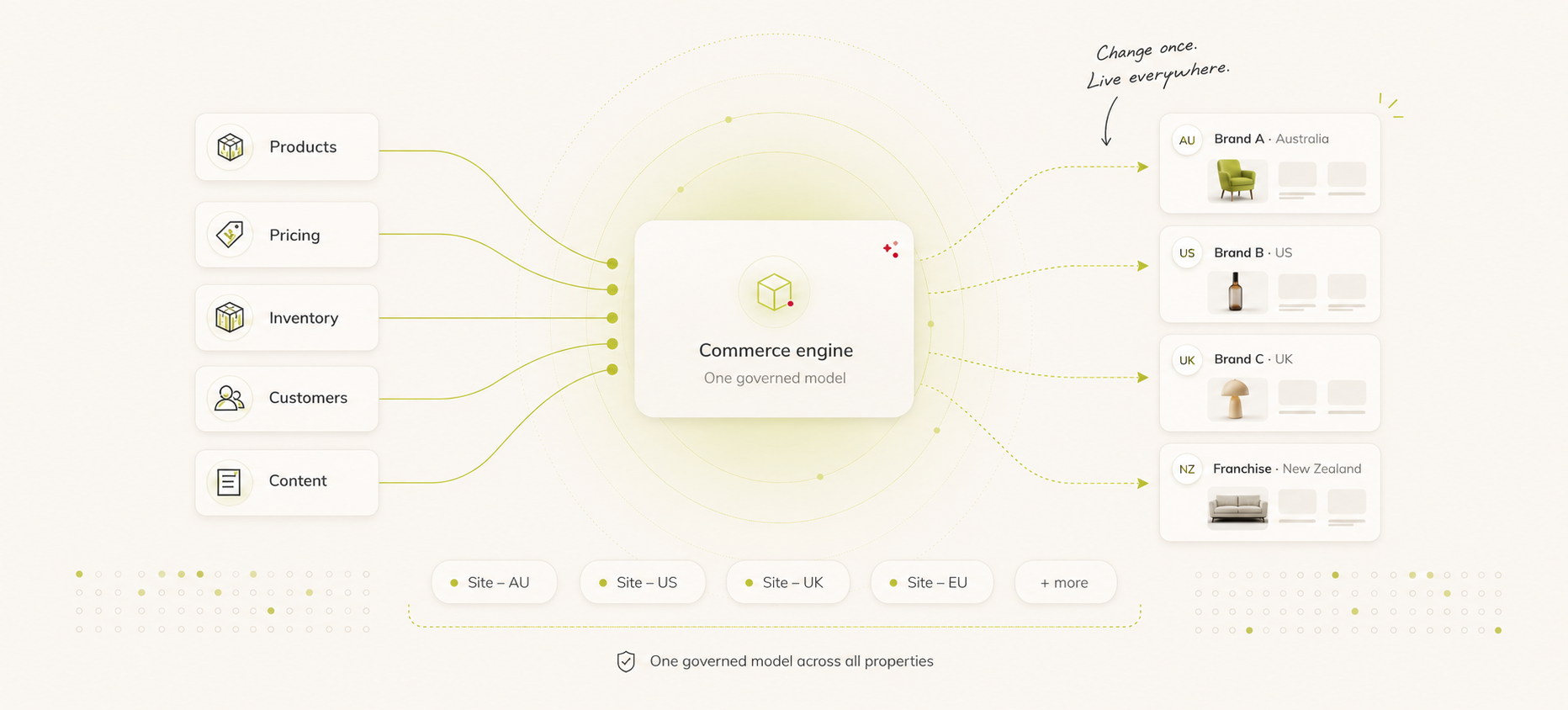
For us, integration alone doesn't make commerce unified. Instead, unified commerce means every storefront, store, brand, and business model runs on one record for products, prices, stock, orders, and customers, inside one platform, with no sync layer in between.
Some vendors also point to their own POS terminals as evidence of unified commerce. In reality, a POS terminal is just one more channel. It should read from the record and write back to it the same way a website or a B2B portal does, and owning the hardware doesn't guarantee that.
A vendor can sell both the terminal and the online store and still run them on separate databases that sync on a schedule, which leaves the store with the same window where prices and stock can disagree. What decides whether commerce is unified is where the record lives, not who makes the hardware.
Unified Commerce vs. Omnichannel
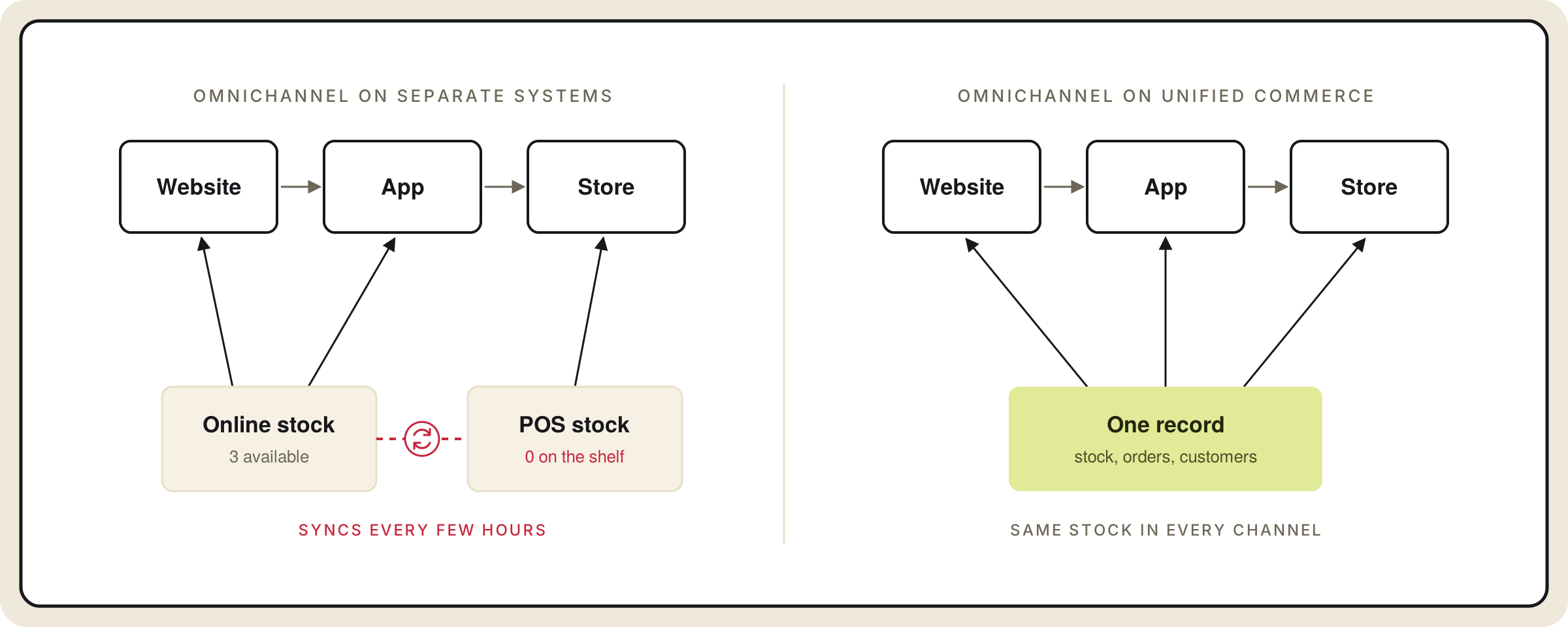 Unified commerce is often confused with omnichannel, since both promise shoppers a consistent experience across the website, the app, and the store. Omnichannel is about the journey, meaning a customer can move between channels and pick up where they left off. Unified commerce sits beneath that journey and decides whether every channel uses the same data.
Click and collect shows how the two can come apart. Offering it is an omnichannel decision. Whether the stock shown online matches what's on the shelf depends on the systems underneath. If store stock lives in a POS that syncs with the website every few hours, a shopper can order an item that sold out at lunchtime and arrive to find nothing to collect.
A retailer can run a convincing omnichannel experience on top of disconnected systems for a while. The cost shows up later in oversold stock, canceled orders, and staff hours spent reconciling one system against another.
Unified Commerce vs. Headless Commerce
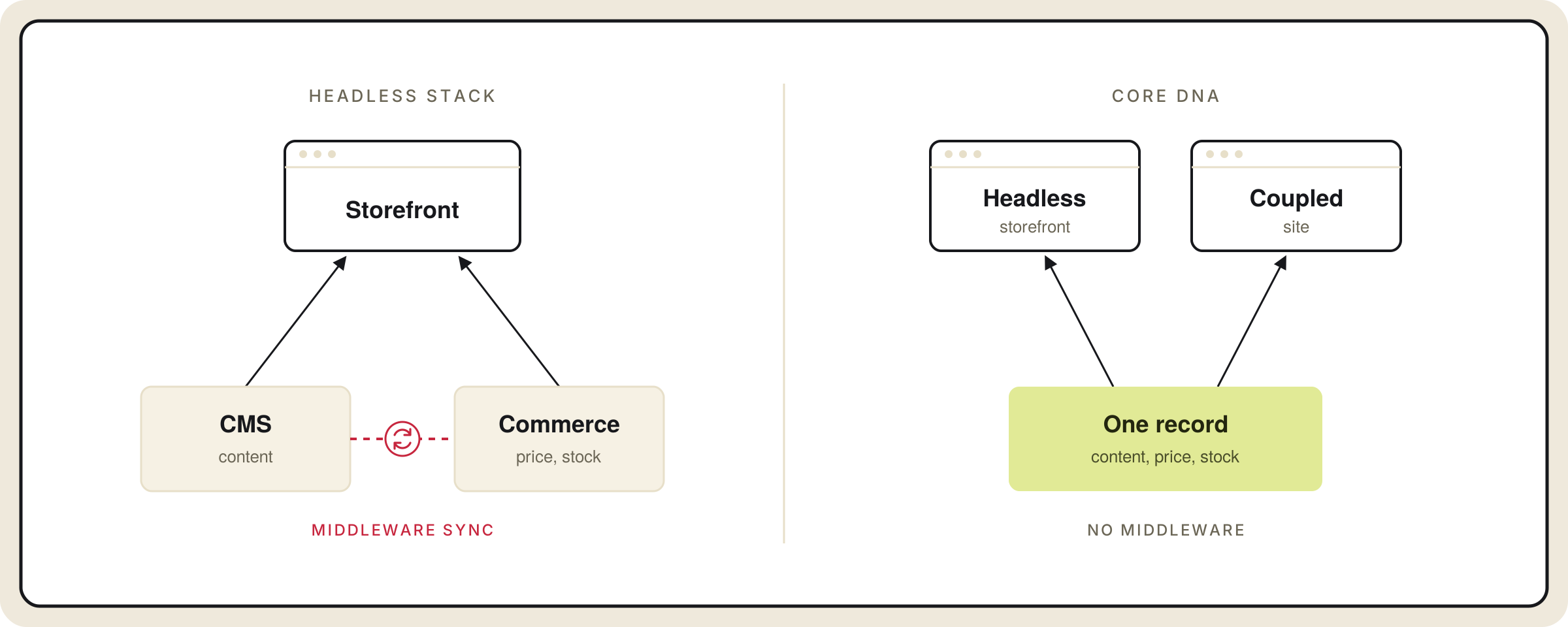
Headless commerce comes up in most platform evaluations alongside unified commerce, and buyers often assume a headless build is the connected, modern option. But headless describes how the storefront connects to the platform. It doesn't tell you where the storefront's data lives.
A headless setup separates the front end that customers see from the back end that manages products, prices, orders, and content. That separation lets developers build each storefront in a framework such as Next.js and change it without touching the back end. However, it says nothing about whether the back end is one system or several.
A common stack pairs a headless CMS for content with a separate commerce engine for products and pricing, then relies on middleware to keep them in step.
A product page pulls its description from the CMS and its price and stock from the commerce engine. When that middleware runs on a schedule, it creates the same sync window described earlier, and the page can promote a discount that the commerce engine has already ended. The site loads fast because the front end is light, while the data behind it is still split across systems.
Core dna runs content and commerce on one engine, so a product's description, price, and stock come from the same record. That record can be delivered headless or coupled from the same content model, so a brand can run a custom storefront for one market and a coupled site for another without adding a second system.
Marketers edit products and content in one place, and developers pull the same data through REST or GraphQL, with no middleware in between.
Where Unified Commerce Lives
Most guides treat unified commerce as physical retail plus ecommerce. But for many businesses, it covers more ground.
- B2B and B2C under one roof: A wholesale portal and a consumer storefront run from the same catalog, with pricing set per account, group, or category.
- Subscriptions and memberships: Sell recurring products and member access through the same customer record as one-off purchases.
- Learning and training: Courses, enrollments, and certificates sit on the same profile that holds orders and payments.
Running more than one storefront on separate systems? See how Core dna puts them on one record.
Types of Unified Commerce Platforms
Most platforms sold as unified commerce fall into one of four models, and the difference comes down to which functions the vendor builds into its own platform and which it connects from other systems through integrations. Knowing which model a vendor uses tells you where the sync windows will be before you sit through a demo.
| Platform + plugins | Suite | Composable | Single platform | |
|---|---|---|---|---|
| What is native | Commerce and point of sale | Commerce, CRM, data, content | A commerce engine exposed through APIs | Commerce, content, promotions, workflows, custom entities |
| Everything else | App marketplace | Bundled products with their own data models | Best-of-breed vendors connected through APIs and middleware | Built into the same platform |
| Data | Split across apps | Shared within the vendor ecosystem | Split across vendors, kept in step by an integration layer | One record |
| Cost pattern | License plus apps plus transaction fees | Large multi-product contract | Several vendor contracts plus an integrator build and ongoing upkeep | One platform contract |
| Trade-off | Fast to start, fragmented as you grow | Powerful, heavy to implement | Maximum choice, highest engineering overhead | Fewer vendors, less marketplace breadth |
The first three models each keep some data in more than one place, and that is where sync windows open as a retailer adds brands, stores, and channels. A single platform runs everything on one record, so the main thing to confirm is whether its built-in modules cover what your channels need.
For how specific vendors fit these models, see our comparison of the best unified commerce platforms.
Why Unified Commerce Matters Now
AI agents need one source of truth
Gartner expects 20% of digital commerce transactions to be executed through AI platforms, either through on-platform checkout or AI agents, by 2030. But an assistant doesn't check with the store before it answers. Whether a shopper asks ChatGPT what something costs or an agent buys on their behalf, the assistant builds its answer from whatever it can read about the product, including the product page, sale and category pages, feeds and comparison sites. When those sources disagree, it has to pick one.
As part of our AI Retail Readiness Study, we asked ChatGPT about a real product at 51 Australian retailers and checked every answer against the live product page. ChatGPT got the price right 43 times. Six answers were wrong, and we couldn't score two because the price changed during the day or the product was listed only on a US storefront. None of the six wrong prices came from the product page. Four came from the retailer's own sale, range, or collection pages, and two came from price comparison sites.
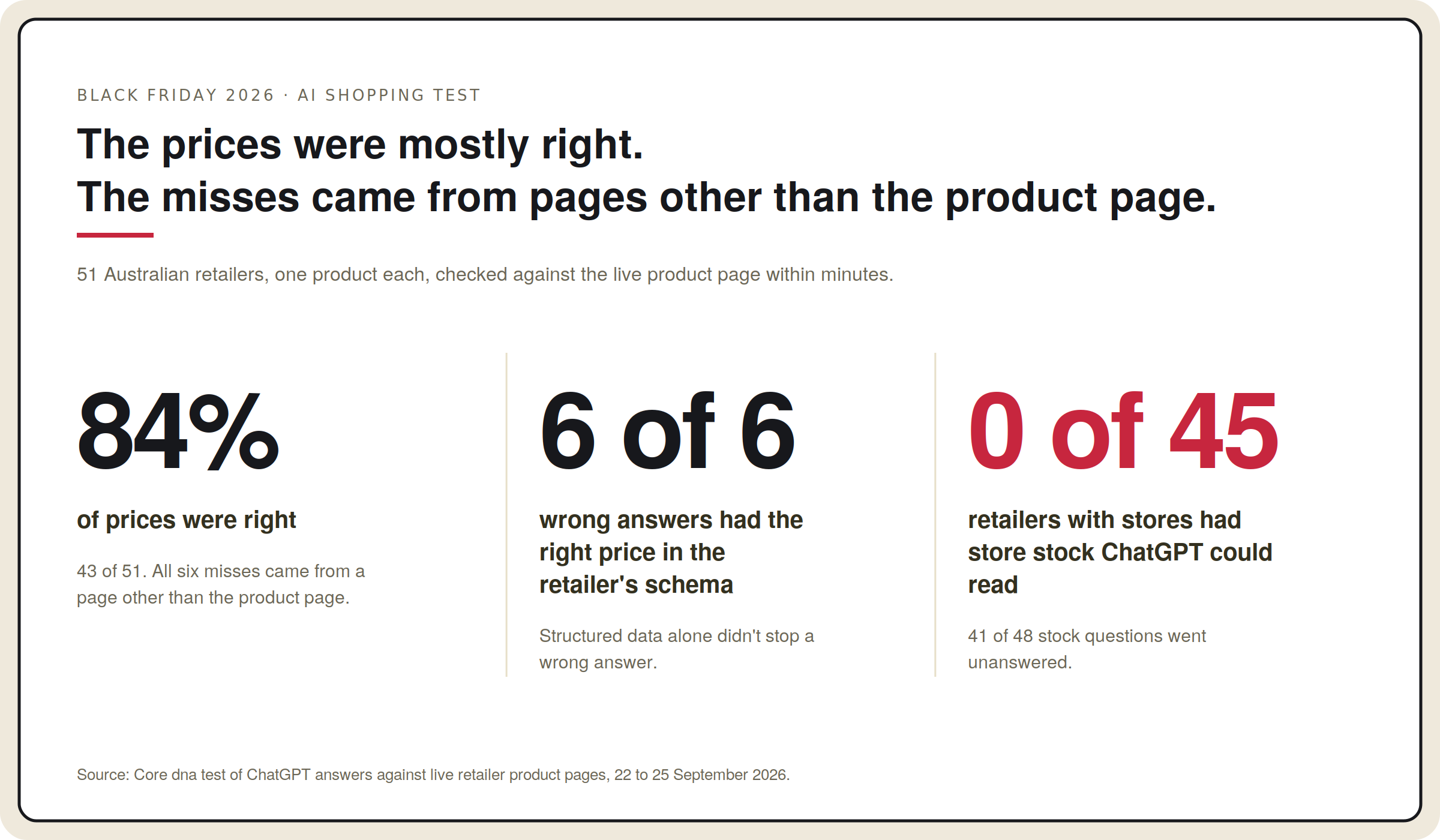
In those four cases, the retailer's site showed two prices for the same product, and ChatGPT picked the wrong one. When every page, feed, and storefront reads from one record, a price change reaches all of them at once, leaving an assistant with fewer conflicting versions to choose from.
Read More: What ChatGPT tells shoppers about 51 retailers
Separate systems depend on people remembering to update them
When the sale page, the collection page, and each marketplace or comparison feed hold their own copy of the price, you have to update every copy for every price change. That's manageable in a quiet week. During peak trading, prices can change on thousands of products within hours, and one missed sale page is enough to show an old price to shoppers and the assistants answering for them.
A stale listing can also linger long after the sale ends. Four days after our first check at Appliances Online, the product page had moved to $845, and ChatGPT was still quoting $742 from the retailer's old Birthday Sale listing, $103 below the real price.
If those pages and feeds read the price from the product record instead of storing their own copy, you only have to change the price once.
Shoppers cross channels before they buy
Shopping on marketplace apps is now almost as common as shopping on retailer websites in Australia, and 6 in 10 Australians already use AI. A shopper might find a product on a marketplace, ask an assistant about the price, then walk into a store, expecting the same answer at every step. In our study, three of the six wrong answers were lower than the real price. That shopper arrives expecting a price the till won't charge, which turns into a price-match request, a complaint, or an abandoned cart.
Business models keep expanding
As they grow, retailers add B2B portals, subscriptions, memberships, and staff training. When each new model needs its own system, the stack grows, and so does the work of reconciling one system against another. On the other hand, a platform that models these as part of the same record lets the business add them without starting another integration project.
Want B2B, subscriptions or training on the same platform as your store? Book a Core dna demo.
Benefits of Unified Commerce
Once every channel reads from one record, you no longer have to keep copies in sync, and the errors that come with it disappear.
- Consistent prices and stock for shoppers: A shopper sees the same price, stock, and order history on the website, in the store, and in an AI assistant's answer. That cuts the price-match requests and "it said it was in stock" complaints that follow when channels disagree.
- Fewer oversold and canceled orders: Online and in-store sales draw down the same stock count as they happen. With no overnight sync to fail, the website stops selling units the store has already sold.
- Reporting you don't have to reconcile: Sales, stock, and customer data from every channel already sit in one place, so teams don't have to stitch together exports from separate systems before they trust the numbers.
- Personalization based on the full customer history: Segments and offers can use everything a customer has bought, in any channel. A loyalty member who buys in store can be recognized and given the right member price when they shop online.
- Changes made once: Enter a price change, promotion, or catalog update in one place, and it reaches every storefront it applies to, which matters most when a sale goes live across several brands at the same time.
- Room to grow beyond retail ecommerce: B2B ordering, subscriptions, memberships and courses can run on the same platform as the stores, so adding one doesn't mean buying another system and connecting it to the rest.
How Core dna Runs Every Channel From One Record
Retailers, franchise networks, and multi-brand groups often feel the cost of separate systems first. Every new brand, location, or channel adds another storefront to keep in step, and every price change has to reach all of them. Here's how Core dna handles that on one platform:
1. One record for every channel
In most stacks, the price a shopper sees has passed through at least one sync before it reaches the page. Core dna runs commerce, content, promotions, search, and workflows on one platform with no plugin layer. A single data model covers content, products, inventory, orders, finance, and customers, plus objects specific to your business, such as dealers, locations, courses, and programs.
Pages are rendered on the same engine that holds that data, so the price and stock on a page come straight from the record rather than from a build that may be hours old. The same content model serves a website, an app, a kiosk, or a partner feed through one API, so a price change reaches the product page, the sale page, and the feed at the same time.
2. Every brand and location runs from the same system
Franchise networks and multi-brand groups often end up with a separate store, catalog, and promotion calendar for each brand, which multiplies the effort for every update. On Core dna, each brand gets its own storefront, pricing and promotions. The catalog and customer records stay shared, and inventory can be pooled across brands or kept separate, depending on the product class. Content, catalog, and components can be scoped to a single site, region, or brand, so a template change reaches every property without rebuilding each site separately.
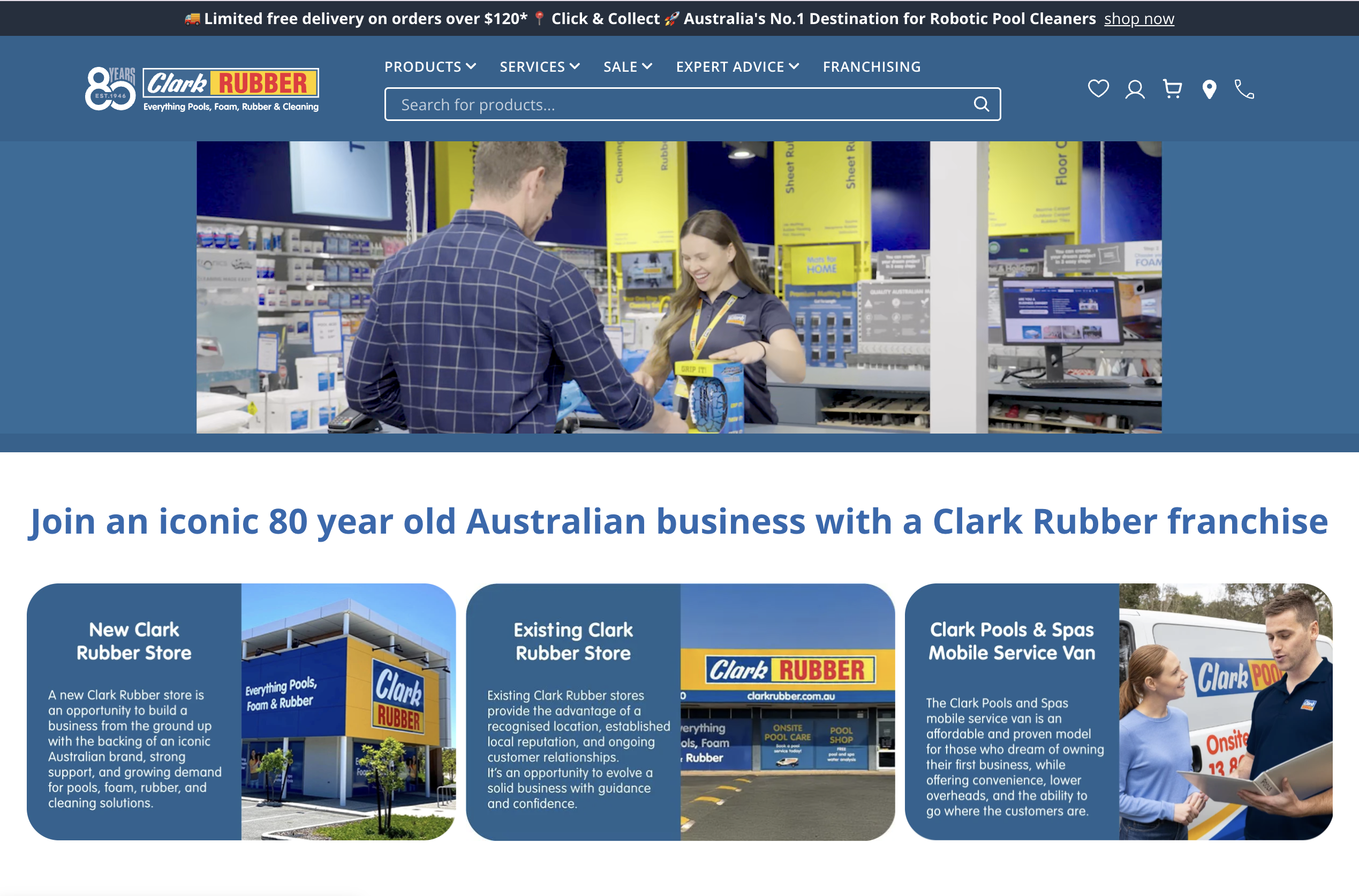
Clark Rubber runs one ecommerce store for all 60 of its franchises. Orders route themselves, and the network handles inventory and back-orders without anyone touching a spreadsheet.
3. B2B, memberships and learning on the same engine
Adding a B2B channel or a training platform usually means buying another system and connecting it to the store. In Core dna, customer-specific catalogs and price books, contract, tiered, and volume pricing, quote-to-order, net terms, purchase orders, and approval flows all run in the same commerce engine as the consumer storefront.
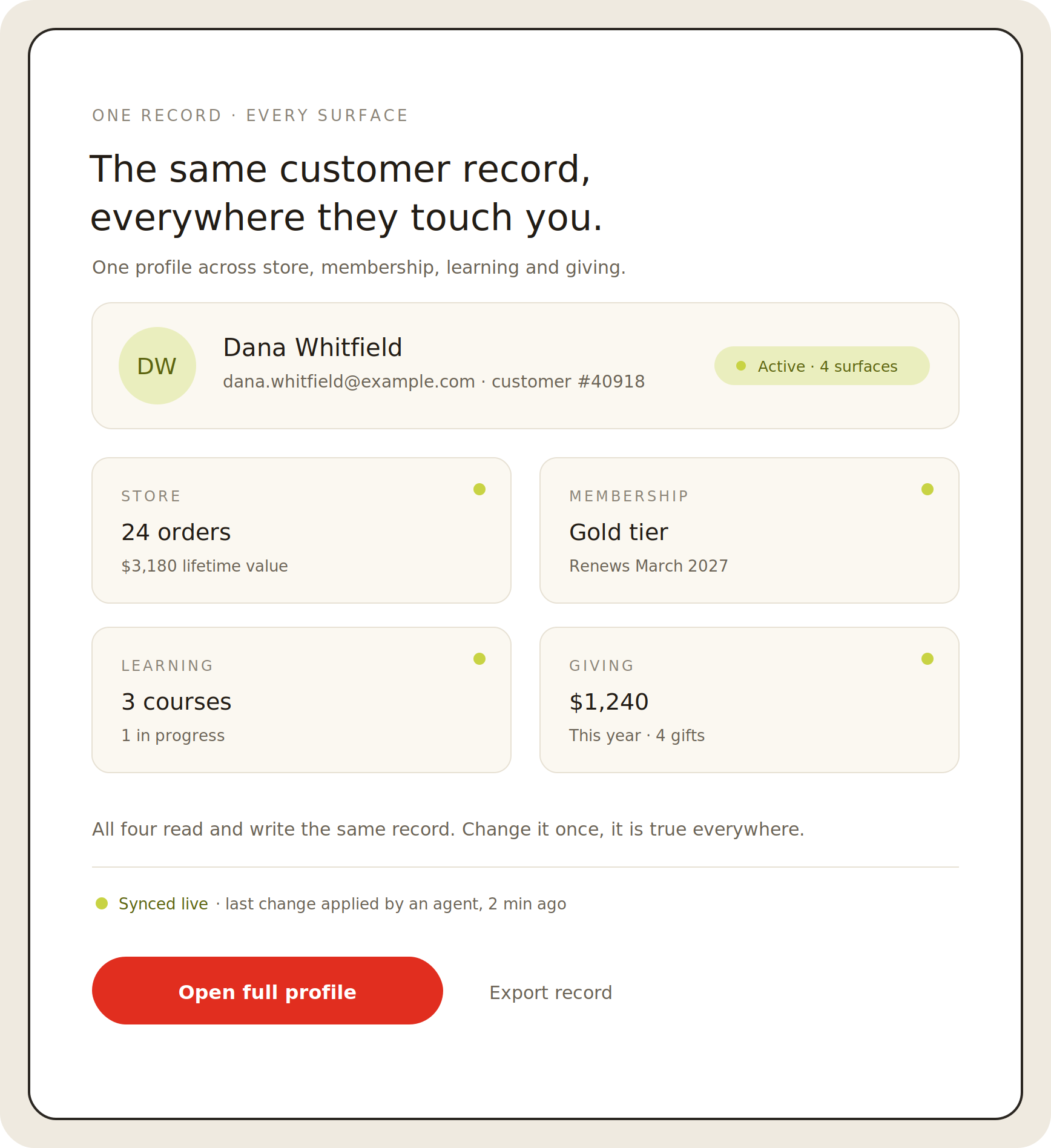
Custom entities make objects like courses, members, or dealers first-class records. An LMS, a B2B portal, or a membership program runs on the same engine as the store and uses the same customer profile, so a member who buys in-store is recognized in the portal and the learning platform too.
Save a Life, which delivers CPR and certification training, runs its website, checkout, and LMS on one platform.
4. Connected to the systems you keep
Unified commerce doesn't mean replacing your ERP or payment provider. Those systems stay, and the platform has to exchange data with them reliably. Core dna has pre-built connectors for SAP, NetSuite, Salesforce, HubSpot, Stripe, and 130+ more, plus an SDK for systems not on the list. A built-in orchestration layer runs the flows between ERP, payments, and the rest of the stack without separate middleware.
5. Changes across every storefront, with approvals and rollback
When twenty storefronts read from one record, a wrong price change reaches all twenty, so changes need a review step before they go live. Teams can update every storefront from Claude, ChatGPT, or Copilot through the Core dna MCP server, which exposes 80+ tools across 400+ APIs. Every change shows a per-property diff and moves through approval before it goes live, with an audit trail and rollback if a run fails partway.
Moving to Core dna in Phases
Moving to unified commerce is a replatforming project, and a phased approach keeps the risk manageable.
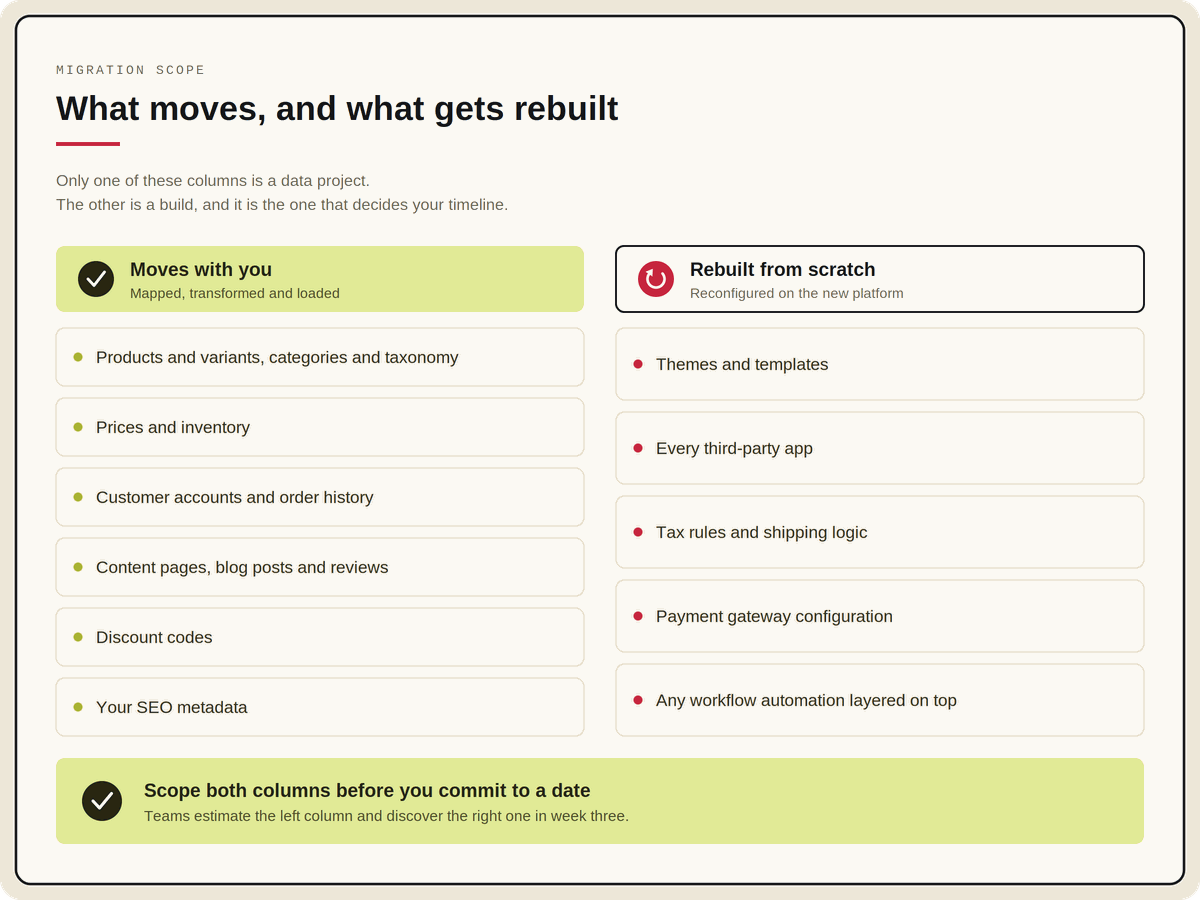
- Map where your data lives: List the systems that hold product, price, stock, order, and customer data, and note where teams enter the same information twice. Those duplicate entry points are where sync errors start.
- Move in phases: Start with catalog and inventory, then orders and customer accounts. Keep the old and new systems running side by side until the numbers match.
- Start with one brand or store group: Launch there, fix what you learn, then roll out to the rest. For multi-brand groups, the first brand becomes the template for the others.
Read More: eCommerce Platform Migration: A 47-Point Checklist for 2026.
Run Every Channel From One Record
When each channel, brand, and business line runs on its own system, you have to make every price change several times, and missed copy ends up in front of shoppers and the AI assistants answering for them. Core dna replaces those copies with one record.
- Products, prices, stock, orders, and customers share one data model, and pages render from the live record.
- Every brand, franchise, and location runs from one system, each with its own storefront and pricing.
- B2B pricing, memberships, and learning run on the same engine as the store.
- Pre-built connectors link your ERP and payment systems without separate middleware.
- Teams and AI agents change every storefront through approvals, with an audit trail and rollback.
See unified commerce on your own catalog. Book a demo with Core dna
FAQs About Unified Commerce
Summarize with