
Kentico Alternatives for Multi-Property Operators
Enterprises considering a Kentico alternative are likely still on its flagship digital experience platform (DXP), Xperience 13, which has an approaching end-of-support date. Although the platform will keep running, the lack of updates, security patches, hotfixes, and support from Kentico means that organizations that continue to use it will expose themselves to potential security risks and suffer without new features.
For multi-property operators who may have been using Kentico, deciding on a new platform requires them to look for specific characteristics that suit their situation.
- Governance is centrally managed and inherited by every property, rather than needing to be configured separately at each one
- Content operations that don't require a developer for every location's routine changes
- A content model built around the business and not just generic pages
In this article, we'll explore some of the factors that can force multi-property operators to a new platform and provide a few alternatives that businesses should consider, starting with our own Core dna, which was built for exactly that kind of operator managing multiple properties.
Managing more than one property on Kentico right now? See what this looks like for your specific portfolio.
The Reasons to Consider a Kentico Alternative
If you're a Kentico customer, there are a few reasons to consider an alternative before migrating to Xperience by Kentico.
Upcoming security issues from end of support
According to Aseva, organizations running unsupported software spend roughly 30% more on IT support, and 33% report that legacy technology has seriously compromised their security. Losing patches, hotfixes, and a support line doesn't save money in the near term; it just shifts the cost to a less predictable place.
Migrating to Xperience by Kentico isn't an upgrade
Moving from Xperience 13 to Xperience by Kentico actually involves moving from ASP.NET Web Forms to .NET Core, adopting a new React-based admin interface, and deprecating the legacy Page API.
A straightforward migration for an enterprise on Kentico typically runs three to four months with an experienced team, but this is true no matter the DXP being chosen, which means that businesses don't have to limit themselves to staying in the Kentico ecosystem.
Governance for multiple properties creates dependency
Although Kentico Xperience 13 supports running multiple sites from a single instance, enterprises can't enforce shared components, brand rules, and permissions across those sites without a developer configuring them.
For a franchise network, multi-chapter organization, or multi-brand portfolio, this means a developer has to get involved whenever shared governance needs to change across the portfolio, which creates additional dependency for lean teams.
Core dna: An Agentic Platform for Multi-Property Operators
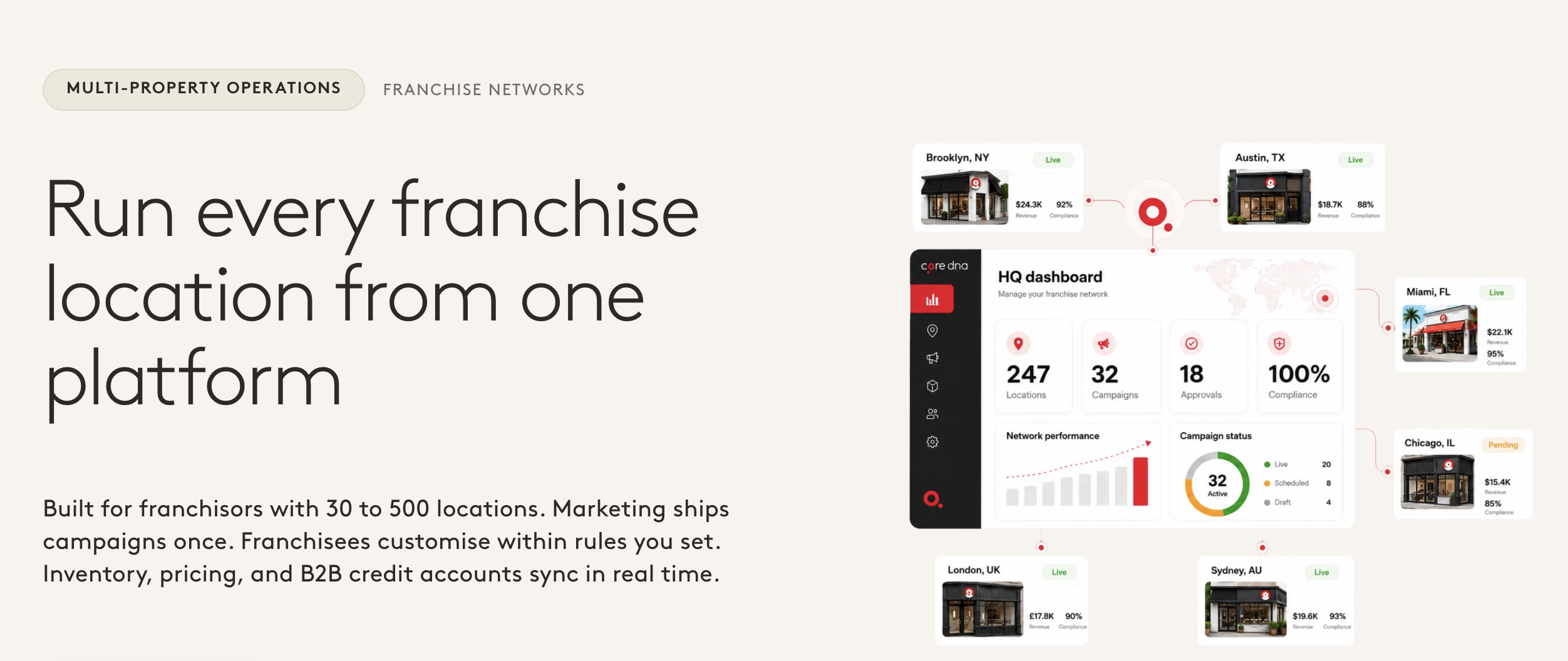
Core dna is an agentic operations platform for franchises, multi-brand retailers, manufacturers, and membership networks. Instead of treating content, commerce, and AI-driven actions as separate systems bolted together, Core dna runs all three from a single content core that every property inherits.
A location doesn't get its own disconnected instance to patch and govern on its own, it gets the same structure, the same approval rules, and the same reusable components as every other property on the platform, with only the specific fields a local team is permitted to touch left open for change.
Learn more: Core dna's content management platform
An MCP server built for marketers
Core dna's AI features run on MCP, an open protocol that lets an AI tool connect directly to live platform data instead of routing through a one-off integration someone has to build and maintain. That's what makes this available to a marketer, not just a developer, since connecting Claude or ChatGPT to Core dna is a configuration step and not an engineering project.
In practice, that means a non-technical team member can batch-publish a folder of Google Docs into staged pages, audit a site for broken links or technical SEO issues, or translate a property's pages into another language, all through the same natural-language interface, without a developer building a custom tool to make any of it possible first.
Read more: MCP Server for Marketers, Not Developers
The same structure, inherited by every property
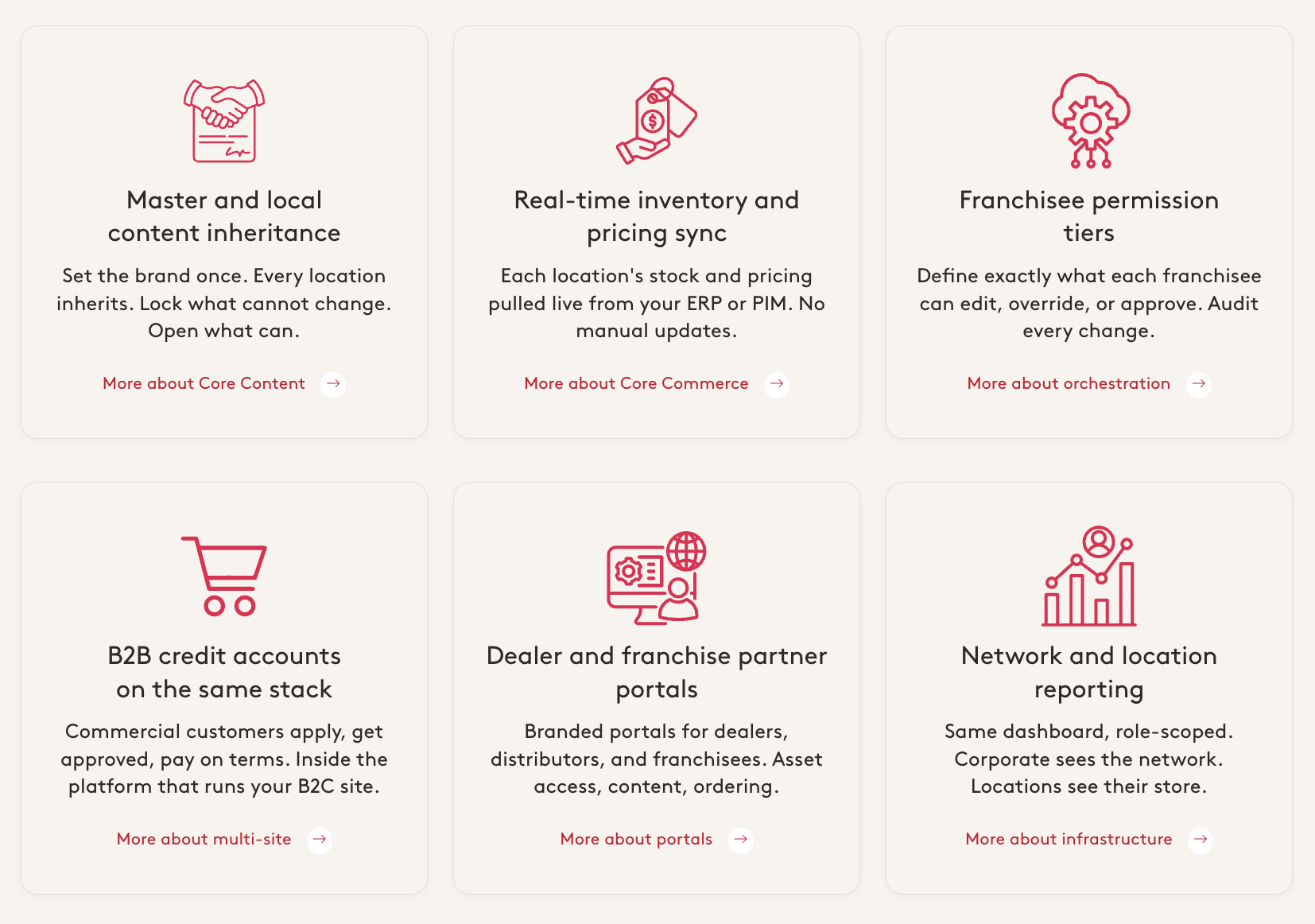
Core dna models the real objects a multi-property business runs on, locations and members, alongside pages, as first-class content types with their own fields and relationships.
Every property inherits that same structure automatically, and a local team can only change the fields they're actually permitted to touch. A regional franchise page and a national campaign page share the same underlying model, rather than drifting into separate, incompatible structures over time.
Eliminate manual updates across every property page
When a price or a location's hours change, someone normally has to open every page that references that detail and update it by hand, one property at a time. On Core dna, a page can reference that data directly instead of storing a fixed copy of it, so when the source updates, every page pulling from it updates with it, without anyone re-editing content that was never meant to be static in the first place.
Describe the change and ship across the portfolio
Every AI-powered action runs through the same natural-language interface, with governance intact. A marketer can author a spring-sale landing page from a campaign brief and have it assembled from governed components, on-brand, ready to refine.
With a single sentence, you can put the summer hero on all sixty franchise pages, apply that change across every property at once, with two-person approval, a diff per site, and rollback built in if anything needs to be undone. A separate request, showing every page changed this week and who approved it, returns the full trail by property, editor, and approver, no reconstruction required after the fact.
See what this would look like for your own portfolio.
3 Additional Kentico Alternatives
Depending on how your properties operate, another platform might suit you better as a Kentico alternative. Here are a few options:
Sitecore
Sitecore is an AI-enabled digital experience platform that bundles content management with personalization, search, and customer data tools into a single, managed SaaS suite. It fits large enterprises that want a bundled DXP beyond just content management. However, the tradeoff is a heavier implementation and more reliance on integration partners.
Read more: 4 Reasons Businesses Are Leaving Sitecore (And What to Do About It)
Contentful
Contentful is an API-first content platform with a large marketp lace of integrations for search, personalization, and asset management. It fits enterprise teams running complex, multi-channel content operations; however, there are no commerce capabilities for organizations that need both content and commerce on the same platform.
Read more: Contentful Alternatives: 6 Platforms That Solve Contentful's Biggest Pain Points
Umbraco

Umbraco is an open-source CMS built on .NET, with a managed cloud option and a large partner network supporting implementation. It fits teams that want to stay in a .NET environment without asking their development team to learn an entirely new stack. However, its multi-site support is built around individually configured sites, so multi-property operators typically end up rebuilding that governance work property by property.
Core dna: Built for Every Property, Not Just One Site
With the right DXP, you can centralize governance and eliminate the manual work that piles up across every property, patch, permission, and page update. This is especially important for multi-property operators managing dozens or hundreds of locations.
Core dna delivers exactly what multi-property teams evaluating life after Kentico need. With Core dna, you can:
- Define a property's structure once and have every location inherit it automatically
- Connect pages directly to live prices, hours, and location data
- Connect AI tools like Claude and ChatGPT via an open standard rather than a custom integration
- Roll out natural-language changes across the entire portfolio with approval, audit, and rollback built in
The YMCA of Greater Toronto runs its entire content operations on Core dna. The organization needed to stop depending on developers whenever marketing wanted to update a page or launch a campaign, and Core dna gave the team one platform they actually own, across every property, every location, and every service category.
Ready to see what this looks like for your specific portfolio?
Summarize with