
Have you ever checked a store's website at lunch, seen the running shoes you wanted listed as in stock at the branch near your office, and decided to pick them up after work? You drive over and the shelf is empty. The last pair in your size sold at the register that morning, and the website never found out.
These scenarios happen more often than most retailers realize. In a survey of more than 1,000 US shoppers, 57% had found items marked available online that were out of stock in the store within the previous 90 days.
Why? The systems that run the brand behind the store, including the website, tills, ERP, and loyalty program, each keep their own copy of the same products and customers but don't share that information.
A unified commerce platform replaces those copies with one set of records that every channel reads from. Below, we cover what to look for and compare seven options for retailers, starting with Core dna, our platform for retail groups running several brands or store networks from one system.
Book a demo to see how Core dna runs every brand and store from one platform.
What to Look For in a Unified Commerce Platform
Unified commerce closes the gaps between channels that teams coming from a disjointed stack might struggle with. It means running commerce, content, customer data, and store operations on one platform, so you write a stock count or price once, and every channel reads the same value. The platform still connects to your ERP, payment gateways, and point-of-sale system. It shouldn't require a separate tool for each job, held together with plugins and middleware.
However, not every vendor selling a unified commerce platform sees it the same way. Some use it for a till paired with an online store, while third-party apps run content, search, and loyalty. Others include a CRM, a data platform, and a storefront sold under one contract.
The most important distinction is that connecting separate systems isn't the same as unifying them. The best unified commerce platform should be able to:
- Write stock and price changes once: A sale in one channel or a price change at head office should reach every other channel from the same record, not after an overnight sync.
- Put store activity on the same record as online orders: In-store sales, pickups, and returns need to land in the order and inventory data your website reads.
- Keep brands separate on a shared back end: Each brand or banner gets its own storefront, pricing, and promotions. A shopper who buys from two of them should still be one customer.
- Connect to the ERP natively: The platform should include two-way connections to the ERP, PIM, and CRM you already run, not as a middleware project.
- Let marketers work without developers: The people who own product content, landing pages, and promotions should be able to change them directly.
- Govern AI and automation: Before an agent or scheduled workflow touches pricing or a live storefront, it needs approvals, an audit log, and a rollback mechanism.
Enterprises considering a unified commerce platform should also consider implementation, apps, integrations, and partner fees, which often add up to more than the license itself.
Core dna: One Platform for Every Brand, Store, and Storefront
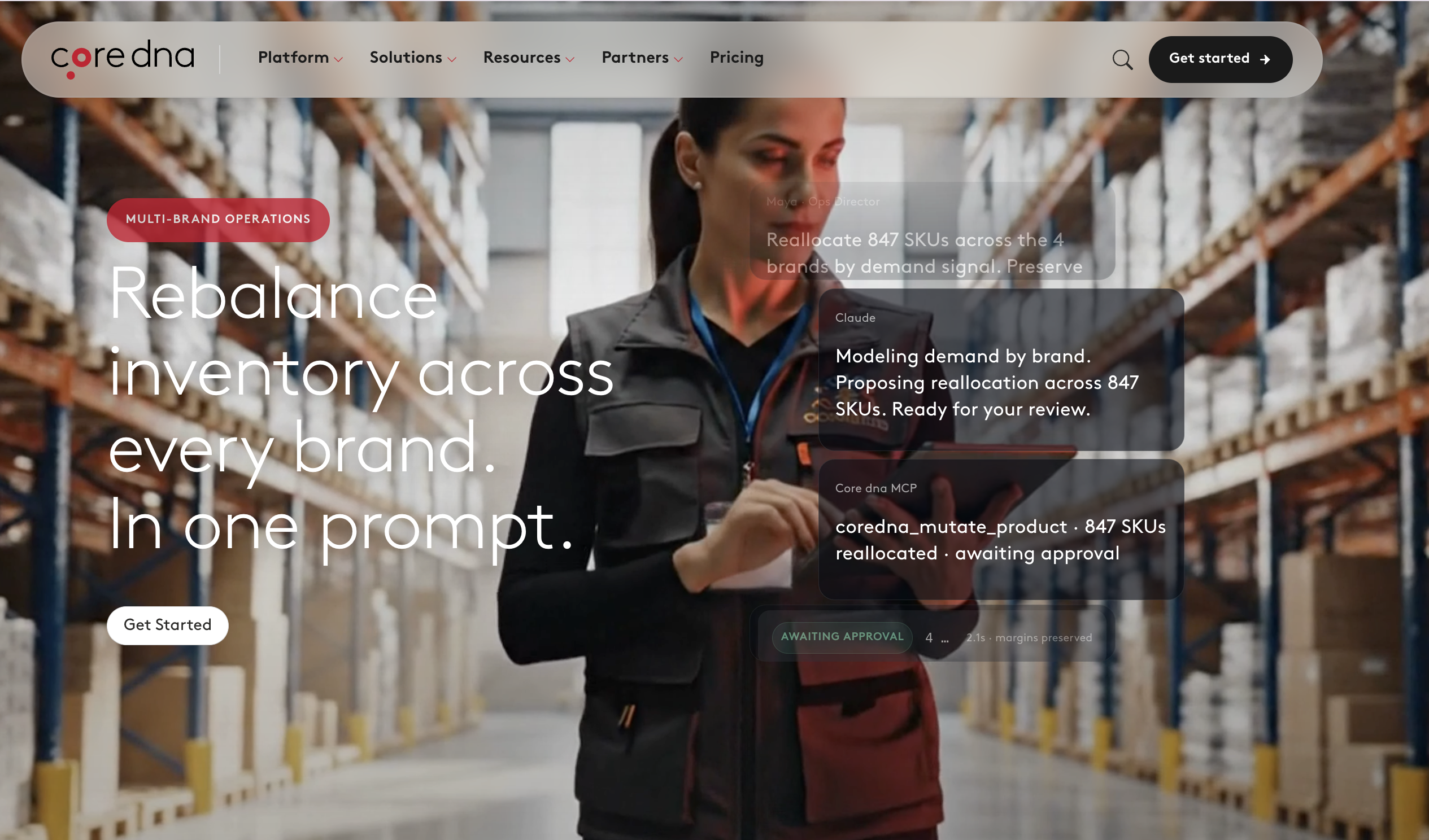
Core dna is a unified commerce platform that runs commerce, content, promotions, search, and workflows natively. It's built for retail groups and portfolio operators running several brands or store networks with a lean team.
Each brand runs as its own tenant with its own domain, storefront, and pricing, while the catalog, customer records, inventory, and integrations stay shared behind the scenes. With one record under every storefront, price or stock changes don't have to travel between systems before shoppers see them.
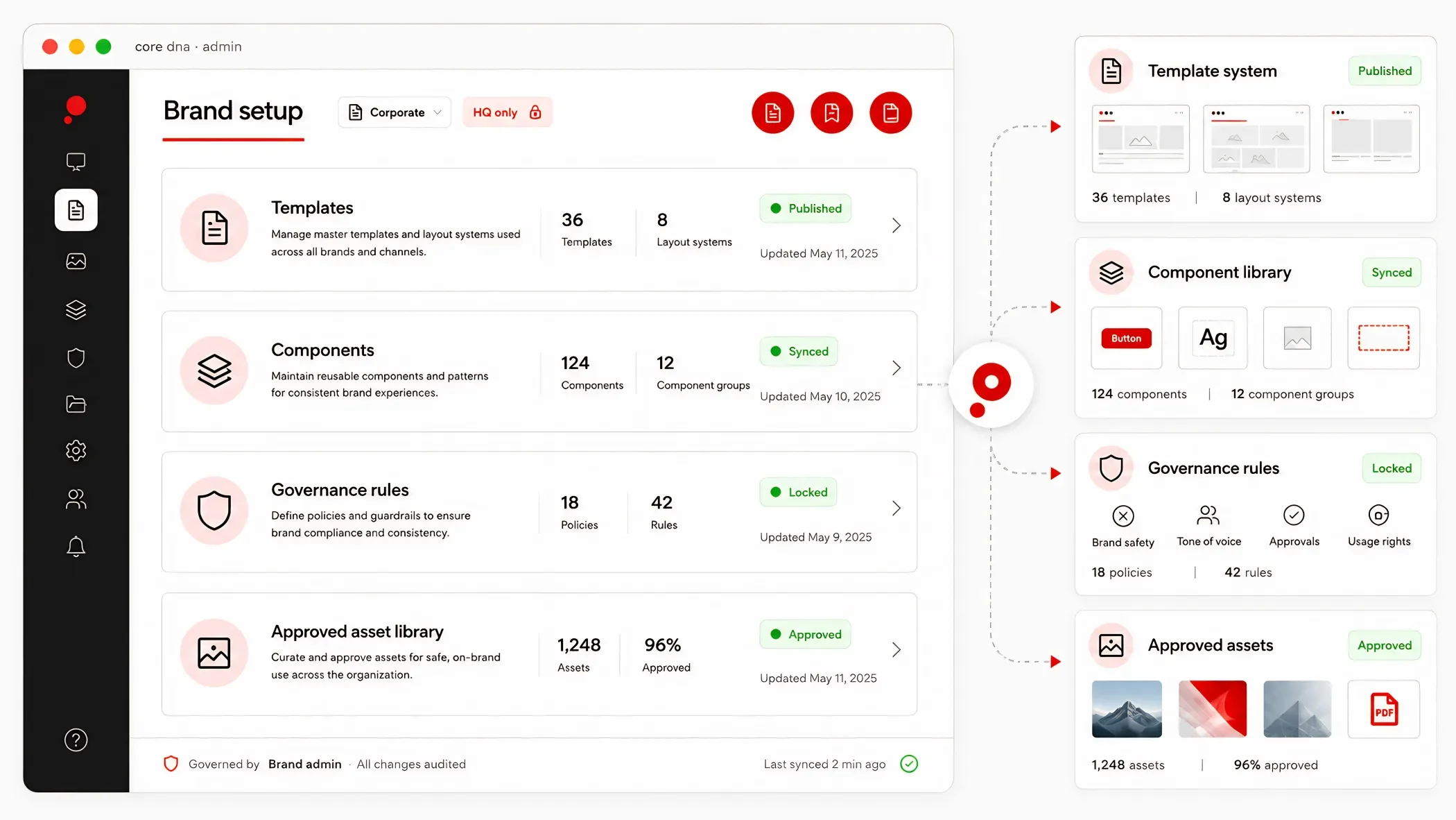
Keep stock and orders consistent across the website and the stores
Most stock mismatches start in the gap between the ERP, the website, and the stores. Core dna connects to SAP, NetSuite, Salesforce, HubSpot, Stripe, and more than 130 other systems out of the box, and teams can build connectors to anything else with its SDK. A built-in orchestration layer runs the data flows between them, so a retail group sets up the ERP connection once and every brand uses it.
Store-level order management ties each online order to the store that fulfills it. Inventory can be pooled across brands or kept separate, depending on the product class. Clark Rubber runs one ecommerce store for all 60 of its franchises through a single ecommerce store. Orders route automatically to the right franchise, and inventory and backorders are managed across the whole network without spreadsheets.
Core dna doesn't supply point-of-sale hardware. In-store sales reach the shared record through the POS, ERP, and payment integrations a retailer already runs.
Run each brand its own way on shared operations
When you add a new brand, you shouldn't have to buy another platform. In Core dna, a new brand is simply a tenant configured in hours to days. Pricing, tax, currency, promotions, and payment methods are set per brand and per market, so one brand's discount logic never touches another's.
A shopper who buys from more than one brand lives in a single customer record that maps to each brand by default. This also means retailers can run loyalty programs brand by brand or across the whole portfolio.
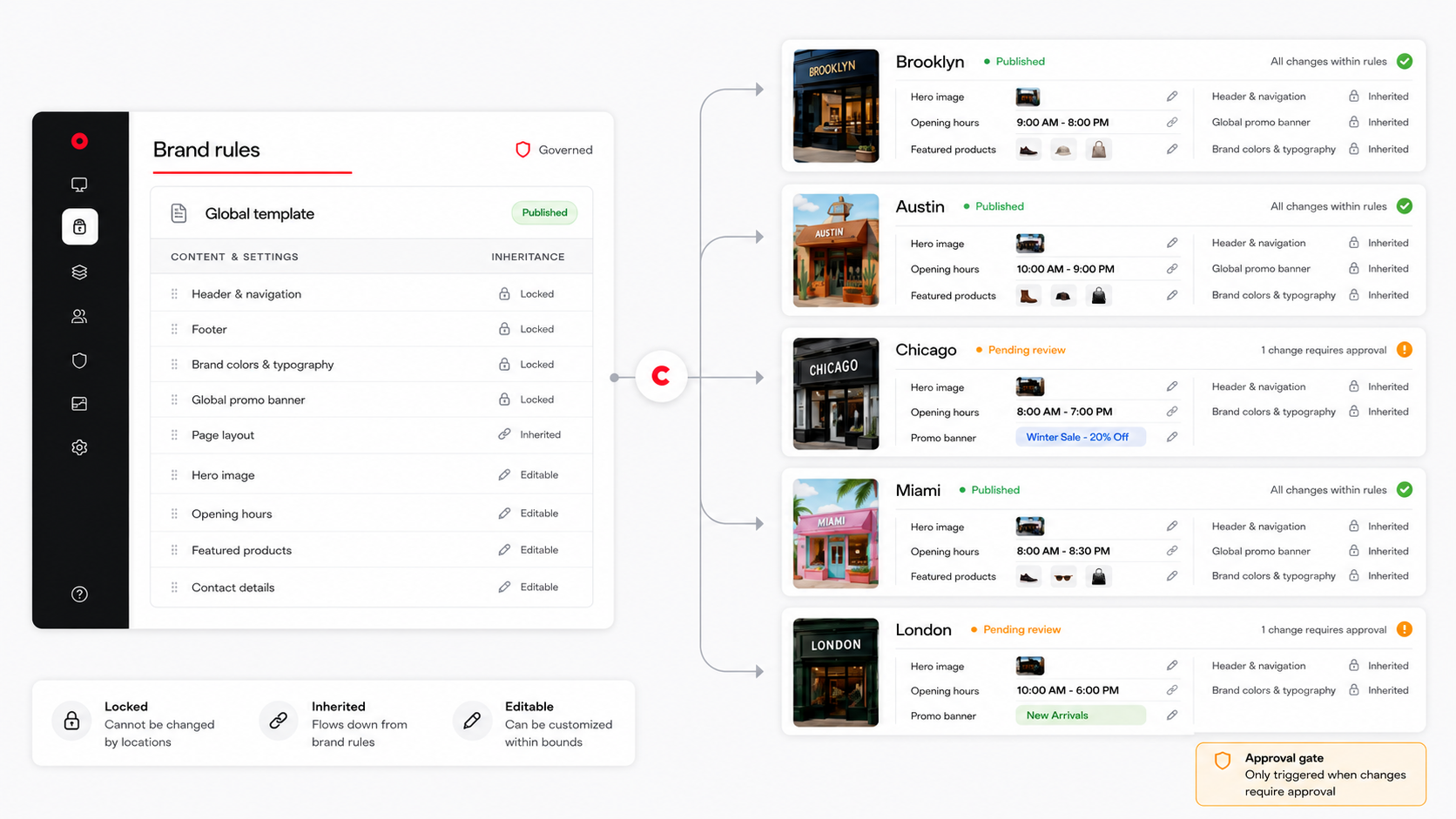
Manage content and commerce without a developer queue
Content, products, and promotions live in the same admin, so a merchandiser can publish a campaign page and the promotion behind it without filing a ticket. With no plugins to maintain, Core dna handles upgrades and security patches at the platform level.
Put AI agents to work under the same controls as people
The Core dna MCP server connects Claude, ChatGPT, Copilot, or any MCP client to your environment, so teams can update storefronts from the AI tools they already use. Every agent runs under the same scoped permissions, approval routes, audit trail, and rollback as a human editor. On critical change types, the person who proposes a change can't also approve it.
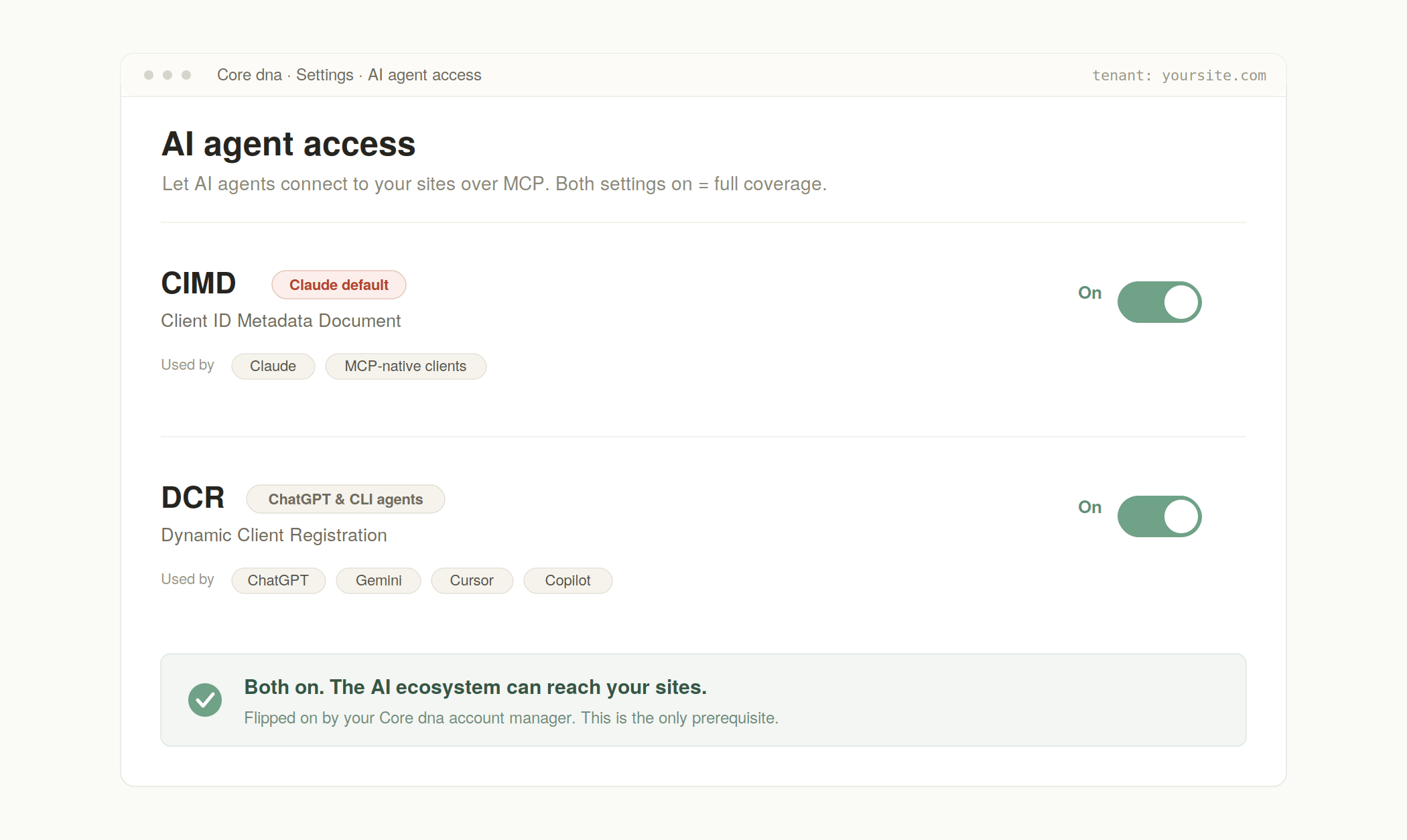
Want to see agents working inside a governed platform? Explore the Core dna MCP server.
6 Other Unified Commerce Platforms for Retailers
If Core dna isn't the right fit, these six platforms may also work for your unified commerce needs.
Liferay

Liferay is a digital experience platform with commerce built into the same product as its CMS. It suits organizations that want content, portals, and commerce from one vendor, and its commerce customers tend to be manufacturers, dealers, and other B2B sellers.
Key features:
- Dozens or hundreds of storefronts on one platform
- Built-in order management with inventory visibility, or OpenAPI connections to an existing ordering system
- Contract pricing, bulk discounts, and promotions with A/B testing
- Support for multiple currencies, languages, and tax options
Limitation: Liferay's commerce features center on B2B buying, such as account catalogs, approval workflows, and reordering. Store-facing retail workflows like buy online, pick up in store aren't part of its commerce positioning.
Salesforce Commerce Cloud
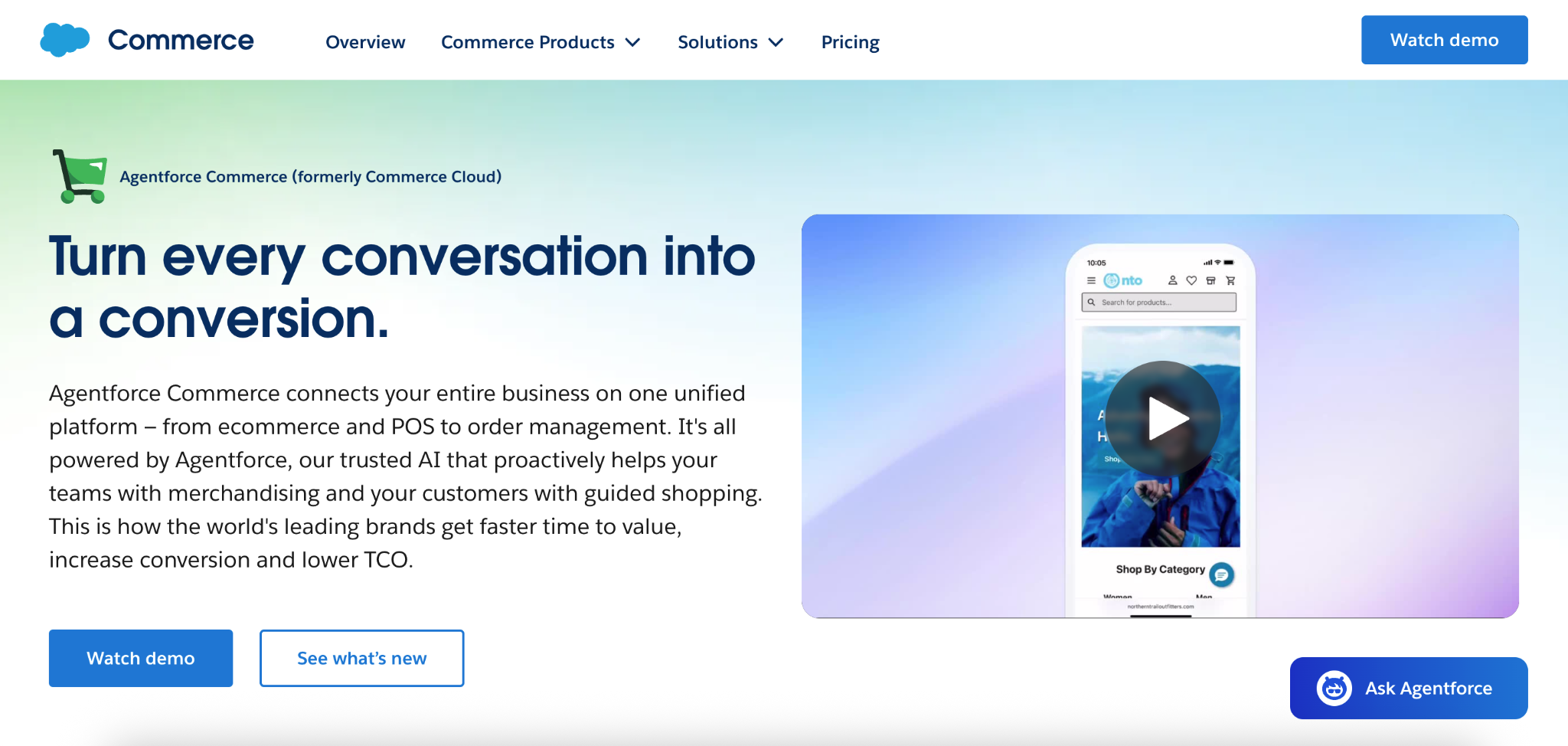
Salesforce Commerce Cloud (now Agentforce Commerce) runs storefronts alongside Salesforce's CRM, service, and marketing products, so commerce data can share the customer record the rest of the business uses. It suits large retailers already committed to Salesforce.
Key features:
- B2C Premium edition with up to 100 sites and full order management
- Salesforce Order Management with distributed order management and omnichannel inventory for up to 50 locations
- Retail Cloud Point-of-Sale for store networks, starting at 25 stores
- Personalization using Data Cloud segments
Limitation: Unifying store and online operations spans several Salesforce products. Retail Cloud Point-of-Sale and Salesforce Payments are listed as offerings separate from the commerce editions, and POS starts at 25 stores.
commercetools
commercetools is an API-first, headless commerce platform. As a composable commerce solution, teams build their own front end and choose the surrounding components, which works best for retailers with strong in-house engineering.
Key features:
- Separate capabilities for catalog, cart, and order management, inventory, pricing, and promotions
- InStore, which gives store associates the same catalog, cart, and orders as online customers
- Unlimited catalogs, channels, and storefronts
- AgentSphere for building and running AI agents
Limitation: commercetools focuses on capturing orders, which typically pass to a separate OMS or ERP, so the order record usually lives downstream. Content management typically comes from a separate headless CMS.
Adobe Commerce
Adobe Commerce is a commerce platform that integrates deeply with the Adobe suite and enables businesses to deliver personalized commerce experiences. Built on Magento, Adobe Commerce gives retailers deep control over the storefront and a large extension marketplace.
Key features:
- Inventory Management that tracks stock across warehouses, stores, and pickup locations
- An in-store pickup delivery method that lets shoppers choose a store at checkout
- Source selection that routes each order to a suitable fulfillment location
- Native B2B features, including order by SKU
Limitation: In Adobe's inventory model, stocks map to sales channels that are currently limited to websites. In-store sales from a POS reach that inventory through an integration or extension.
SAP Commerce Cloud
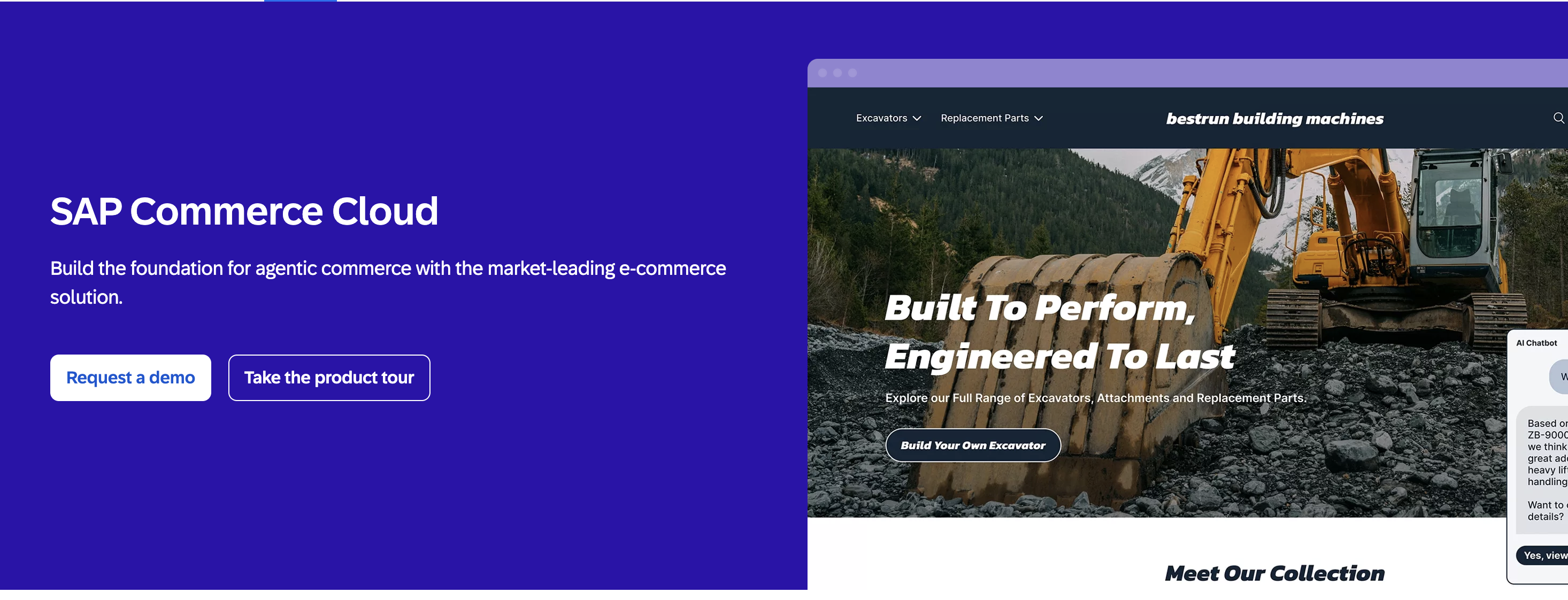
SAP Commerce Cloud is an enterprise commerce solution for B2B, B2C, or B2B2C business models. Retailers already running SAP S/4HANA for merchandising and finance often look to SAP Commerce Cloud first.
Key features:
- Integration with S/4HANA for orders, pricing, and master data
- Omnichannel article availability and sourcing, which shows store and network stock online
- Pricing and order value calculations handled centrally in S/4HANA
- B2B and B2C storefronts on the same platform
Limitation: SAP's omnichannel availability depends on several SAP products working together, including S/4HANA or SAP Retail, SAP Customer Activity Repository, and an integration package, with the Activity Repository as the system of record.
BigCommerce

BigCommerce is a flexible open commerce platform. It serves mid-market retailers that want SaaS commerce with multiple storefronts under one account. Teams can also deploy it in several ways, including hosted, headless, or fully composable.
Key features:
- Multi-storefront management from one dashboard
- POS integrations with Square, Clover, Heartland Retail, and others
- No extra BigCommerce transaction fee when using its embedded payment providers, though standard card processing fees still apply
Limitation: BigCommerce ties each plan to a cap on online sales and moves a retailer up a tier once it passes that cap. Lower plans also limit the number of storefronts to three, five, or eight, depending on the plan.
Unify Every Brand and Store With Core dna
Core dna runs stock, pricing, customers, and content on one platform, so every storefront and every store reads the same record from the start. Other platforms on this list can achieve a similar setup, but they do it by combining separate products, modules, or apps. With Core dna, retail teams can:
- Connect SAP, NetSuite, and 130+ other systems through pre-built connectors and built-in orchestration, with no middleware project.
- Launch a new brand as a configured tenant instead of a new platform project.
- Recognize a shopper as one customer across every brand, with loyalty set per brand or across the group.
- Publish content, products, and promotions without waiting on developers.
- Let AI agents make changes under the same approvals, audit logs, and rollback as people.
Book a demo to see how Core dna would run your brands and stores on one platform.
Summarize with