E-learning businesses often run on several systems: an enterprise LMS for courses, a plugin LMS for a second program, WordPress for content and downloads, and a payment processor for sales. When one of those systems is being retired, as Saba Cloud is, the replacement project usually turns into a review of all of them.
Course features are usually the easiest part of the RFP to write. The requirements that decide whether a platform works are the ones around the courses: sales and renewals, seats that move between a client's staff, continuing education (CE) credits that change with each accreditation cycle, and reports that an executive over several locations can read without asking for an export.
Below, we go through each section of an LMS RFP for an e-learning business that sells courses, certifications, and seats to individuals and organizations. It's based on a recent RFP we answered, with the organization's details removed.
If you're still deciding what kind of LMS you need, or haven't mapped your systems and costs yet, start with our guide on how to choose an LMS. This guide picks up once you're ready to write the RFP.
What Should an LMS RFP for an E-Learning Business Cover?
An e-learning business sells access to courses, certifications, documents, and live sessions, through one-off purchases, subscriptions or memberships, and seats bought by organizations. The LMS has to deliver the learning and also run the sales, access, and reporting around it. A complete RFP covers:
- Objectives: What the new platform must improve, such as learner access, admin workload, and reporting.
- Dealbreakers: The minimum capabilities a vendor needs to stay in the process.
- Scope: User roles, content types, ecommerce, certificates and CE, reporting, and integrations.
- Vendor qualifications: Experience, implementation approach, migration, support, and security documentation.
- Submission requirements and evaluation criteria: What vendors must send and how proposals will be scored.
Include a short summary of your current setup too: the number of programs, client organizations, active learners, courses, and documents. Vendors size implementation and pricing from these numbers, and proposals that guess at them are hard to compare.
If you're replacing your CMS and store at the same time, our CMS and eCommerce RFP template covers those requirements in detail.
Which Requirements Should Be Dealbreakers?
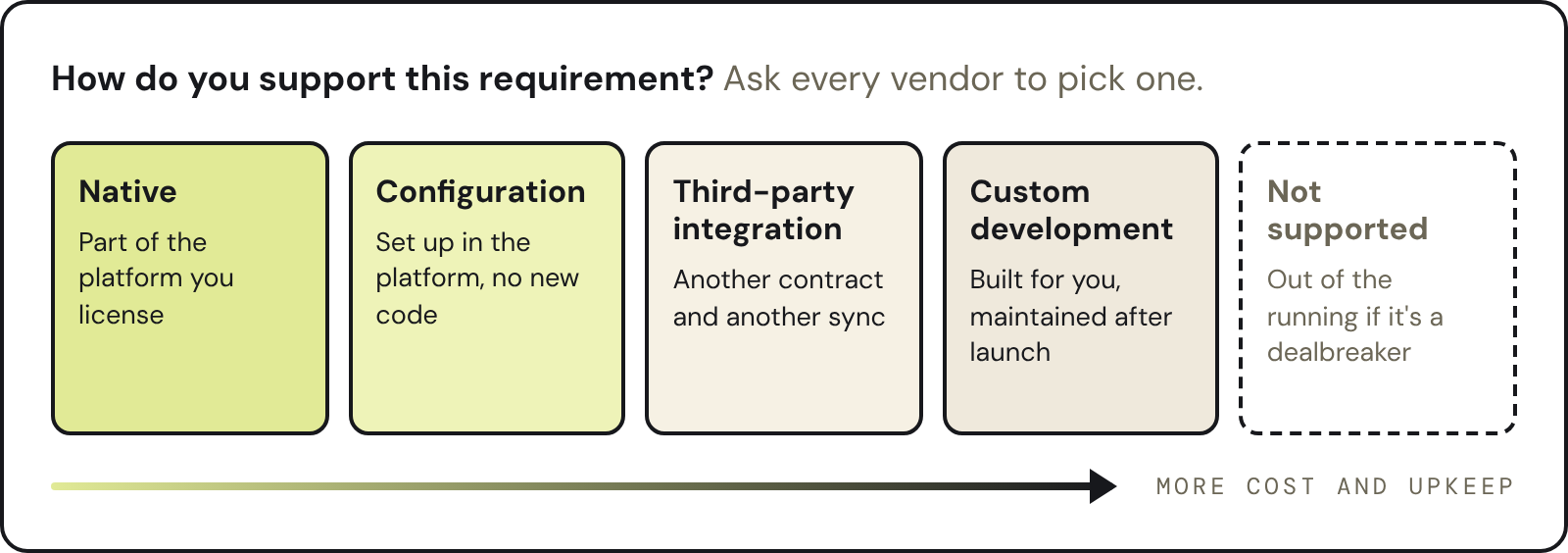
A short list of dealbreakers keeps the detailed evaluation for vendors who can do the job. Ask each vendor to say how they support every item:
- Native
- Through configuration
- Through a third-party integration
- Through custom development
- Not supported
Those five answers show where the cost sits. A feature delivered through a third-party integration comes with another contract and another sync, and custom development has to be maintained after launch. Vendors that pass this round then complete a detailed requirements matrix and book a demo.
For an e-learning business, a dealbreaker list can look like this:
- Programs and access model: Separate programs or academies, each with its own access rules, pricing, content and document libraries, renewal logic, and reporting.
- Role-based administration: Organization-level data separation, bulk upload, deactivation and reactivation, seat reassignment, and user history that survives all of it.
- Learning, certificates, and CE: Assignment by role, organization, product, or credential, plus certificates, annual transcripts, multiple CE credit types, course versions, retakes, and annual resets that keep past records.
- Notifications: Automatic reminders for renewals, expirations, new assignments, overdue courses, and completed certificates, plus progress alerts for managers.
- Community forum: A learner forum with access based on what each learner bought, their program, role, and organization.
- Reporting: Role-based dashboards and exports covering progress, seat usage, CE status, downloads, purchases, and revenue.
- Integrations: Payments, CRM, ERP, support ticketing, and identity management for sign-in and provisioning.
- Migration and security: Migration from your current LMS and CMS platforms, enterprise hosting with SOC 2 Type II and PCI compliance, audit logs, backup and recovery, and data retention controls.
Which User Roles Should the RFP Define?
Training sold to organizations has more layers than an employee LMS. List each role and what it can do across content access, reporting, administration, and purchasing. A typical set:
- Platform administrator: Your own team, managing programs, content, learners, and settings across the whole system.
- Enterprise lead: An executive over several organizations or locations, who needs reports across all of them and may buy seats for each.
- Organization manager: An administrator at one client organization, who adds and removes staff, assigns courses, and tracks completions.
- Learner: Takes courses, downloads resources, joins the forum, and keeps a transcript.
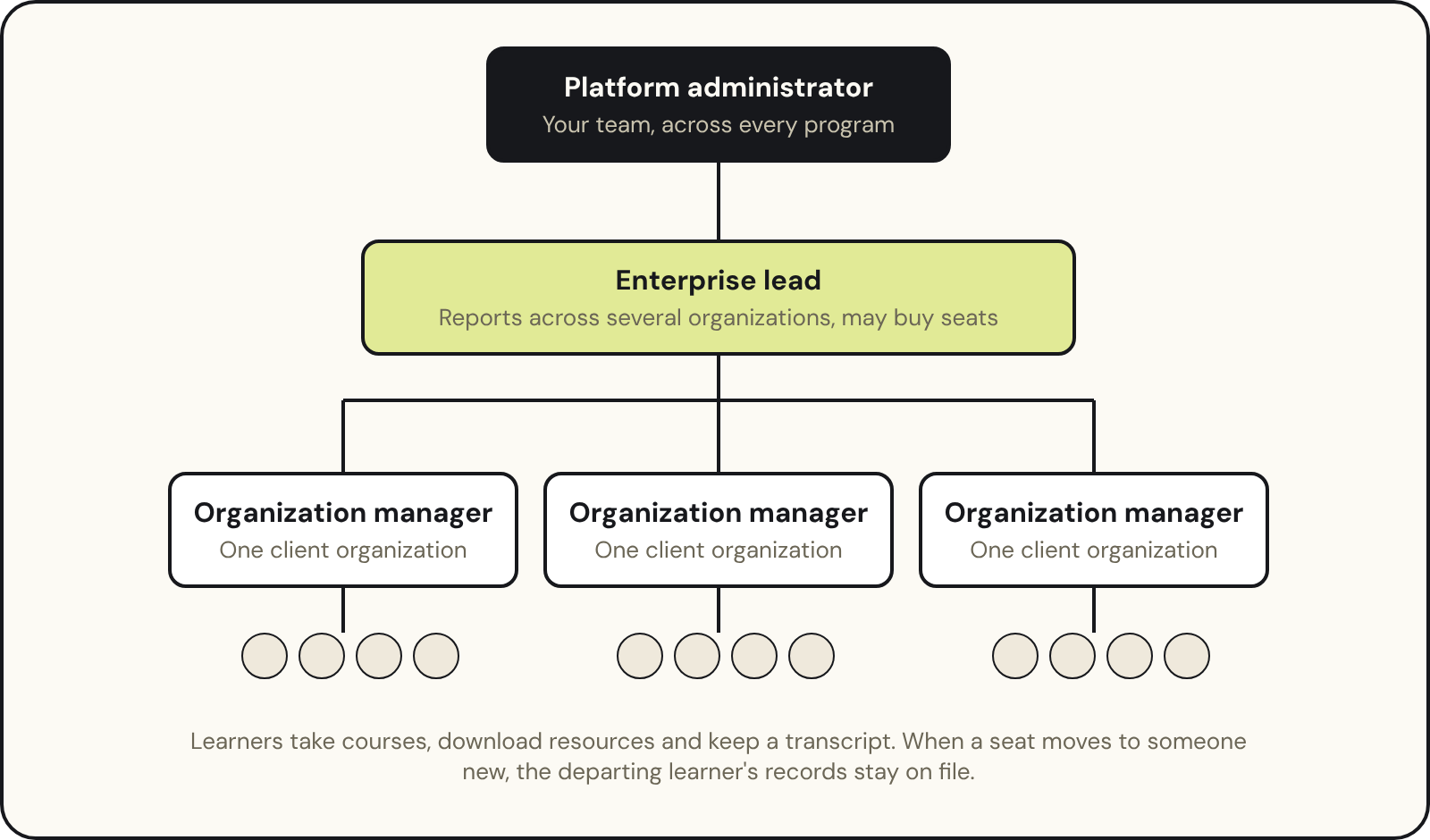
In the RFP, ask each vendor to describe how an enterprise lead sees several locations at once, and what happens to a departing learner's completions and certificates when their seat goes to someone new. Those records should stay on file.
How Detailed Should CE and Certificate Requirements Be?
As detailed as your accreditation rules. CE rules differ by credential and change on each accreditor's schedule, so vague requirements leave room for very different readings across vendors. Spell out whether the platform needs to support:
- Several credit types on a single course
- Several certificates for one course, issued based on the learner's credential or choice
- Credit values that change on a set date, and course versions for each accreditation cycle
- Annual course resets and recurring compliance training
- Transcripts and certificate history that stay intact through resets, version updates, and retakes
Ask vendors to answer each rule on its own line, so you can see which ones they handle natively and which need configuration or custom work. The riskiest rule is the one to see in the demo. Our guide on how to choose an LMS has demo scenarios to start from.
What Ecommerce Requirements Should You Include?
E-learning businesses that sell to companies bill in ways a basic course store doesn't handle. If your LMS and store are separate systems, each of these also needs a sync between them. Ask for:
- One-off course purchases, subscriptions, and memberships, with renewals and auto-renewal
- Seat-based licensing and seat reassignment
- Discounts, promotions, and bundles
- Tax calculation and tax-exempt customers
- Refunds, partial refunds, and offline payments such as checks
- Enrollment that starts on purchase, and access that ends when a subscription or membership expires
Name the payment processor you need to keep, and ask whether the vendor's commerce is built in, a paid add-on, or a connection to a separate store.
Which Content Types Should the Platform Support?
E-learning businesses sell more than courses. List every type of content learners get, and how access to each is controlled:
- SCORM and HTML5 courses
- Video courses and content
- Assessments, exams, and evaluations
- Certificate programs and curricula sold as course bundles
- Webinars and live events
- Downloadable tools and resources in PDF, Word, Excel, and PowerPoint
- A community forum for questions and discussion
Access to each type should follow role, the product or membership bought, its status, and program. Document libraries often hold hundreds of files, so ask how they're organized, searched, and permissioned, and whether downloads appear in reporting.
What Reporting Should You Require?
Reporting needs differ by role, so tie each report to the people who'll use it. Require:
- Course completion tracking
- User-level and organization-level reports
- Custom report builders and dashboards
- Exports in CSV, Excel, and PDF
- Time on task and engagement metrics
- Page views and document downloads
- Purchases, revenue, and order history
- Reports scoped to each role's permissions
Purchase and revenue data usually sits in the store, and completions in the LMS. If they're in separate systems, ask how a report that combines both gets built and kept up to date.
Which Integrations and Security Requirements Belong in the RFP?
List the systems the LMS must connect to, and say whether each connection is required or preferred. For an e-learning business, that usually means:
- A payment processor, such as Stripe
- A CRM, such as HubSpot or Salesforce
- An ERP or finance system, such as NetSuite
- A support desk for learner tickets
- An identity provider for sign-in, provisioning, and access control, with APIs for each
- Data migration from your current LMS and CMS platforms
For security and hosting, ask for:
- SOC 2 Type II, ISO 27001, and PCI compliance documentation
- Audit logs and role-based administrative security
- Backup and recovery procedures, and data retention controls
- A staging environment for testing changes before they go live
What Should Vendors Include in Their Proposals?
Ask every vendor for the same set of documents, so proposals can be compared line by line:
- Company background and experience with subscription education products sold to businesses
- Examples of similar organizations at a similar scale
- Implementation methodology and timeline
- Data migration approach, including how records are checked before launch
- Training and support model
- Recommended third-party implementation partners, if any
- Security certifications and compliance documentation
- Any third-party tools or add-ons the solution requires
- Pricing structure and licensing model
- Implementation and ongoing support costs
Look closely at the licensing model. Pricing per active or registered user rises as your learner base grows, and add-ons for commerce, external audiences, or forums can change the total a great deal.
How Should You Score the Proposals?
Agree on the criteria and their weights before the RFP goes out, so the team scores every proposal the same way. A common set:
- Functional fit against requirements
- Ecommerce and membership capabilities
- Reporting and analytics
- Integration and scalability
- Security and compliance
- Total cost of ownership
- Vendor experience and support model
Score total cost of ownership over several years, including add-ons, implementation, integrations, and the internal time each option needs to run.
One Platform or a Tightly Integrated Ecosystem?
Many RFPs, including the one this guide is based on, accept either a single integrated platform or a tightly integrated ecosystem. That keeps more vendors in the running.
Many e-learning businesses built their current setup one system at a time. The first program ran on an enterprise LMS. A second program came later, on a plugin LMS added to the WordPress site that already held the downloads. Payments went through a processor, and learner records sat in a CRM. Each system kept its own copy of the learner, and every connection between them became something the team had to maintain and fix when a renewal or seat change didn't carry over.
Which do you think will be easier to run five years from now: one platform, or an ecosystem with the same number of syncs as today?
This is our take. An ecosystem can work, but every system that holds part of the learner record adds a sync to maintain. Before scoring proposals, count how many systems each one uses to store a learner, their seats, their purchases, and their certificates. Proposals with fewer copies of that record usually cost less to run, even when the license price is higher.
Organizations Running Their E-Learning Business on Core dna
Core dna runs learning, content management, and ecommerce on one data model, configured around how your programs run. Training providers and nonprofits use it to sell courses, issue certificates, and report on participation from the same records. Here are two of them.
Save a Life Sells Each Certification Four Ways
Save a Life sells CPR, BLS, and other certification courses through Advanced Medical Certification. It moved off WordPress, a standalone LMS, and a separate store onto Core dna.
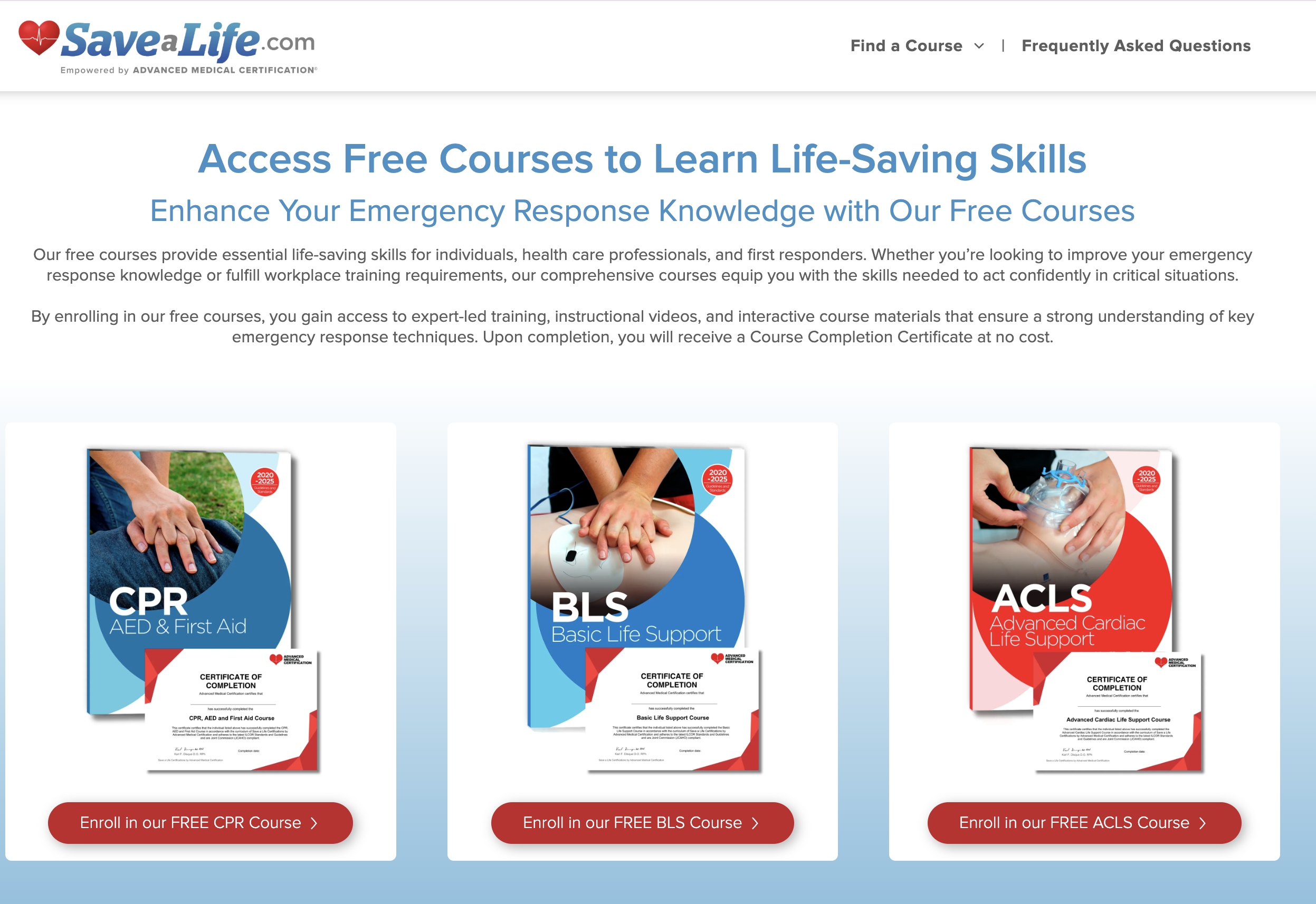
- Recertification as its own product: Each course sells as a first certification, a recertification, a for-life product, and part of a bundle, with one course behind all four. In the first eight weeks of 2026, 58% of its enrollments were recertifications.
- Continuing education credits: CME credits sell as their own product on its ACLS practice test course.
- Two languages and several currencies: About 1,700 pages were localized for Spanish-speaking learners, with a medical advisor approving each one, and checkout runs in local currency.
YMCA Ignite Runs Free and Funded Courses Across Canada
YMCA Ignite is YMCA of Greater Toronto's online learning platform, with free and low-cost courses in career development, financial empowerment, entrepreneurship, and child care. YMCA reports more than 41,000 learners and 11,000 certificates issued since launch.
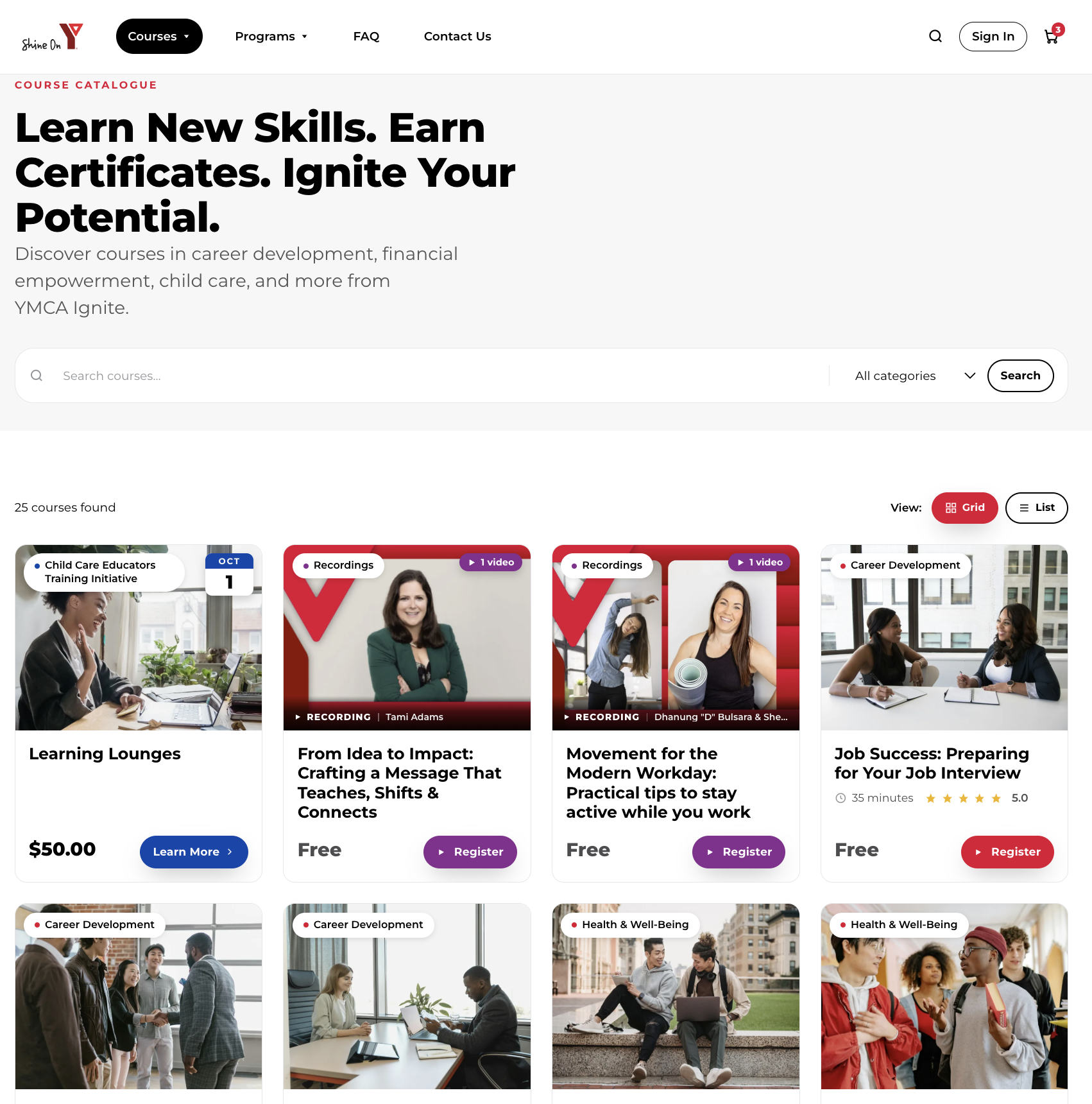
- Migration: Ignite moved its SCORM courses and learners off Absorb in about six weeks, onto the same Core dna setup as ymcagta.org.
- Reporting for funders: Every free enrollment creates an order, and the monthly participant count YMCA's funders rely on comes from sign-in and course activity on the platform.
- Proctored certificates: For a food handler course YMCA is preparing for Ontario accreditation, Core dna is connecting online exam proctoring. Each certificate is held until the review comes back valid.
What Core dna Covers in an LMS RFP
- Several academies or programs on one instance, each with its own branding, access rules, pricing, and course catalog.
- Learner, organization manager, and administrator roles enforced at the data layer.
- Enrollments, completions, and certificates on the same record as orders, payments, and subscriptions, with certificate rules, credit types, and renewal cycles on course and enrollment records.
- Courses, seats, bundles, subscriptions, and memberships sold inside the platform through Stripe, Apple Pay, Google Pay, and PayPal, with access tied to payment.
- CRM and ERP connections such as HubSpot, Salesforce, and NetSuite, plus SSO for sign-in.
- Migration handled by our team, with your data tested in a copy of your site before launch.
Summarize with