Saba Cloud is a learning management system that large organizations use to train employees and external audiences, including customers, partners, and members. Cornerstone OnDemand acquired Saba in 2020, and the product is now listed as Cornerstone Learning SBX.
However, if you're running training on Saba today, you're probably weighing your options for a few reasons.
- The platform is being retired: Cornerstone partners report that in autumn 2025, customers were told Saba would be phased out, with a deadline at the end of 2027. That puts a deadline on a move many teams hadn't planned for.
- Staying put still means migrating: Cornerstone's own Saba page invites customers to upgrade to Cornerstone Workforce AI, which is a separate project with its own data move.
- External training needs workarounds: Organizations that train their clients' staff usually want courses on the client's website. On older Saba setups, teams often can't do that, so administrators end up assigning courses to external learners one by one.
- Selling courses requires extra systems: Many organizations run Saba alongside WordPress, a plugin LMS such as LearnDash, or a separate store to market and sell their programs. Each keeps its own copy of the learner, so an order in the store and an enrollment in Saba must be matched by hand or through an integration.
Since a migration is coming either way, it's worth choosing a platform that removes those extra systems rather than recreating them. Below, we compare six Saba Cloud alternatives, starting with Core dna, a custom-configured platform for organizations that sell training to other companies and their people.
Planning your move off Saba? See how Core dna would run your training programs.
What to Look For in a Saba Cloud Alternative
Many LMS vendors claim they support external training, but many were built for employees first. When learners work for your clients, the platform has to handle more than course delivery. Here's what to check with every vendor on your shortlist. For each item, ask whether it's native, set up through configuration, a third-party add-on, or custom development.
- Records that stay with the learner: Completions, certificates, and transcripts carry over when a course is updated or a new accreditation period starts, so annual retakes don't wipe last year's history.
- Learning on your client's website: Client staff take courses on the client's own site, under the client's brand, rather than on a portal hosted on your domain.
- Separate admin for each client: Each organization gets its own admins, users, and reports, with no access to system-wide settings. Check that the role model also covers executives who oversee several locations.
- Bulk and automatic assignment: One action assigns a course to an entire group, and new hires land in the right group without anyone adding them manually. When someone leaves, their seat can go to a colleague while their completion history stays on file.
- Live classes on the same record: Instructor-led sessions and virtual classrooms run inside the platform, so attendance counts toward completions.
- Member-only resources and community: Document libraries and discussion forums open based on membership, role, and organization, and downloads show up in reporting.
- Course and membership sales: One-time purchases, seat bundles, subscriptions, and renewals run in the same system as the courses. Access starts when someone pays and ends when they cancel. If you bill other companies, check tax-exempt handling, partial refunds, and payments by check.
- Automated reminders: Renewal, expiration, and overdue-course reminders go out automatically, and managers get alerts on their team's progress.
- Integrations for external training: SSO lets client staff sign in with their work accounts, and HR system connections keep group membership up to date. You'll also want CRM and ERP links for sales and billing, plus data export to your BI tools.
- Security documentation: Ask for SOC 2 Type II reports, PCI compliance documentation, audit logs, and a staging environment where you can test changes before they go live.
- Clear implementation scope: Ask what the vendor configures and what your team must set up. A free setup fee often means your team does most of the configuration.
- Pricing that fits a growing audience: Check whether you pay per active, monthly, or registered user. External audiences grow quickly, and registered-user pricing charges for people who signed up once and never came back. Add any required add-ons to the total before comparing quotes.
For the full list of requirements to put in your RFP, see our LMS RFP guide for membership and certification programs.
Core dna: A Custom-Configured LMS, Content and Commerce Platform
Core dna runs learning, content management, and ecommerce on one data model, so the course catalog, marketing site, and store share the same records. For teams running Saba alongside WordPress and a separate store, the extra systems disappear instead of moving to a new LMS.
Each implementation is configured around how the organization trains and sells, so we build only the features you need, with no third-party CMS or store like WordPress, WooCommerce, or Shopify to bolt on.
Keep one record per learner through every accreditation period
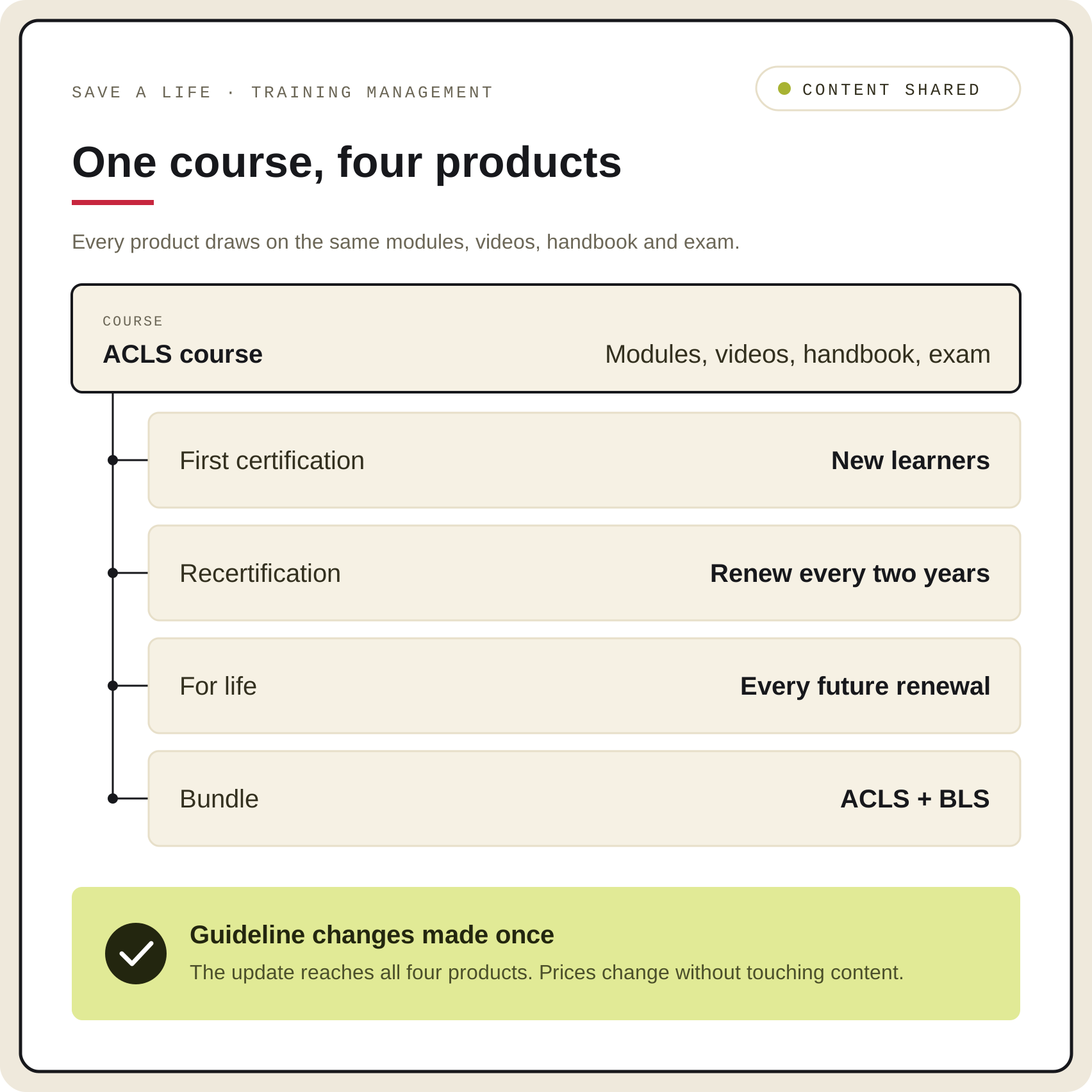
Many LMS setups lose history during annual retakes. Core dna keeps enrollments, completions, and certificates on the same profile as orders, payments and memberships. Certificate rules, credit types, and renewal cycles live on course and enrollment records, so each accreditation period can have its own course version while the learner keeps their full history.
Passing a course issues a personalized PDF certificate with the issue date, a renew-by date and a QR code for verification. You can query or export every record to a BI tool or BigQuery.
Give each client organization its own academy
Several academies can run on one instance, each with its own branding, access rules, pricing, and course catalog. Partner organizations get admin access limited to their own courses and groups, with learner, organization manager, and administrator roles enforced at the data layer.
Client admins manage their own users and reports without touching system-wide settings. Delivering courses on a client's own website is configured during the build, using the same API that serves Core dna content to any site, app, or partner feed.
Assign courses in bulk or automatically
Client admins can assign courses to whole groups from their dashboard, and new users can be added to the right groups automatically. Enrollment also happens on payment, since a completed checkout creates the enrollment and opens the course.
Teams can make assignments in plain language through Claude, ChatGPT, or Copilot via the Core dna MCP server. Each change made that way shows a diff and goes through approval before it takes effect, with an audit log and rollback if a run fails partway.
Live classes and webinars built around your programs
Custom entities let teams model courses, programs, accreditation periods and client organizations as first-class records. As part of the implementation, you scope and build live classes, webinars, and interactive classrooms around your programs, rather than choosing from a fixed feature list.
Sell courses, seats and memberships without a separate store
Sell courses as one-time purchases, bundles, subscriptions, or memberships, with coupons and pricing rules by user group and country. Payments run through Stripe, Apple Pay, Google Pay, and PayPal, with no transaction fees on course sales. Access opens as soon as checkout completes and is removed if a member cancels, so nobody has to reconcile a store against the LMS.
Connect to the systems around learning
CRM and ERP systems such as HubSpot, Salesforce, and NetSuite connect through Core dna's orchestration layer. Through its APIs, Core dna can also send completions to a client's HR system, import employee records, and trigger onboarding for new hires. Learners sign in through SSO, OAuth, or passkeys.
Migration handled by our team, with no per-learner fees
Every Core dna build is set up around how your programs run, so implementation is priced separately from the subscription, and we agree on the scope and timeline with you at the start. Our own team handles the migration. We move your members, orders, enrollments, completions, and certificates into a test copy of your site first, then check them against Saba before launch.
One subscription covers the software, hosting, security, and support. There are no per-learner fees, so your costs don't rise as more people take your courses.
How Save a Life Replaced Three Platforms with Core dna
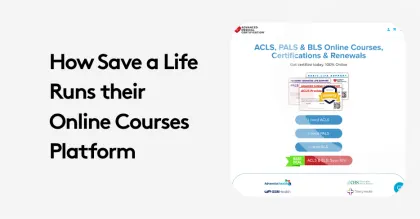
Save a Life delivers CPR, BLS and certification training at scale. Before Core dna, it ran WordPress for content, a standalone LMS for courses and a separate ecommerce system for payments, across several websites.
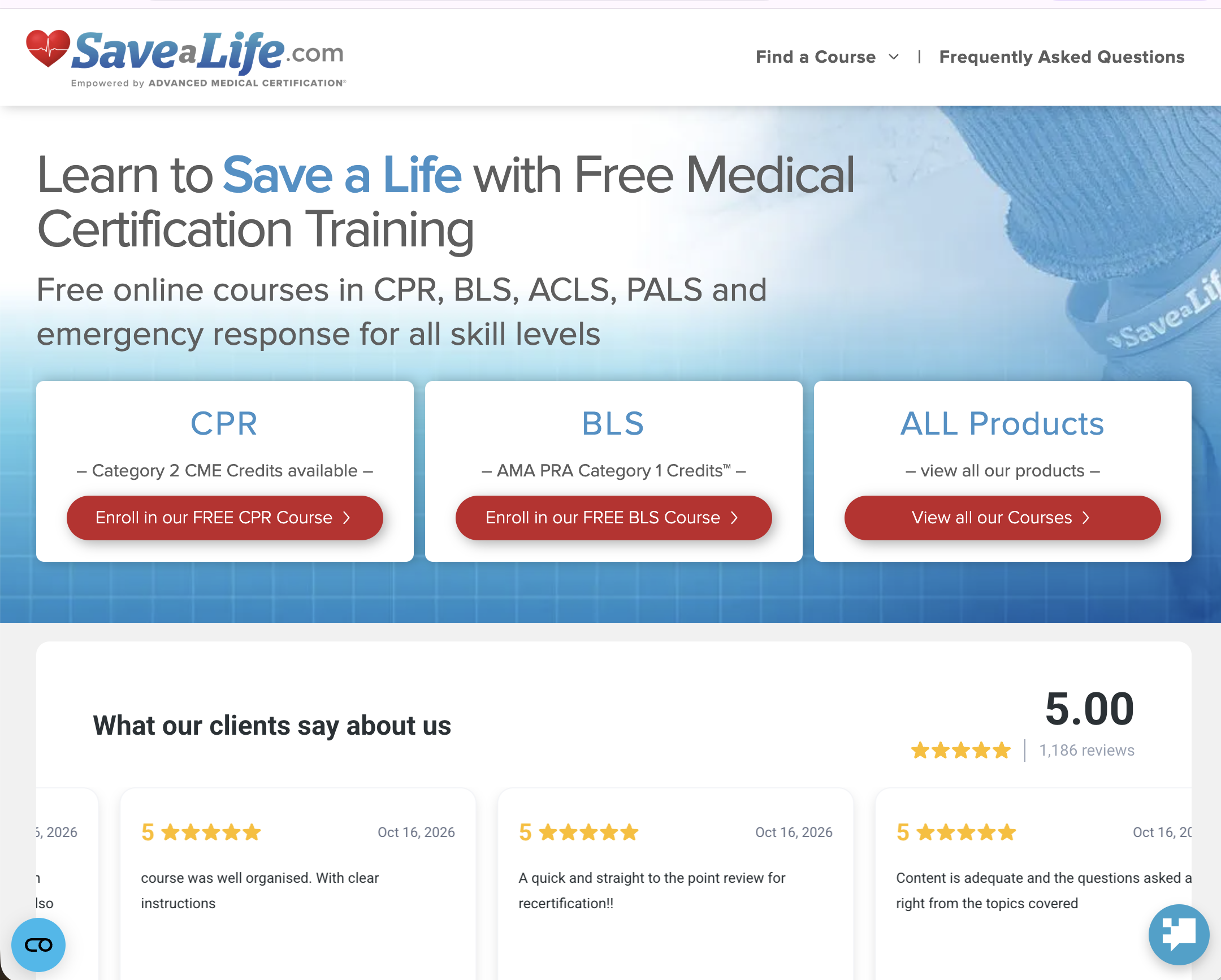
Learners had an inconsistent experience moving between them, and the team had to coordinate every update across tools. The team spent more than a year trying to build its own system before deciding to put that time back into delivering training.
On Core dna, Save a Life modeled its training around custom entities for courses and certification paths, question banks, learner progress, and certification records. The workflow engine handles progression rules, scoring, pass/fail conditions, and immediate certificate delivery. Its marketing pages, checkout, and courses now run on one platform with one login, and no plugins or middleware.
As the team put it, "we didn't want a bloated university-style LMS. We needed something lean, fast, and built for marketers."
5 Other Saba Cloud Alternatives
If you're comparing more options, these five platforms also come up in Saba replacement projects.
Cornerstone Workforce AI

Cornerstone Workforce AI is the platform Cornerstone offers Saba customers who want to stay with the vendor. Cornerstone supports the move with data migration tooling, certified partners, and a customer community.
Key features:
- Automated data migration and certified partners for Saba customers
- Cornerstone Extended Enterprise, listed as its own product, for scaling and monetizing training for customers, partners, and association members
- A customer community where upgrading customers can work directly with Cornerstone experts
Limitation: External training sits in Extended Enterprise, which Cornerstone lists as a separate product from Workforce AI, and its datasheet doesn't explain how course sales work. Teams on older Saba setups without branded external sites still have to migrate to get them.
Docebo

Docebo is an enterprise LMS that supports separate branded learning experiences for partners, customers, franchisees and resellers, each with its own admin rights.
Key features:
- An ecommerce app for selling courses, catalogs and certifications, with subscriptions, bundles and upselling
- Payment options including PayPal, Stripe, Adyen and Authorize.net
- Separate design, login experience, and catalog for each audience
Limitation: Ecommerce is a paid add-on, and extended enterprise is either a separate add-on or capped at 10 domains on the Enterprise plan. Pricing is based on active users with a one-year minimum contract.
Absorb LMS

Absorb LMS serves employee, customer, and association training, with commerce included in the base product.
Key features:
- A free, built-in shopping cart in every instance
- Member and non-member pricing through availability rules
- Bundles, coupons and bulk seat purchases through enrollment keys
- More than 70 payment gateways and local currency pricing
Limitation: Absorb's ecommerce covers course sales inside the LMS, and its ecommerce page doesn't mention memberships, events, or other products. Organizations that sell beyond courses, or that need to manage a public website, typically run those in separate systems.
LearnUpon

LearnUpon sells its LMS as three separate products, one each for employee training, customer education, and associations.
Key features:
- Portals that create separate learning environments for different audiences from one account
- Single sign-on and Salesforce and HubSpot integrations
- Ecommerce positioned as a revenue channel for associations
Limitation: For customer education, ecommerce, white labeling, and group branding are part of the Enterprise plan, which starts at 300 users.
TalentLMS

TalentLMS is a cloud LMS for small and mid-size teams, with published pricing tiers.
Key features:
- Branches that separate audiences within one account
- SSO with SAML 2.0, LDAP, and OpenID Connect
- Course sales through PayPal and Stripe
- Annual plans at 20% less than monthly billing
Limitation: Pricing is based on unique monthly logins, with caps of 100, 500, and 1,000 users on the main plans, plus $6 per additional user on Pro. Branches are limited to 1, 3, or 15 depending on the plan.
Replace Saba With Core dna
Most Saba replacements still leave the store, website, and client portals in separate systems. Core dna runs learning, content, and commerce on one platform, configured around your programs.
- Each client organization gets its own branded academy and its own admins.
- Assign courses in bulk or automatically as new users join.
- One record per learner carries completions and certificates across every accreditation period.
- Courses, seats, and memberships sell inside the platform, with no transaction fees and access tied to payment.
- Core dna's team maps, test-migrates, and reconciles your Saba data before launch, well ahead of the 2027 deadline.
See how your Saba programs would run on Core dna. Book a demo!
Summarize with