When you evaluate a franchise website platform, you're not choosing a simple website for the brand. You're choosing the system that head office, every franchisee and, if you sell online, every store will work in each day. That makes it a bigger project than a standard website build, with more to check before you sign:
- Your setup. One central website with store pages, franchisee-edited location pages, microsites or separate franchisee websites.
- Every location online. A page for each location, a store locator, and store markup so search engines and AI assistants read each location the same way.
- Franchisee access. What each franchisee can edit, who approves their changes, and how every change is recorded.
- Orders by store. Whether online orders go to the store that can fill them, and how each sale is credited to the franchisee.
- Your other systems. The POS, ERP, CRM, payment and shipping tools the website has to connect to.
- The long run. Who builds the platform, who maintains it, and what it costs to add a location.
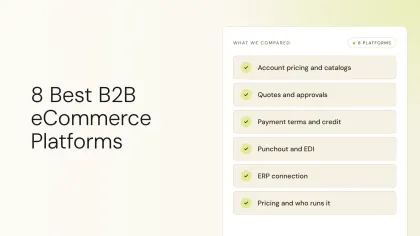
We looked at eight platforms that can each do the job in their own way. Which one fits depends on your setup and what your network needs.
Below, you'll find how to choose a franchise website platform, the 8 best platforms of 2026 with their key features and pricing, and the questions to ask each vendor before you sign.
How to choose a franchise website platform
Before you talk to any vendor, take these three steps. They're the same ones we take with franchise networks at the start of a project.
1. Decide which setup you'll run
You'll most likely run one of four setups: one central website with store pages, a central website where franchisees edit their own location pages, microsites for each location, or separate franchisee websites. Your setup decides which platforms fit. Our guide to franchise website design and development compares the four.
2. Agree on your must-have features
Sit down with head office and a few franchisees and agree on what you need:
- Brand templates that every location inherits
- A page for each location, with store markup for search engines and AI assistants
- A store locator, and whether it should show stock by store
- Which fields franchisees can edit, and who approves their changes
- Forms and analytics by location
- An online store with stock by location, and how each sale is credited to the franchisee
- Portals for store teams and for trade customers
- Integrations with your POS, ERP and CRM
- AI assistants: what they can change, and whether their changes go through your approvals
3. Ask every vendor the same questions
Send every vendor the same questions, and ask for a demo with one of your real locations: its page, a franchisee updating their opening hours, and, if you sell online, an order going to that store. Ask what it costs to add a location, and who looks after the platform once you're live. Our request for proposal templates help you compare the answers side by side.
8 best franchise website platforms of 2026
Here are the 8 platforms we picked, and who each one suits best:
- Core dna: if you sell online from store stock and need franchisee access, store portals and trade accounts
- Adobe Experience Manager: if you're a large brand already on Adobe, with developers or an Adobe partner
- Drupal with Acquia: if you run many sites and have your own Drupal developers
- WordPress Multisite: if you have a WordPress team or agency and sell little online
- HubSpot Content Hub: if your marketing team leads and your CRM already runs on HubSpot
- Shopify Plus: if online sales come first
- DevHub: if you want templated location pages and local sites quickly
- Uberall: if you want location pages, a store locator, listings and reviews next to the website you already have
For each one, you'll see what sets it apart, how it handles location pages, the store locator, franchisee access and online orders by location, and its pricing where the vendor publishes it. We read each vendor's product pages, help center and pricing pages in November 2026. Where we say "not documented", the vendor's own pages don't mention the feature; a partner may still offer it.
1. Core dna
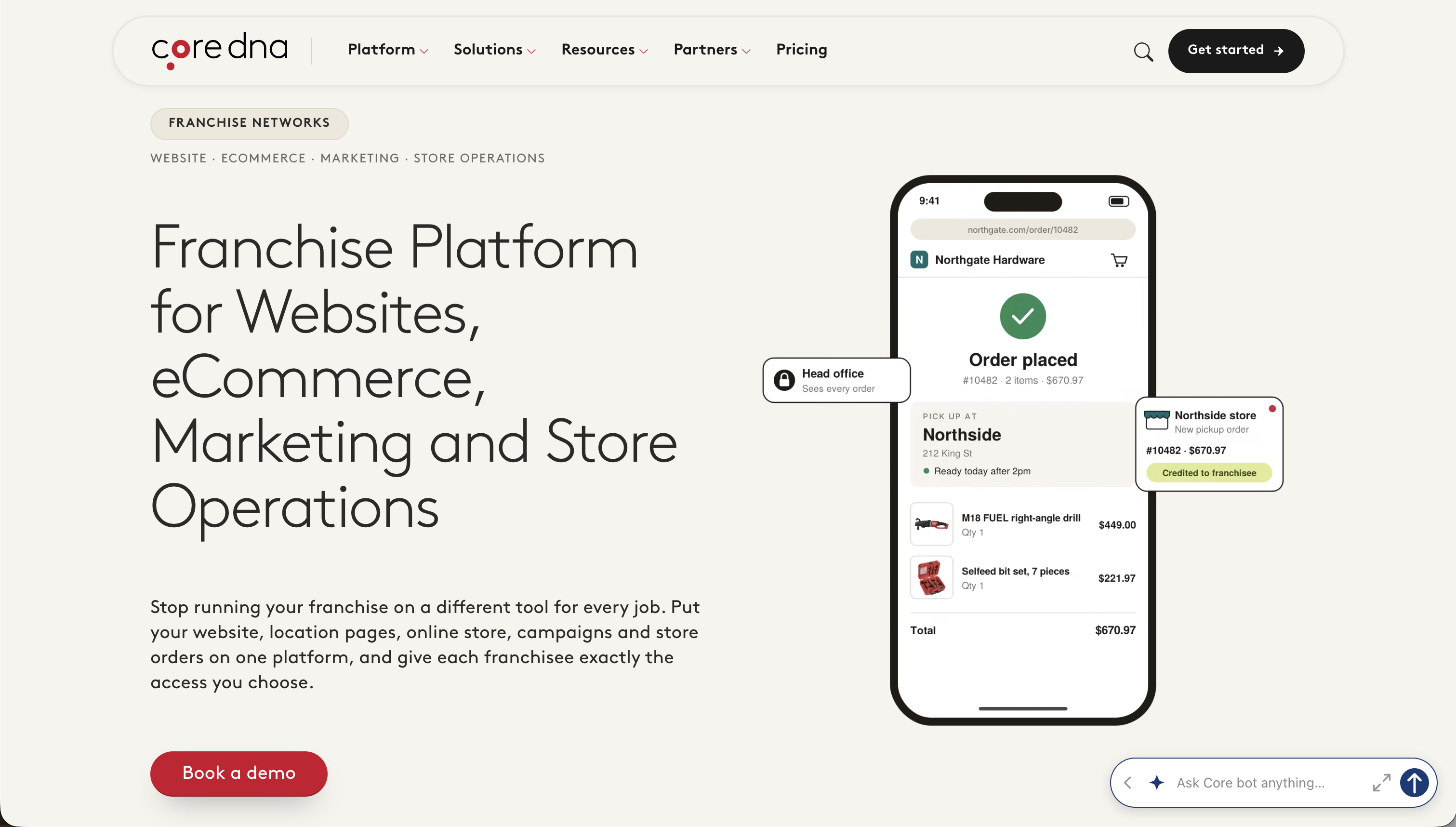
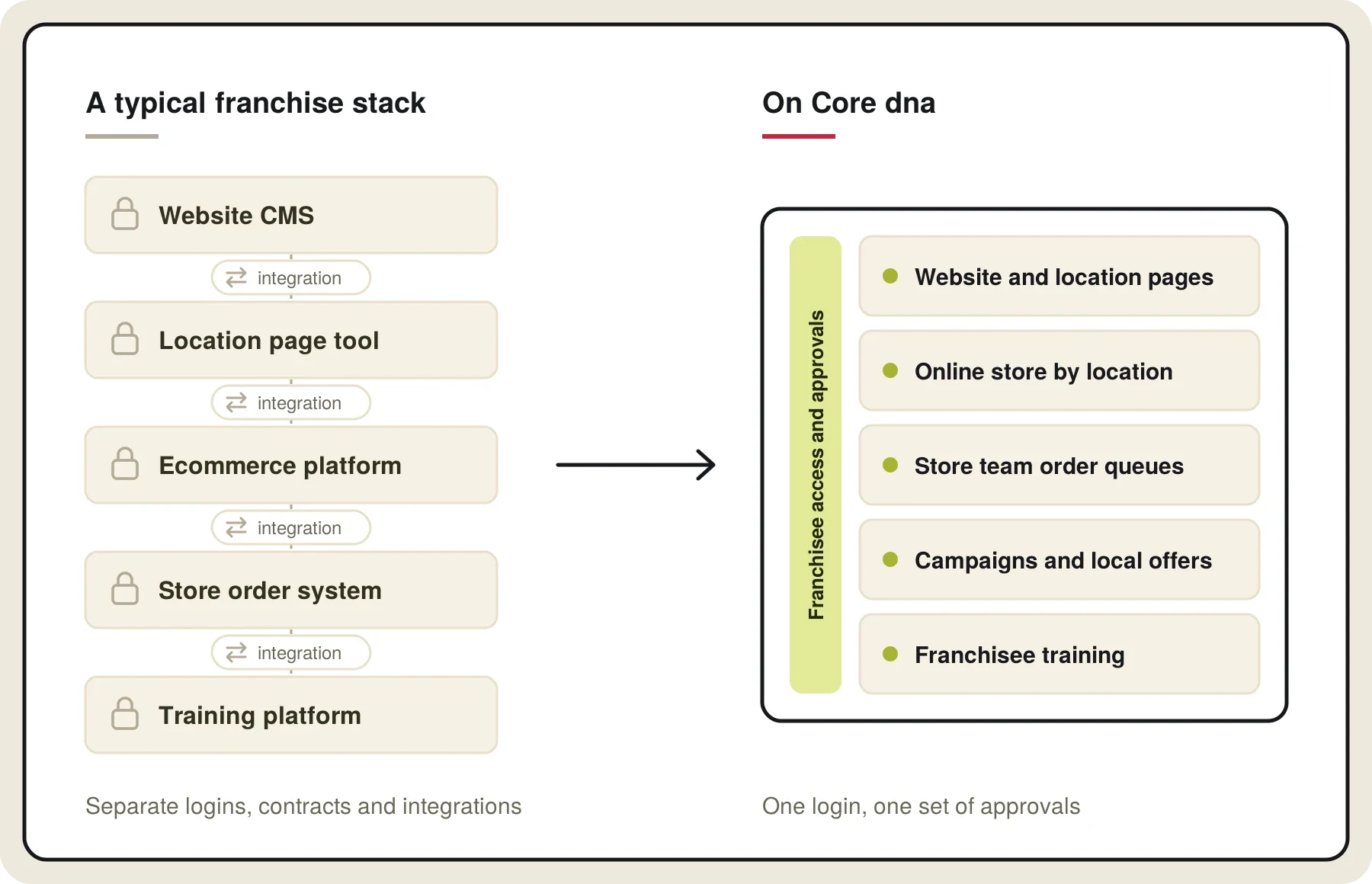
Choose Core dna if head office and every location share one website and one online store. Your main website, every location page, the online store, campaigns, store order portals and franchisee training all run on one platform, where many networks use a separate tool for each.
Where it differs most from the other seven is selling online from each store's stock: every order goes to a store that can fill it, and the sale is credited to that store's franchisee. Clark Rubber runs this across more than 60 franchise stores, and Direct Chemist Outlet is moving its 150+ franchised pharmacies onto it (see the case studies below).
Platform architecture
Unified SaaS: content, commerce, learning and orchestration on one platform and one codebase. With custom entities and workflows, you can build what your network needs on the same platform, such as franchisee onboarding.
Location pages and store locator
- A page for each of your locations from one template, on your own domain, with store markup for the address, coordinates and opening hours
- A store locator with stock by store: at Clark Rubber, every product page lists the stores that have it in stock, with their address and phone number
- Microsites or separate franchisee websites on the same platform, when a location needs more than one page
- Your listings tool, such as Yext or Uberall, alongside for Google Business Profile and reviews
Franchisee access and approvals
- You set the brand, templates, catalog and prices once, and every location inherits them
- Each franchisee gets their own login and edits only their own location, in the fields you open, such as opening hours, local offers, photos and team
- Their changes come to head office for approval before they go live
- Every change is saved as a revision you can preview and roll back
Online orders by location
- Stock by store, read from your POS or ERP
- Delivery orders go to the closest store that can fill the whole cart, and Click & Collect orders to the store your customer picks
- Each sale is credited to the franchisee whose store fulfills the order
- Each store team works through its own order queue, and you see every store from head office
- Trade and business customers get B2B accounts with credit terms, quotes and invoices, linked to the store that serves them
Training, AI and implementation
- Train new franchisees and store hires with courses and assessments in the built-in learning management system
- Let AI assistants such as Claude and ChatGPT update location pages, offers and prices through Core dna's MCP server, with their changes going through your approvals
- Most franchise networks go live in 6 to 10 weeks, and the people who build the platform run your implementation
Plans and pricing
Plans are scoped to the sites, stores and volume you run, with no per-seat charges, so adding franchisees or store staff doesn't change your price.
Ask Core dna: which integrations you'll need at launch (POS, ERP, shipping), and what the working prototype in discovery will cover for one of your locations.
See a location page, an online order and a store's order queue run on one platform.
Location pages, stock by store, order routing and franchisee access on one platform, connected to your POS or ERP.
30 minutes. Bring your store list and your current website.
2. Adobe Experience Manager
 Consider Adobe Experience Manager (AEM) Sites if you're a large brand already running on Adobe. Its Multi Site Manager lets you build a source site, called a blueprint, and create live copies of it for each market or location. When you change the blueprint, the change rolls out to every live copy, and local authors can break inheritance for a single component or a whole page when a location needs its own content. Adobe's own documentation uses a national franchise system, with a central franchisor and local franchisees, as its example.
You'll need developers or an Adobe partner to build your location pages, store locator and any franchisee-facing tools. If you sell online, you'll license Adobe Commerce separately and connect it to AEM through Adobe's Commerce Integration Framework.
Platform architecture
Cloud service (AEM as a Cloud Service), with managed and self-hosted options for existing customers.
Location pages and store locator
Your developers or partner build them with AEM templates and components. Adobe doesn't document a packaged store locator.
Franchisee access and approvals
You get user groups and permissions per site, review and approval workflows, and Multi Site Manager inheritance that local authors can break for specific components or pages.
Online orders by location
Through Adobe Commerce. Stock by store, and sending orders to your franchisee stores, depend on how you set up Adobe Commerce and your order management.
Plans and pricing
Adobe doesn't publish AEM prices, so you'll need a quote from Adobe sales.
Ask Adobe: who will build your location pages and store locator, and what it costs to add a location once you're live.
3. Drupal with Acquia
 Consider Drupal with Acquia if you run many sites and have your own Drupal developers. Drupal is an open-source CMS, and Acquia runs its best-known enterprise cloud. With Acquia's Multi-Experience Operations, you run many Drupal sites from a single codebase: you can push code changes to the whole portfolio or to groups of sites on their own schedule, and copy a proven site as the starting point for the next one.
For your network, that usually means a template site for each location or region, which your developers or a Drupal agency build and maintain. Drupal core gives you roles and permissions, content moderation and editorial workflows. Location pages, store locators and ecommerce come from contributed modules, such as Drupal Commerce, or custom development.
Platform architecture
Open source, on Acquia's cloud or any Drupal host.
Location pages and store locator
You'll build them with contributed modules and custom development. Nothing is packaged.
Franchisee access and approvals
Roles, permissions, content moderation and workflows come with Drupal core. You configure how each franchisee is limited to their own location in your project.
Online orders by location
Drupal Commerce or an integration with another commerce platform. Stock by store and crediting your franchisees are custom work.
Plans and pricing
Drupal is free. Acquia doesn't list a price for multi-site operations on its product page, and you'll pay separately for the agency build and maintenance.
Ask your Drupal partner: who maintains the codebase and modules across every location site, and how updates are tested before they reach your whole network.
4. WordPress Multisite
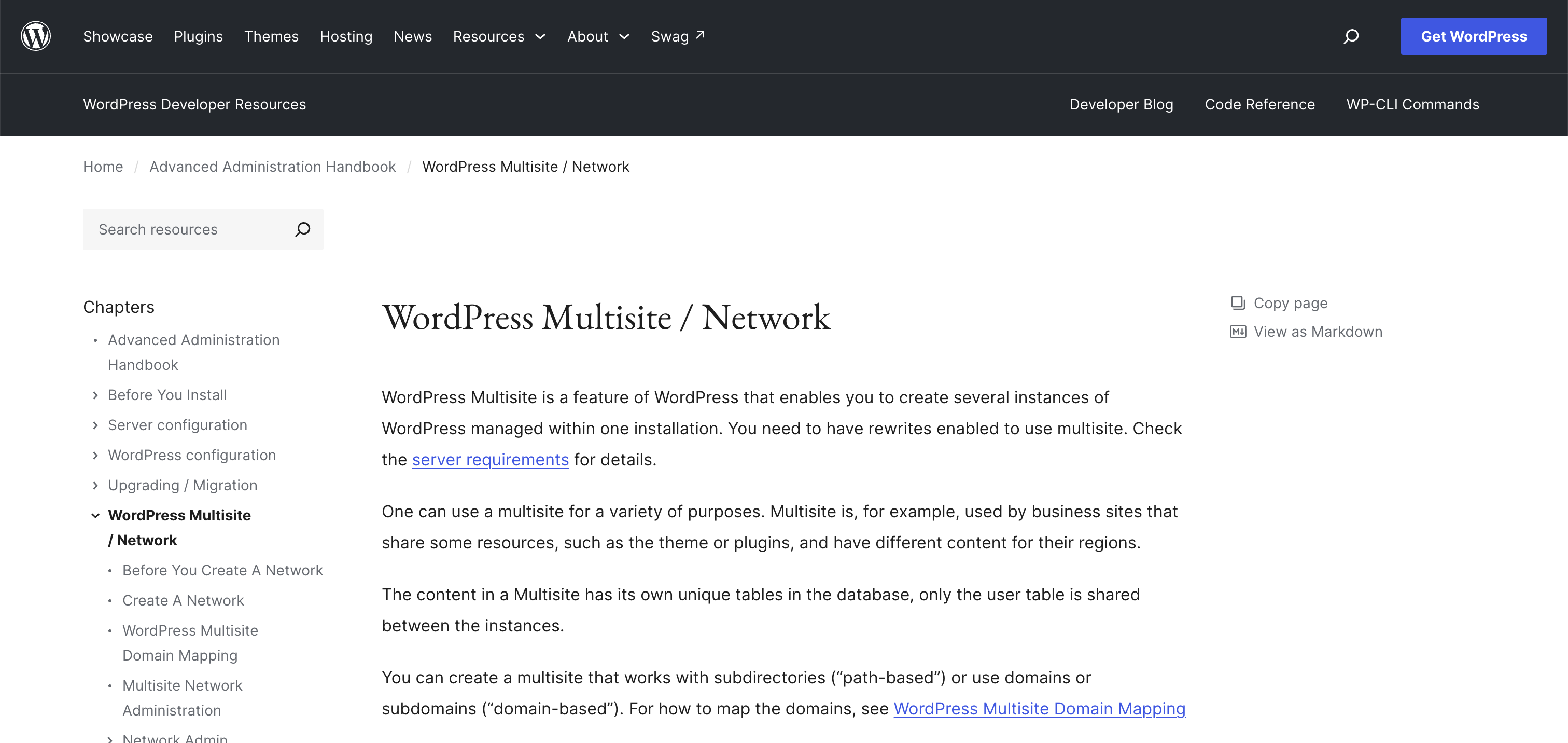
Consider WordPress Multisite if you have a WordPress team or agency and sell little online. Multisite runs a network of sites from one WordPress installation. A super admin manages the network, its themes and plugins, and each site can have its own administrators. Sites can sit on subdomains or subfolders of your main domain, which makes it a common choice for networks that give each location its own site.
You'll get most franchise features from plugins or an agency build: location pages, store locators, approvals beyond WordPress's built-in roles and pending review status, and ecommerce through WooCommerce. WordPress now has an official MCP Adapter plugin, so AI assistants can work on your sites inside WordPress user roles. For more on the trade-offs, see WordPress CMS vs modern platforms.
Platform architecture
Open source, self-hosted or on managed WordPress hosting.
Location pages and store locator
Through plugins, such as Sitelets for local pages, or a custom theme.
Franchisee access and approvals
Site administrators and WordPress roles, with a pending review status for contributors. For detailed approvals and audit trails, you'll need plugins.
Online orders by location
WooCommerce on each site, with plugins or custom development for stock and orders by location.
Plans and pricing
WordPress is free. You pay for hosting, plugin licenses and agency time, and you or your agency keep every site updated and secure. Managed enterprise hosting, such as WordPress VIP, is priced separately.
Ask your agency: how many plugins your network will rely on, who updates them, and what happens to every location site when one of them breaks.
5. HubSpot Content Hub
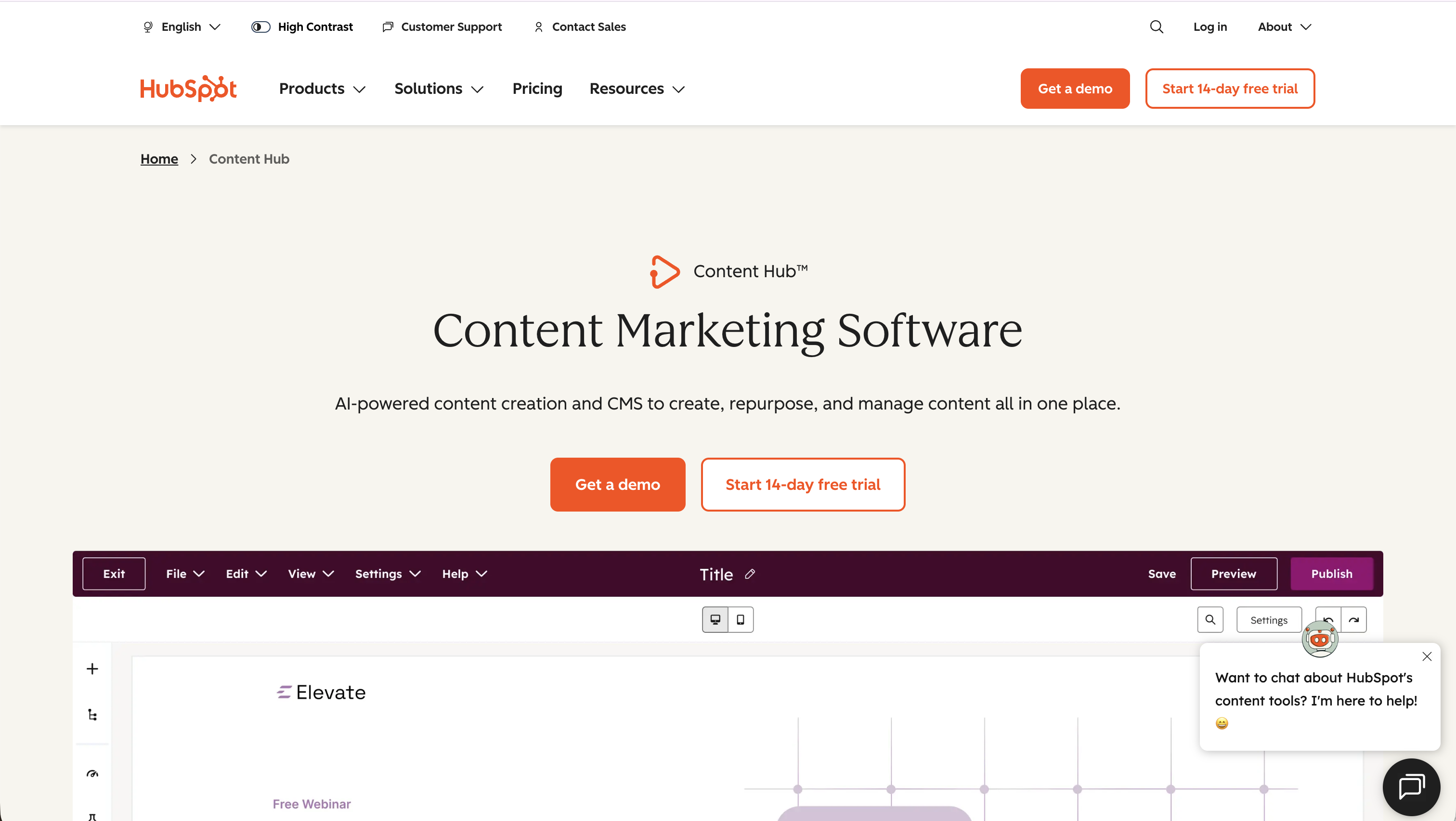 Consider HubSpot Content Hub if your marketing team leads and your CRM already runs on HubSpot. Content Hub is HubSpot's CMS, so your website, forms, email and lead routing sit on the same platform as your CRM.
On Enterprise, you get hosting for up to 10 root domains, content partitioning so teams only see their own content, and up to 300 teams. Professional gives you content staging and approval workflows. You'll usually build location pages as dynamic pages from HubDB tables or, on Enterprise, from custom objects such as a location directory. HubSpot doesn't document a built-in store locator or an online store with stock by location, so if you sell online by store, you'll connect a commerce platform such as Shopify.
Platform architecture
SaaS, part of the HubSpot customer platform.
Location pages and store locator
Dynamic pages from HubDB or custom objects, built by your team or a HubSpot partner. For a store locator, you'll need an app or a custom build.
Franchisee access and approvals
Approval workflows on Professional. Content partitioning and team permissions on Enterprise.
Online orders by location
Not documented in Content Hub. You'll need an integration with a commerce platform.
Plans and pricing
HubSpot publishes its prices. In January 2026, Content Hub Professional started at $450 a month billed annually, with 3 core seats, and Enterprise started at $1,500 a month, with 5 core seats. Extra seats were $45 and $75 a month.
Ask HubSpot: which of the features you need are Enterprise only (partitioning, extra domains, custom objects), and how many seats your franchisees will need.
6. Shopify Plus
Consider Shopify Plus if online sales come first. Plus supports up to 200 inventory locations and nine expansion stores, includes B2B with unlimited catalogs, and tracks inventory and fulfills orders by location. Your store teams can fulfill online orders through Shopify POS, and POS Pro adds in-store pickup and flexible delivery; the first 20 POS Pro locations are included with Plus.
Shopify is built for selling, so the franchise side of your website takes extra work. You'll add location pages and a store locator through apps or theme development, and Shopify doesn't document location pages or franchisee access to local content. Clark Rubber ran its franchise ecommerce on Shopify Plus before moving to Core dna in 2022. If you're on Shopify Plus today, see our guide to Shopify Plus alternatives.
Platform architecture
SaaS.
Location pages and store locator
Through Shopify apps or theme development.
Franchisee access and approvals
Staff roles and permissions. Franchisee access to local content isn't documented.
Online orders by location
Inventory and fulfillment by location, in-store pickup and delivery through POS Pro, and B2B on Plus. Paying each franchisee for the orders their store fulfills isn't documented, so plan for an app or your own finance process.
Plans and pricing
Shopify publishes its Plus price: $2,300 a month on a three-year term or $2,500 a month on a one-year term, and Shopify may add a variable platform fee based on your revenue. Card rates start at 2.25% + 30¢.
Ask Shopify or your Shopify partner: which apps you'll need for location pages, the store locator and franchisee payouts, and what they add to your monthly cost.
7. DevHub
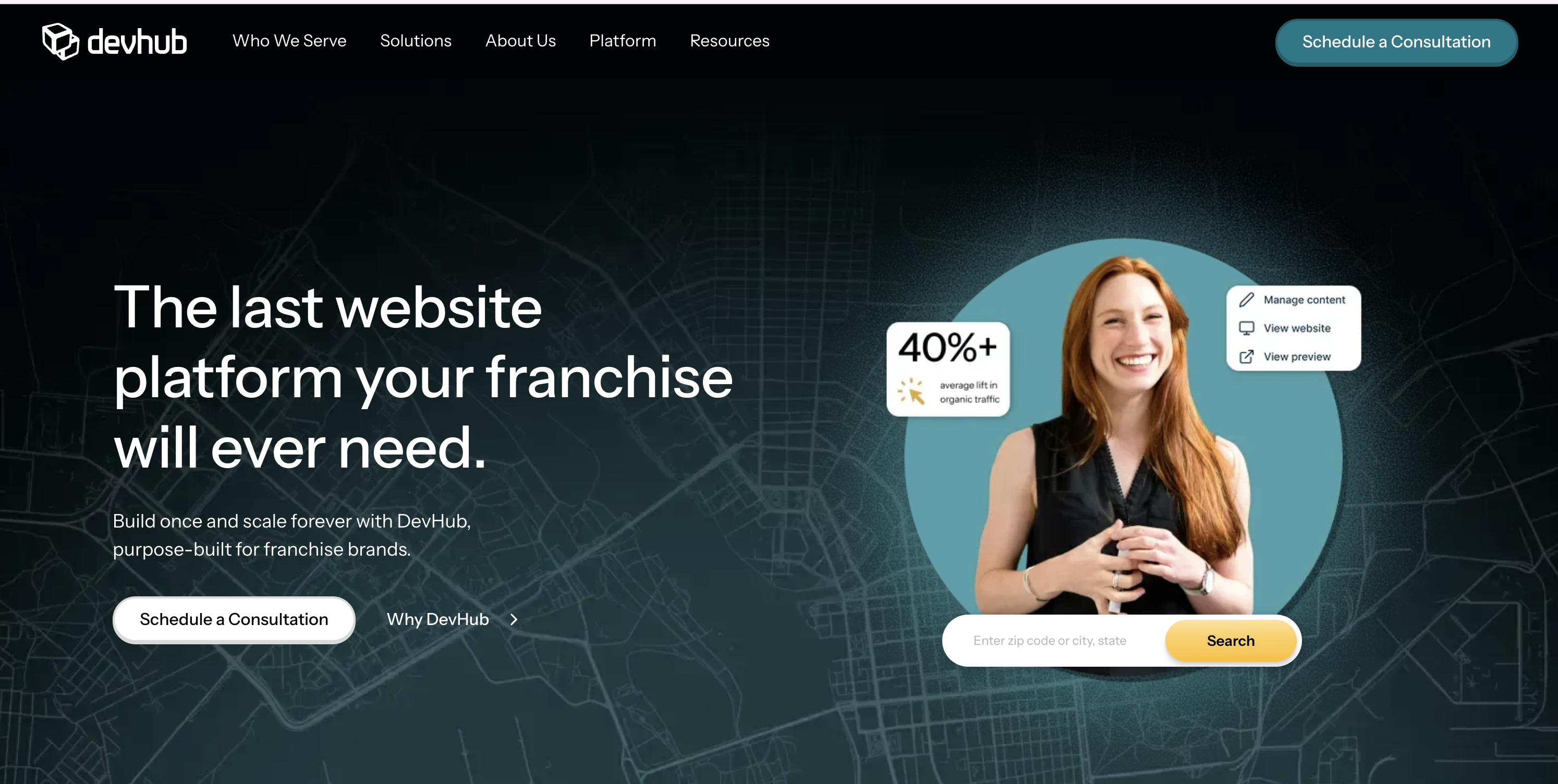
Consider DevHub if you want templated location pages and local sites quickly. You start from one central template, or set brand requirements by region, and update every location from one dashboard, with every change tracked and reversible. Your franchisees can edit predefined blocks of content and images, such as services, promotions, photos, blogs and testimonials, within brand-safe limits.
Its store finder gives your customers geolocation, address search, radius search and custom filters, and it syncs hours, phone numbers and addresses from Google Business Profile. DevHub recommends a subdirectory of your domain for most franchise brands. Ecommerce, online ordering and order portals aren't documented on its franchise pages.
Platform architecture
SaaS, with location pages on a subdirectory of your domain for most franchise brands.
Location pages and store locator
Built in: location pages, local sites and a store finder.
Franchisee access and approvals
Permissions to edit predefined blocks, with changes tracked and reversible. An approval workflow isn't documented.
Online orders by location
Not documented.
Plans and pricing
On request. You pay a one-time implementation cost and a recurring annual cost, based on the size of your system, your integrations and how much DevHub builds.
Ask DevHub: how your location pages connect to your main website and online store, and what the annual cost covers as you add locations.
8. Uberall
Consider Uberall if you want location pages, a store locator, listings and reviews next to the website you already have. Its Locator and Local Pages give each of your locations a crawlable page with structured data, with no limit on the number of pages. Uberall can host them on a subdomain, or your web team can add them to your own site with a snippet and some server configuration.
Uberall also manages your Google Business Profile and other listings, replies to reviews with AI, and offers UB-I, an AI agent for location performance. Permissions by brand, region and location, with approval workflows for location data, come with its Collaborate Plus add-on. Uberall doesn't run your main website or an online store, so you'll use it alongside your website platform.
Platform architecture
SaaS.
Location pages and store locator
Built in, hosted on a subdomain or added to your own site.
Franchisee access and approvals
Permissions and approval workflows for location data through the Collaborate Plus add-on.
Online orders by location
Not included.
Plans and pricing
Uberall doesn't publish prices, so you'll need a quote for its plans and the Locator add-on.
Ask Uberall: whether your location pages will sit on a subdomain or your main domain, and how they link to your website and online store.
Which franchise features are built in, and which need another tool?
Every platform on this list can give each of your locations a page. Where they differ is franchisee access and selling online by store.
A built-in feature is part of the platform you license, and it's maintained with it. An app, plugin, module or partner build adds another product or custom code, with its own owner, costs and upkeep for you to manage.
| Platform | Location pages | Store locator | Franchisee access and approvals | Online store with stock by location | Store team and B2B portals |
|---|---|---|---|---|---|
| Core dna | Built in | Built in, with stock by store | Built in, by location | Built in | Built in |
| Adobe Experience Manager | Partner build | Partner build | Built in: permissions, workflows, live copies | Adobe Commerce, licensed separately | B2B through Adobe Commerce; store portals are a custom build |
| Drupal with Acquia | Modules and custom build | Modules | Roles and content moderation built in | Drupal Commerce or an integration | Custom build |
| WordPress Multisite | Plugins or custom theme | Plugins | Roles built in, approvals through plugins | WooCommerce, with custom work for stock and orders by location | Plugins or custom build |
| HubSpot Content Hub | HubDB or custom objects | App or custom build | Approvals on Professional, partitioning on Enterprise | Integration, such as Shopify | Not documented |
| Shopify Plus | Apps or theme development | Apps | Staff roles; franchisee content access not documented | Built in, up to 200 locations | B2B built in; store teams fulfill orders in Shopify POS |
| DevHub | Built in | Built in | Local editing within brand templates | Not documented | Not documented |
| Uberall | Built in | Built in | Collaborate Plus add-on | Not included | Not included |
What about AI assistants?
Several platforms on this list now offer AI assistants or MCP connections, including Uberall, WordPress and Core dna. Ask what an assistant can change (location pages, offers, products or prices), and whether its changes go through the same approvals as your team's.
Our take
In the franchise projects we've delivered, the hardest parts are usually franchisee access and orders by store: who can change what, and which store fills each online order. Test both with one of your real locations before you choose.
Franchise website case studies: Clark Rubber and Direct Chemist Outlet
Here's how two franchise networks run on Core dna.
Clark Rubber
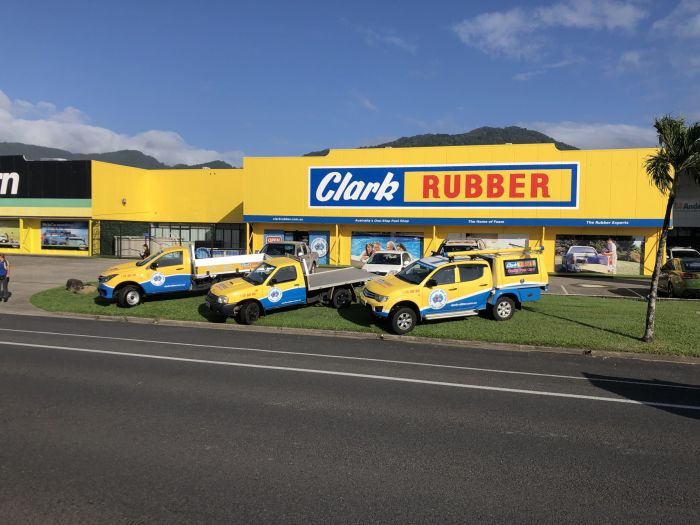
Clark Rubber is an Australian franchise retailer of pool, rubber, foam and cleaning products with more than 60 stores. It moved its franchise ecommerce from Shopify Plus to Core dna in 2022. Each store has its own page built from one template, every product page shows stock by store, delivery orders go to the closest store that can fill the whole cart, and each sale is credited to the franchisee whose store fills it. Read how Clark Rubber manages stock across 60+ franchise stores.
Direct Chemist Outlet
Direct Chemist Outlet is an Australian pharmacy group with more than 150 franchised pharmacies. It's moving its website and store operations onto Core dna: consumers and business customers shop on one website, delivery orders go to a pharmacy by state, then by stock and distance, and each pharmacy works through its online orders in one store portal. Read the Direct Chemist Outlet story.
Best franchise website platforms: FAQ
Most franchise networks go live in 6 to 10 weeks, and the people who build the platform run the implementation.
- Week 1: we map your locations, catalog, store data and who edits what.
- Weeks 2 to 5: your templates, the location page template, head office and franchisee permissions, and the catalog and stock feeds.
- Weeks 6 and 7: content is migrated and mapped, redirects are set up, and each location's team is onboarded.
- Weeks 8 to 10: launch, with your implementation lead on standby.
After launch the same team stays on, with a dedicated success manager and quarterly business reviews.
Summarize with