Why is B2B eCommerce so essential and successful?
B2B eCommerce is crucial due to digitalisation, enhancing reach, recognition, and offering numerous benefits like cost savings and 24/7 support.
B2B eCommerce is now so essential and successful as the digitalisation of everything is the expectation and reality, applying to even B2B commerce.
Even if one’s B2B business has physical brick and mortar, for the sake of better reach, recognition and opportunity, marketing as eCommerce allows B2B to transcend borders. There are a plethora of reasons that answer this question; from cost savings, globalization, automation, 24/7 support… Find out in the blog below:
Related Questions
Yes. eCommerce in Core dna is a native capability, not a plugin. That includes customer-specific and contract pricing, product catalogue management, subscription billing, multi-currency, and order management. For B2B operations specifically, RFQ workflows, account hierarchies, net payment terms. Core dna is built to handle these natively rather than requiring third-party plugins to fill the gaps.
What is a unique selling point?
A USP is a promise that answers the question, “Why should someone buy from you instead of another brand?” It's about understanding what makes your product, service and brand truly different and unique.
What do you offer your customer that they can't find anywhere else. By defining your USP, you are able to communicate clearly the benefits and resonate with your audience.
Effective USPs show how that unique trait translates into a tangible payoff for the end user. Basically you should be able to answer a user that says: “What’s in it for me?”
Why your brand needs a strong USP
- A strong USP can help you differentiate and standout in a noisy world. When you can formulate your USP clearly, you create your blue ocean and a new market that is distinctly yours.
- When you value proposition is strong, it make it easier for online visitors to convert. When your USP is front-and-center, it decreases confusion and helps potential buyers act with confidence.
- A well-defined USP anchors your entire brand communication. Every ad, landing page, or pitch can revolve around this key differentiator.
- A compelling USP often justifies premium pricing or fosters loyalty, because customers view what you offer as one-of-a-kind.
Common Challenges Brands Face When Defining a USP
Why brands often struggle to communicate their core value effectively?
- Unclear Value Proposition
- Many websites bury their real message under jargon or flashy design. Users leave feeling unsure about what the business actually does.
- Marketers sometimes focus too heavily on features, forgetting to express tangible value or how they solve specific problems.
- Attempting to Be Everything to Everyone
- Companies fear narrowing their focus, thinking they might miss potential customers.
- Result: broad, watered-down messaging that doesn’t resonate strongly with any particular audience.
- Confusion Between UVP and USP
- Brands conflate “Value Proposition” (customer-centric) with “Selling Point” (product-centric).
- Without clarity, they end up with vague statements that address neither the product’s unique features nor the customer’s exact needs.
- Ignoring the Customer’s Perspective
- Some businesses talk only about their achievements, technology, or self-perceived greatness.
- They forget to explain which problem they solve and why that matters to the end user.
USP vs. UVP: Is There a Difference?
Unique Selling Point (USP):
- Product-Centric: Focuses on a singular attribute that makes the product or service unique.
- Competitive Advantage: Often highlights a feature, technology, or method that’s exclusive to you.
- Selling Proposition: Communicates how you outdo others in the marketplace.
Unique Value Proposition (UVP):
- Customer-Centric: Emphasizes what the user gains (i.e., how their life improves).
- Benefit-Oriented: Addresses practical or emotional advantages from the user’s perspective.
- Value Proposition: Usually more holistic, describing the overall experience or outcome the customer receives.
In Practice:
A USP can be part of a bigger UVP. For instance, your USP might be “fastest beard trimmer blades,” while your UVP might be “Look and feel your best in minutes—every day.” The USP explains why it’s uniquely better, and the UVP explains the value a customer gains.
Crafting an Effective USP
- Pinpoint the Core Difference
- Start by listing all your product’s distinguishing features. Is there a patented mechanism, a specialized process, or a unique guarantee?
- Choose the one that truly matters most to your target audience.
- Translate Features into Benefits
- Don’t stop at “We have the sharpest blades.” Ask: How do sharp blades benefit the user? Maybe it’s a “clean shave in half the time” or “no skin irritation.”
- Validate with Real Feedback
- Ask actual customers or do user testing to see if your perceived uniqueness resonates in real-world scenarios.
- A difference you consider noteworthy might be trivial to buyers—or vice versa.
- Keep It Concise
- A USP often works best as a short, punchy line (one or two sentences) that can appear on your homepage, packaging, or elevator pitch.
- Avoid heavy jargon; aim for language your audience understands immediately.
- Weave It Across Channels
- Integrate the USP consistently into your website’s hero section, ad campaigns, and sales decks.
- Ensure everyone from your marketing team to your customer support knows and reiterates the USP.
Examples of Clear USPs
- Domino’s Pizza: “You get fresh, hot pizza delivered to your door in 30 minutes or less—or it’s free.”
- (Highlighting speed, guaranteed timeframe.)
- FedEx: “When it absolutely, positively has to be there overnight.”
- (Emphasizing reliability and speed.)
- Dyson Vacuums: “No loss of suction.”
- (Pinpointing a specific, exclusive technology advantage.)
- Slack: “Make work simpler, more pleasant, and more productive.”
- (Although slightly broader, it’s still a distinct promise focusing on how Slack stands out from other work communication tools.)
Common Mistakes in Defining a USP
- Being Too Vague
- “We deliver quality and excellence.” That’s not unique—everyone claims quality.
- Instead, specify your unique form of “excellence” (e.g., delivering to remote locations overnight or a lifetime warranty no one else provides).
- Overloading with Jargon
- Technical or corporate-speak can dilute clarity. Keep the language straightforward enough that a new visitor instantly “gets it.”
- Ignoring the Competition
- If your competitor also does free 2-day shipping, that’s not unique. You need an angle that’s truly distinctive.
- Do competitive research to ensure you’re highlighting something that sets you apart.
- Failing to Integrate
- Even a brilliant USP won’t help if it’s hidden or inconsistently referenced.
- Place it front and center in your main messaging, and ensure all channels reflect it.
- Choosing an Unimportant Differentiator
- If you tout a minor detail that doesn’t impact buyer decisions, your USP will fall flat.
- Focus on what your audience really cares about: time savings, cost, innovation, reliability, or specific solutions to their problems.
How to Refine (or Rediscover) Your USP
- Ask Your Existing Customers
- Send surveys or conduct interviews: “What made you choose us over other options?”
- Their answers reveal real-life perceptions of your uniqueness.
- Leverage Competitive Analysis
- Identify competitor messaging and USPs.
- Determine what gap or angle you alone can fill.
- Test Multiple Variations
- Use A/B testing on landing pages or ads to see which USP resonates best in terms of clicks or conversions.
- Align with Corporate Goals
- If your strategic focus is innovation, ensure your USP highlights how you’re pioneering a new approach.
- If sustainability is your anchor, your USP might revolve around eco-friendly practices that no one else matches.
- Evolve Over Time
- Markets, technologies, and consumer needs change. Update your USP when those shifts occur so you remain relevant.
A well-defined Unique Selling Point is critical in helping potential customers understand why they should engage with you—and it can stop them from walking away to a competitor that shouts their differentiation more clearly. In an environment where many businesses “aren’t sure what they do” or fail to communicate it effectively a strong USP stands out as a beacon of clarity.
Frequently Asked Questions about Unique Selling Points
How is a USP different from a slogan or tagline?
While a slogan or tagline might express a USP in a memorable way, they're not the same thing. A USP is the fundamental differentiation strategy that underlies your business, while a slogan is a creative expression designed for brand recall. Many successful slogans directly communicate the USP (like M&M's "Melts in your mouth, not in your hands"), but the USP itself is the strategic concept behind the creative execution.
Can a company have multiple USPs?
While a business might have several competitive advantages, focusing on a single, powerful USP typically creates the strongest market position. Multiple USPs can dilute messaging and confuse customers. However, different product lines within the same company might have different USPs targeting specific market segments.
How often should a USP be updated?
USPs should evolve as markets change, competitors emerge, and customer needs shift. However, dramatic or frequent changes can confuse customers and erode brand equity. Most successful companies maintain their core USP for years or decades, making incremental adjustments rather than wholesale changes. According to marketing research firm IPSOS, brands that maintain consistent positioning while making tactical adjustments outperform those that frequently pivot by nearly 2:1.
Can small businesses compete with a USP against larger competitors?
Absolutely. In fact, a sharp, focused USP often allows small businesses to carve out profitable niches that larger competitors overlook or can't efficiently serve. Many successful small businesses have USPs centered on personalized service, local expertise, specialized knowledge, or catering to underserved market segments that larger companies find unprofitable.
How do I know if my USP is effective?
An effective USP typically shows measurable impact on key performance indicators like conversion rates, customer acquisition costs, repeat purchase rates, and willingness to pay. Customer research can also reveal if your target audience recognizes and values your claimed differentiation. If customers can easily articulate what makes your business unique and valuable, your USP is likely working.
What is Search Engine Optimization (SEO)?
Search Engine Optimization refers to the process of optimizing online content to give it the best chance to rank high in the search engine results page. The higher the ranking of online content, the more traffic it will drive to a brand's site.
Most content marketers focus on SEO to boost visibility and ranking which leads to increased organic traffic. And organic traffic will always be more cost-effective than any paid traffic.
By focusing on what people are searching and creating content that aligns with that search intent, businesses can win the game online search.
Effective SEO involves optimizing content quality, website structure, technical elements, and external factors such as backlinks to ensure maximum visibility online.
Does Investing in SEO Still Makes Sense in 2025?
SEO is not dead and it will probably never be. People will keep searching, whether is it on google, by asking questions to alexa or scrolling on tiktok.
While the concept of SEO is forever, the adaptation is what changes and evolves. For these reasons, investing in Search Engine Optimization (SEO) remains a powerful tool for online businesses in 2025.
Yes, the digital landscape has evolved with generative AI and user search behavior has slightly changed but SEO continues to be a foundational element of online visibility and engagement.
The rise of AI-powered search experiences, such as Google's Search Generative Experience (SGE), has shifted the focus toward more user-centric, conversational, and intent-driven content.
Organic search remains a the main driver of online traffic. Data indicates that websites ranking at the top of search engine results pages (SERPs) receive approximately 27% of all clicks, underscoring the importance of maintaining strong SEO practices to capture this valuable traffic.
Key Components of SEO in 2025
As Search Engine Optimization (SEO) continues to evolve, integrating AI technologies and adapting to the new user behaviors is essential to stay relevant. These are the key components of an effective SEO strategy today:
1. Use AI to optimize content
Use AI and understand how to integrate it in your content creation process. From keyword research to outlines and content writing, AI can help content marketers across the whole workflow. Analyze user intent and search patterns will help create highly relevant and personalized content, enhancing engagement and search rankings.
2. Focus on user-experience
User experience is what sets online experiences apart. When looking at SEO optimization, ensure your site is designed with the visitor in mind, fast-loading, mobile-responsive, and user-friendly website designs improves dwell time and reduces bounce rates, positively influencing SEO performance.
3. E-E-A-T (Experience, Expertise, Authoritativeness, Trustworthiness)
Establishing credibility through high-quality content, authoritative backlinks, and transparent business practices is crucial for maintaining strong search engine rankings.
4. We are moving away from typing and into talking
As users' behavior shoft from the classic typing your search to shouting your request to Alexa, it is important we start optimizing content for voice search queries and natural language processing.
5. Social media is a search engine
Aligning SEO efforts with social media strategies amplifies content reach and enhances brand visibility across multiple platforms.
By focusing on these components, businesses can adapt to the dynamic SEO landscape of 2025, ensuring sustained online visibility and competitiveness.
How Core dna Content Management System Supports SEO?
Core dna content management system integrates SEO tools to support our clients' content strategy.
Integrated SEO Tools
Easily manage metadata, focus keywords, and optimization directly within the Core dna platform.
SEO-Friendly Architecture
Core dna’s platform ensures fast loading speeds, mobile responsiveness, and clean URL structures to improve search rankings.
Webhook and API Integrations
Use Core dna’s webhooks and APIs for streamlined integrations, enabling seamless data exchange, workflow automation, and enhanced site performance.
By leveraging Core dna's robust platform, businesses can effectively enhance their SEO efforts, driving sustained growth and improved visibility online.
What is a Landing Page?
The debate around landing pages is never ending and for good reasons. Technically, landing page is a separate web page used to promote a specific product or marketing campaign.
It is usually optimized to create the best results whatever the goals are. Landing pages are usually combined with email marketing. PPC, social media to control the user journey once they click on a link.
Unlike a homepage, which serves as a gateway to a website’s full range of content, a landing page is focused on a single objective—whether it’s capturing leads, encouraging sign-ups, or driving sales.
Key Characteristics and Benefits
Landing pages differ from regular website pages for a few reasons:
- Single Focus: A landing page is designed around one clear goal or call-to-action (CTA). This focused approach helps reduce distractions and guides visitors toward conversion.
- Targeted Messaging: The content, design, and CTA align with the specific campaign or offer, ensuring consistency between the ad and the landing experience.
- Optimized for Conversions: Every element—from headlines to forms—works together to encourage visitors to take the desired action.
- Measurable Performance: Landing pages are central to A/B testing and analytics, allowing marketers to optimize campaigns and measure ROI.
Essential Components of an Effective Landing Page
Headline and Subheadlines
- A compelling headline that grabs attention and communicates value.
- A subheadline that reinforces the offer and provides extra context.
Engaging Visuals
- Relevant images or videos supporting your message.
- Visuals that build trust and illustrate benefits.
Clear Call-to-Action (CTA)
- A prominent button or form that directs visitors to the next step (e.g., “Sign Up,” “Download Now,” “Buy Today”).
- Persuasive language that is consistent with your ad or campaign.
Concise and Persuasive Copy
- Benefits-focused content that quickly explains what visitors stand to gain.
- Minimal distractions or unnecessary links.
Trust Indicators
- Testimonials, client logos, reviews, and trust badges.
- Social proof to reassure visitors and encourage them to convert.
Simple Form or Conversion Mechanism
- An easy-to-complete form for lead capture (if applicable).
- Clear instructions with minimal friction.
Mobile-Responsive Design
- A layout that adapts seamlessly across devices.
- Quick load times and intuitive navigation.
Why Do Some Marketers Choose Not to Use a Dedicated Landing Page?
In many online discussions—especially within the eCommerce space—marketers and business owners sometimes opt to send ad traffic directly to a product detail page (PDP) or other parts of their website rather than creating a standalone landing page. Common reasons include:
Familiar Shopping Experience
- Many shoppers are used to seeing complete product info (price, specs, reviews) immediately.
- A “generic” landing page can feel like an extra step, potentially raising bounce rates if it lacks detailed product info.
Fewer Clicks, Less Friction
- Each additional page visitors must go through increases the risk they’ll leave without converting.
- For straightforward purchases—especially if the ad already “sold” the product—going straight to the PDP can be more efficient.
Time and Resource Constraints
- Designing, testing, and maintaining a dedicated landing page requires extra time, budget, and expertise.
- Some businesses, especially smaller ones, may focus on optimizing their existing product pages instead.
Success with Default Product Pages
- Many large eCommerce stores rely on well-optimized PDPs that already convert well, making extra landing pages seem unnecessary.
- For high-volume campaigns, even a small difference in load times or clicks can significantly impact performance and ROI.
Audience Expectations
- If your brand is well-known and your ads provide enough context, viewers might expect to land on a product page to purchase immediately.
- In contrast, landing pages can be more valuable for high-ticket or B2B offers that need extra explanation and trust-building.
Takeaway: A landing page isn’t always the default solution—particularly in eCommerce—if the product page is already optimized for conversion. However, for lead generation, high-ticket products, or campaigns needing extra persuasion, a dedicated landing page can offer huge benefits.
When Is a Landing Page the Right Choice?
While some marketers opt to send traffic directly to product or homepage URLs, there are specific scenarios where a dedicated landing page shines:
High-Ticket or Complex Offers
- Why: Buyers often need more in-depth information, trust elements, and persuasive content before committing.
- How: Present detailed benefits, client testimonials, FAQs, and unique selling points (USPs) on a single page that guides potential buyers toward requesting a demo, quote, or consultation.
Lead Generation Campaigns
- Why: Capturing contact info (such as email addresses or phone numbers) for future nurture sequences is the primary goal.
- How: Provide a valuable downloadable resource (eBook, whitepaper, checklist) or an exclusive offer in exchange for a visitor’s contact details. Keep the form straightforward to minimize friction.
Pre-Launch or Limited-Time Promotions
- Why: Time-sensitive campaigns thrive on urgency and require a focused message that showcases the benefits of acting now.
- How: Use countdown timers, clear CTAs, and concise copy emphasizing scarcity (e.g., “Only 50 spots left!” or “Sale ends in 24 hours”).
Niche Targeting and Segmentation
- Why: When ads are tailored to a very specific audience segment, a specialized landing page can deliver more personalized messaging and visuals.
- How: Reference the audience’s needs or pain points in the headline, showcase relevant testimonials, and maintain consistent branding and language from ad to page.
Multi-Step Sales Funnels
- Why: Some products or services require multiple touchpoints, where each step focuses on a smaller ask (like signing up for a webinar) that builds toward a final sale.
- How: A dedicated landing page for each step (webinar signup, offer details, final purchase) helps keep visitors on track and measures drop-off points more precisely.
Brand Building and Storytelling
- Why: A tailored landing page can serve as an immersive brand experience or narrative-driven approach, ideal for new product launches or brand repositioning.
- How: Combine engaging visuals, strong storytelling elements, social proof, and a clear next step so visitors feel they understand—and trust—your brand.
Testing and Optimization
- Why: A single-purpose landing page is easier to A/B test and optimize than a sprawling product or homepage with multiple links.
- How: Experiment with different headlines, CTAs, layouts, or images to identify which combination yields the best conversion rate or lead quality.
A dedicated landing page is often best when your goal is to educate, persuade, or collect information—especially where extra detail, trust-building, or segmentation is needed before a purchase. By contrast, if your offer is simple and your audience is already prepared to buy, a direct product page might suffice. The key is testing both approaches to see which setup resonates with your specific customer segment.
FAQs Marketers Ask About Landing Pages
Q1: What exactly is a landing page?
A dedicated page designed to prompt a specific action—sign up, purchase, or download—after a visitor clicks on an ad, email link, or social post.
Q2: How does a landing page differ from a homepage?
A homepage offers multiple navigation paths, while a landing page has a single focus and clear CTA.
Q3: What are the essential elements of a landing page?
Headline and subheadline, engaging visuals, clear CTA, concise copy, trust indicators, simple forms, and mobile-responsive design.
Q4: How can I optimize my landing page for better conversions?
Use compelling headlines, limit form fields, utilize social proof, run A/B tests, and ensure fast load times across devices.
Q5: What metrics should I track for landing page performance?
Conversion rate, bounce rate, time on page, form completion rate, and A/B testing results.
Q6: How often should I update or test my landing page?
Regularly. Continuous testing and optimization help you keep up with changing audience preferences and industry trends.
Q7: How do landing pages fit into my overall marketing strategy?
They act as the conversion touchpoint in campaigns, capturing leads, driving sales, or prompting other critical actions to measure the success of your marketing efforts.
What is Content Authoring?
Content authoring is the process of creating and preparing content — like text, images, videos, or graphics — so it can be published on a website, app, or digital platform.
It’s basically writing and building the content you see on product pages, blog posts, landing pages, or social media, using tools like content management systems (CMS) to make sure it looks good, is easy to read, and works well for the audience.
Content Authoring is often used when referring to the marketers' and content creators' interface of a CMS. Features like content components, easy duplication and visual editor play a big role in making content authoring a seamless experience for non-technical users.
Why is Content Authoring Experience Important?
If you want your digital experience to be agile and competitive then you should look at the content authoting experience of your CMS and eCommerce platform.
It really matters so much to have smooth, intuitive authoring experience as it empowers marketing teams to move quickly, stay creative, and deliver content that drives results.
1. Speed to Market
Marketing campaigns often run on tight timelines. A user-friendly authoring environment allows marketers to create, edit, and publish content without technical delays, making it easier to launch promotions, update product information, or publish timely blog posts.
2. Consistency Across Channels
A good content authoring experience ensures marketers can follow brand guidelines and maintain consistent messaging, whether creating landing pages, email content, or product descriptions. Pre-built templates and reusable content blocks make this easier.
3. Creative Flexibility
Marketers need freedom to craft compelling content. An intuitive authoring tool with drag-and-drop components, rich text formatting, and media embedding allows teams to focus on storytelling, not technical hurdles.
4. Reduced Dependency on Developers
A great content authoring system reduces bottlenecks by allowing marketers to manage content independently, with minimal reliance on IT or development teams for basic updates or changes.
5. Optimizing for SEO and Conversion
When the authoring experience integrates features like SEO fields, metadata suggestions, preview modes, and content optimization tools, marketers can create content that not only reads well but also ranks well and converts.
6. Faster Iteration and Testing
In digital marketing, testing different headlines, CTAs, or content layouts is part of continuous improvement. A streamlined content authoring experience makes it easy to experiment, adjust, and republish — fueling better performance over time.
7. Collaboration and Approval Workflows
Marketers often collaborate with designers, writers, and stakeholders. Built-in collaboration tools and approval workflows make it easy to co-create, review, and ensure content goes live without missed steps.
In short: The better the content authoring experience, the faster marketing teams can move from idea to execution — with more creativity, fewer roadblocks, and better results.
How Core dna Supports Content Authoring
Core dna is a CMS and eCommerce platform built for marketers and content creators. The driving force behind what we do is enabling non-technical teams to deliver high-tech outcomes without a single line of code.
With an intuitive content authoring interface and extensive features that make complex structures easy - think global components, component duplication, visual editor, multilingual management and more.
No need to be a dev expert to navigate the platform.
Some of Core dna’s content authoring features include:
- Intuitive visual content editors
- Rich text formatting with embedded media
- Drag-and-drop content components
- Pre-defined templates based on content models
- Version control and revision history
- Multi-language authoring support
- Integrated workflows for reviews and approvals
This ensures teams can focus on creating impactful content while the platform handles the complexity of delivery and formatting across different websites, storefronts, and digital channels.
Content authoring is much more than writing text — it’s the strategic creation, organization, and preparation of digital content that drives engagement and business outcomes.
Whether for eCommerce, CMS-driven websites, or multichannel marketing campaigns, having a structured and efficient content authoring process ensures teams can publish content quickly and at scale.
What Is a Payment Solution?
A payment solution is a service, platform, or technology that is integrated into an e-commerce or retail business to accept digital payments from customers.
Without a payment solution, a business won't be able to accept credit cards, debit cards, digital wallets, bank transfers, and any other digital payment. Implementing a payment solution is a must in our world today as it streamlines checkout processes and, let's be honest no one carries cash anymore.
Why Implement Payment Solutions?
Let's just start by saying that a business can't survive today without a payment solution unless you are a cash-only corner bagel shop - and even this one is debatable.
Frictionless Checkout: Who doesn't enjoy a tap-and-go or a one-click checkout? A user-friendly payment experience is proven to increase conversion rates and customer satisfaction.
Security & Compliance: By law, payment solutions need to offer encryption, fraud detection, and compliance with industry standards like PCI DSS. It a secure way of payment that protects the merchant and the buyer.
Expand Reach: By offering multiple payment methods, payment plans and different currencies, you will expand your business reach to new market and target audience.
Analytics & Insights: Most payment platforms will also give you detailed reporting and dashboards to track transactions, sales performance, refunds, and give you insight on customer behavior.
Key Benefits of Using a Payment Solution
Convenience for Customers and merchant
By offering multiple payment methods, you increase eCommerce conversion odds. With easy integrations, make broaden your payment offers —credit cards, PayPal, digital wallets, Buy Now Pay Later (BNPL).Reduced Operational Complexity
Implementing a payment solutions streamlines back office operations tremendously as it manages bank authorization, refunds, currency conversion, payment plans etc.Lower Fraud Risk
Payment solutions are secure platforms that have built-in security features, like tokenization and 3D Secure which reduce fraud and chargebacks risks.Real-Time Transactions
Money moves almost instantly and if the funds are unavailable, then the transaction is declined given merchant peace of mind.Easy Integration
Most payment solutions will easily integrate into your business systems via APIs to make sure most of you business operations are automated and give you a holistic view on your business.
Types of Payment Solutions
Payment Gateways
These are the middle man between the merchant and the banks. They encrypt and secure the payment data and sent it for processing to authorize payments.Payment Processors
These are usually the banks or companies that handle the payment routing. They have the authorization to move the buyers' funds to the merchant's account.Merchant Service Providers (MSPs)
MSPs is a grouping of multiple services that includes payment processing, invoicing, and account management.Aggregators & Marketplaces
These are solutions like Stripe and Paypal that allow businesses to set up an account under their umbrella instead of having a dedicated merchant account.Digital Wallets & Mobile Payments
Apple Pay, Google Pay, or Samsung Pay, Ali pay etc.. all these are new payment solutions in the last years that store encrypted credit card and bank information to facilitate checkouts with tap and go features on mobile.
Considerations When Choosing a Payment Solution
The most important point to look at when choosing a payment solution are:
Fees & Pricing Models: Make sure you look at all the fees and pricing model - transaction fees, monthly fees, gateway fees.
Security & Compliance: Choose a trusted provider and check if the provider meets PCI DSS and other relevant regulations.
Integration Capabilities: Evaluate what integrations you need and ensure the payment solution easily connects to the solutions you already have.
Customer Support: Read reviews and investigate the provider’s support channels and response times.
Global Acceptance: If you sell internationally, confirm that the payment solution supports multiple currencies and localized payment methods.
Frequently Asked Questions
Can I Use Multiple Payment Solutions on My Website?
Yes. Offering multiple payment solutions can be a competitive advantage as you are catering to different buyers preferences. (e.g., PayPal, credit cards, buy-now-pay-later options). Core dna’s flexible architecture lets you manage and optimize multiple payment methods within a single platform.
Are Payment Solutions Secure?
This answer should be yes but again we can't speak for everyone. Normally, yes. Payment solutions should guarantee security of information, secure transactions and protection against fraud. Leading providers use encryption, tokenization, and real-time fraud prevention tools to protect sensitive information.
How Do Payment Solutions Handle Refunds?
Most gateways and processors include refund functionality in their dashboard. They give you the option to process partial or full refunds, and funds typically return to the customer’s original payment method. Always check the provider’s policies for associated fees or timelines.
Do Payment Solutions Work with Subscriptions or Recurring Billing?
Yes, many payment solutions give the possibility to setup recurring billing for subscriptions and membership services. Core dna supports these integrations, letting you manage subscriptions and automated payments efficiently.
How Core dna Helps
Core dna is a complete platform with an eCommerce solution and content management system that integrates seamlessly with leading payment solutions. We offer
Flexible Payment Gateways: Core dna eCommerce solution has pre-integrated gateways that can be used immediately and also integrates any payment solution of your choice via secure APIs.
Secure Infrastructure: Core dna ensure your customers' data is secure as well as PCI compliance with our robust security features.
Global Scalability: Building global online business is our specialty with multi-site and multi-currency support and localized payment methods.
What is an AI eCommerce platform?
An AI eCommerce platform is an online commerce system that applies artificial intelligence, mostly large language models and machine learning, to the work of running a store. Where a traditional platform records products, prices, and orders and waits for a person to act, an AI eCommerce platform can write product content, build and tag catalogues, suggest merchandising and search results, recommend prices and promotions, answer customer questions, and in the most advanced systems take those actions under defined rules.
The term covers a spectrum. At one end, AI is a set of add-ons to an existing store: a description generator, a recommendation widget, a support chatbot. At the other end, AI runs operations: agents that read a brief and make changes across the catalogue, the storefront, and the rules that govern them.
- Product content: descriptions, attributes, and metadata generated and structured from source data
- Merchandising and search: ranking, recommendations, and on-site search driven by models
- Pricing and promotions: price and offer suggestions based on demand, margin, and rules
- Customer service: assisted or automated answers across pre-sale and post-purchase
- Agentic operations: in the most advanced systems, agents that execute catalogue, pricing, and publishing changes with guardrails
Understanding an AI eCommerce platform
A traditional eCommerce platform is a system of record for products, prices, and orders. People do the merchandising, the copywriting, and the campaign work, and the platform stores it and serves the storefront. An AI eCommerce platform moves some of that work to models. It helps to read the category as three layers, because most of the confusion in the market comes from treating them as one thing.
The first layer is assistance. A model helps a person write a description, pick a related product, or draft a reply, and the person stays in the loop on every action. This is where most claims sit today.
The second layer is automation. A model performs defined tasks, such as generating descriptions, tagging a catalogue, or translating product data, across thousands of items at once, without per-item human effort.
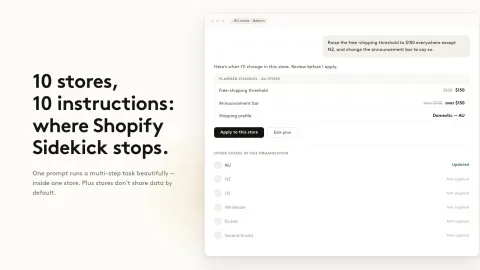
The third layer is agentic. Agentic means you describe the change in plain language and the platform plans and ships it, with approval and audit built in, rather than you clicking through every step yourself. At this layer the question is no longer whether the platform has AI, but whether AI can act across every storefront you run, or only inside one store.
One point decides how well any of this works: an AI eCommerce platform is only as good as the product data and the guardrails around it. Structured catalogue data gives models clean inputs. Permissions, approval, and audit decide whether a model's price change or product edit is safe to publish. Anything that touches price, stock, or a live storefront needs a control around it before it runs at scale.
Real-world applications of an AI eCommerce platform
Catalog and product content at scale
A retailer with tens of thousands of SKUs uses an AI eCommerce platform to generate descriptions, attributes, and metadata from source data, then routes them through review. The win is a complete, consistent catalogue without a team writing every product by hand.
Merchandising and on-site search
Models rank products, build related-item sets, and interpret search queries so shoppers find what they want faster. The platform adapts results to behaviour while merchandisers keep control of the rules and the exceptions.
Pricing and promotions
An AI eCommerce platform suggests prices and offers based on demand, margin, and competitive signals, within limits a person sets. The model proposes, and a human approves anything that goes live, so margin and brand stay protected.
Customer service and post-purchase
Assisted or automated answers handle common pre-sale and post-purchase questions, drawing on order data and product information, and hand off to a person when the question needs judgement.
Multi-store and multi-brand operations
A group running several storefronts, brands, or regions uses an AI eCommerce platform to apply shared rules and structured data across all of them, so each store stays on brand and on price without a person re-checking every catalogue by hand.
Top benefits of an AI eCommerce platform
Faster catalog and campaign launches
By generating product content, tagging, and campaign assets, an AI eCommerce platform shortens the time from a new range to a live, shoppable storefront, which lets teams launch and react faster.
Higher conversion through relevance
Model-driven search, recommendations, and merchandising put more relevant products in front of shoppers, which tends to lift conversion and order value when the underlying data is clean.
Lower operating cost per store
The cost of running a storefront falls when models handle the first pass on content, tagging, translation, and routine support, and people review rather than build from scratch. The effect compounds across stores and markets.
Consistency across storefronts
Shared rules and structured catalogue data keep product information, pricing logic, and tone consistent everywhere you sell, which is hard to hold by hand once the number of storefronts grows.
Smaller teams running more stores
A small commerce team can run output that used to need a much larger one, because the repetitive catalogue and campaign work is automated and people focus on strategy, margin, and the products that drive revenue.
Implementing an AI eCommerce platform: best practices
Start with the outcome, not the feature
Begin with a specific result, such as cutting the time to launch a new range in half, or running promotions across six storefronts without adding headcount, before choosing tools. A feature list is easy to buy and hard to use; an outcome tells you which capabilities actually matter.
Get your product data in order first
Models produce good output from structured product data and poor output from inconsistent catalogues. Time spent on a clean data model, attributes, and taxonomy pays back every time a model touches your catalogue.
Govern AI actions before you scale them
Decide who can approve a model-generated price, product, or campaign change, how it is audited, and how it is rolled back, before you let AI act at volume. On a storefront, generation without governance moves real risk, to margin and to brand, straight into production.
Keep a human approval step for pricing and publishing
The strongest pattern today is simple: the model drafts and proposes, a person approves. Let the model do the volume, and keep a human decision on anything that changes a price or goes live to shoppers.
Decide early whether AI runs one store or many
This is the question that determines what you actually need. A single-store AI tool makes one storefront faster to run. Running many stores, brands, or markets is a different problem: operating the whole estate on a lean team, not optimising one store of it.
Frequently asked questions about an AI eCommerce platform
How is an AI eCommerce platform different from a traditional eCommerce platform?
A traditional eCommerce platform stores products, prices, and orders and serves the storefront, while people do the merchandising and content work. An AI eCommerce platform adds machine learning to that work, so the platform can generate product content, rank and recommend, suggest prices, answer customers, and in the most advanced systems take those actions on its own. The commerce foundation is the same; what changes is how much of the work the platform can do for you, and how much judgement it still leaves to people.
Is an AI eCommerce platform the same as adding a chatbot or recommendations to a store?
Often that is all the term means in practice today: a recommendation engine or a support chatbot added to an existing store. Those are useful, and they are the first layer of the category. It is worth separating them from systems where AI can also run operations across the catalogue and storefront, such as generating content, tagging, pricing, or publishing under rules, because the two solve very different problems at very different scale.
What is agentic commerce, and how does it differ from an AI eCommerce platform?
"AI eCommerce platform" describes any commerce system that uses AI. "Agentic commerce" describes a specific level of it: you describe an outcome in plain language and the system plans and executes the steps, with approval and audit, rather than you doing each step. An agentic system is an AI eCommerce platform, but most AI eCommerce tools are not agentic. The difference is whether the platform assists a person or acts on instructions across the store.
Can an AI eCommerce platform change prices or publish products without human review?
Technically some can, but for most businesses that is the wrong default, because price and stock errors are expensive and public. The reliable pattern is a model that proposes and a person who approves, with an audit trail and a way to roll back. The value is in removing repetitive work, not in removing the decision about what goes live.
Does an AI eCommerce platform work across multiple stores, brands, or markets?
It depends on the system, and this is the question that separates tools. Many AI eCommerce products add AI to a single store. Running content, pricing, and merchandising across many storefronts, on brand and under one set of rules, is a harder problem that most single-store tools are not built for. If you run more than one storefront, test this directly before you buy.
What should I look for when evaluating an AI eCommerce platform?
Look past the feature checklist, because almost every vendor now claims AI. Ask three questions: can it act across every storefront you run, or only one; can you govern what it does, with approval, audit, and rollback, especially on price and stock; and does it work from clean, structured product data rather than an inconsistent catalogue. Those three decide whether an AI eCommerce platform helps a real operation or just demos well.
Future trends in an AI eCommerce platform
From recommendations to action
The clearest direction of travel is from AI that suggests to AI that acts. Recommendations and content generation are becoming table stakes; the difference will be whether a model can carry out merchandising, pricing, and publishing work across a store rather than only assist a person.
Governance and auditability as the gating factor
As models do more, the constraint shifts from whether a system can generate to whether you can trust what it changes on a live storefront. Approval, audit, and rollback move from nice-to-have to the thing that decides whether AI is allowed near price and stock at all.
Product data built for machines, not only shoppers
Structured product data, designed so models and agents can read and act on it, becomes the foundation rather than an afterthought. Teams that structure their catalogue well get more from every new model; teams that do not stay stuck at the widget layer.
Operating every storefront, not one at a time
For organisations running many storefronts, the frontier is not a smarter single store. It is operating every store, brand, and market from one place, under one set of rules, on a lean team.
Getting started with an AI eCommerce platform
Start by finding where AI actually saves time or lifts revenue in your commerce operation, rather than buying a feature list. Document one or two specific outcomes, get the product data that feeds them in order, and decide the scope question up front: do you need AI to run one store, or every storefront you operate.
Most AI eCommerce tools add AI to a single store. If you run many storefronts, across brands, regions, B2B and B2C, or franchise and dealer networks, the harder problem is operating all of them on a lean team, not optimising one of them.
Core dna is the operations platform for multi-property operators. Its operations are agentic: you describe the change in plain language and the platform ships it across every property, with approval and audit built in. Commerce is one of the things you run from one prompt; content and orchestration are governed the same way, on one platform, backed by a live MCP server, 80+ tools, and 400+ APIs.
See how Core dna runs every storefront from one platform, with agentic workflows and approval and governance built in, then book a demo.