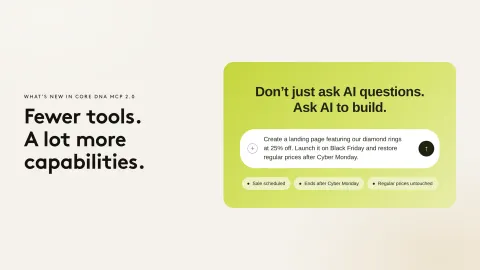
Do I still need a developer to build a website with ChatGPT?
Not for everyday work. The person who wants a change makes it by describing it. Developers get their time back for what genuinely needs engineering.
Related Questions
We integrate with 20+ payment gateways, including PayPal and Amazon Pay and our open API allows us to easily integrate with just about any partner you chose. The same is true for shipping and 3PL partners.
Yes, we sure do.
D2C, or Direct to Customer, is a low barrier-to-entry eCommerce strategy that allows manufacturers and CPG brands to sell directly to the consumer. It bypasses the conventional method of negotiating with a retailer or reseller to get your product on the market. In D2C, brands sell directly to the consumer through an online medium.
Going D2C has many advantages, with competitive pricing being a major benefactor for consumers. Other advantages include having direct contact with consumers to get a better understanding of them, and being able to freely experiment with new product releases and test them with a segment of your consumer-based to gain their feedback.
For more information visit our ultimate guide to D2C
There are several ways to increase B2B eCommerce sales:
1) Consistent SEO
Research shows that the majority of B2B marketers consider SEO as their primary source of lead generation, even more so than B2C. In this digital age, it is no surprise that over half of B2B buyers go online before they buy to research and compare.
2) Include self-service for B2B clients
Self-service will bring in a lot of B2B sales as it will mean your B2B company is online 24/7 and a checkout does not need to be supervised, thus never missing a customer.
3) Be mobile-user friendly
The world is utilizing mobile more than ever, even B2B target markets so it is crucial your eCommerce site is just as compatible and efficient on mobile as it is desktop, thus effecting sales.
4) Do not neglect social media!
According to the Content Marketing Institute, social media sites and blogs reach eight out of ten of all Internet users in the U.S. B2B companies are not missing out on the social media craze either. B2B companies use social media to market their company, sell their goods and services, and provide quality customer service.
5) Content, content, content
The more quality content you have, the more pull of clients you will receive, thanks to the further reach and consistency.
6) Customer reviews
You know how you always scroll down to check the customer reviews before buying? This is because customer reviews are the voice of the people. The supposedly unbiased ‘’truth’’ of the product/service. So, numerous, positive customer reviews go a long way.
7) DXP
Personalized experience: Who does not want to feel special? When a client, B2B or not, feels directly catered to or has felt the company has had efforts to give them a thorough, genuine DXP, they will recommend your B2B company, use it again and leave reviews, increasing sales, but also loyalty and customer satisfaction.
One of the most effective ways to improve your b2b website's conversion rate is through personalization. By tailoring the user experience to each individual visitor, you can make a significant impact on your bottom line. Additionally, to add interest, strong branding and diversity; all critical factors for your business.
A SaaS Digital Experience Platform (DXP) like Core dna can help you business create these personalizations and scale you business. Core dna offers a flexible B2B eCommerce catalog, advanced segmentation, integrations and headless CMS... These are just some of the features you need to compete in today's market.
With these features, you can create experiences and customizations for both users and admins. Take advantage of our decoupled environment to create rich omnichannel experiences that convert.
At Core dna, we make sure you never have to replatform again and always stay ahead of the competition. With regular updates and features upgrades, your business is future-proof.
We wrote a blog article about 5 Key Strategies To Strengthen Your B2B Relationships. Here are the key takeaways:
- Use dynamic content: Dynamic content is content that changes based on the visitor's specific characteristics, such as their location, industry, or job title. For example, if you sell software to businesses in a specific industry, you can use dynamic content to show each visitor only the software products that are relevant to their industry.
- Geo-targeting: Geo-targeting allows you to show different content to visitors from different geographic regions. This is especially useful if you have products or services that are only available in certain regions.
- Creating custom landing pages: This can be done by tracking the visitor’s behavior on the site and then creating a unique landing page that is tailored to their interests.
- Offering live chat:live chat: This can be a great way to engage with visitors and offer them help or support in real-time.
- Personalized email campaigns: This can be done by segmenting the list of subscribers and then sending them emails that are relevant to their interests.
Building rock-solid B2B eCommerce relationships do not scale easily, but it does have the potential to pay dividends that are exponentially greater than the investment that is made.
Schedule a one-to-one consultation with your product specialist
Here’s what you can expect:
- Walkthrough: An introduction of the Core dna platform
- Analysis: Personalized recommendations based on your business needs.
- Case studies: How other businesses have used Core dna to scale more efficiently
B2B eCommerce is now so essential and successful as the digitalisation of everything is the expectation and reality, applying to even B2B commerce.
Even if one’s B2B business has physical brick and mortar, for the sake of better reach, recognition and opportunity, marketing as eCommerce allows B2B to transcend borders. There are a plethora of reasons that answer this question; from cost savings, globalization, automation, 24/7 support… Find out in the blog below:
Yes. eCommerce in Core dna is a native capability, not a plugin. That includes customer-specific and contract pricing, product catalogue management, subscription billing, multi-currency, and order management. For B2B operations specifically, RFQ workflows, account hierarchies, net payment terms. Core dna is built to handle these natively rather than requiring third-party plugins to fill the gaps.
Core dna is framework agnostic.
An agnostic framework means you can create any design using the front-end technology and frameworks that you know and love.
We believe in being open-minded and non-discriminatory when it comes to technology choices, and we want our clients to feel empowered to use whatever works best for them and their projects, regardless of whether it's something we've already tried and failed with before!
Core dna never requires you to use specific templates or libraries. As a decoupled platform, Core dna also has server side templating that can be used to deliver projects quickly and efficiently using only HTML, CSS and Javascript. The server side frameworks supported are Twig and Smarty.
What is an agnostic framework?
An approach to software development that doesn't favor any one language or technology over another. Agnosticism is a philosophical position which states that it is not possible to know anything about God or other supernatural beings. A Software Agnostic approach would say that there is no right or wrong when it comes to the tools you use in your job as long as they get the job done.
What is Smarty?
Smarty is a template engine for PHP. More specifically, it facilitates a manageable way to separate application logic and content from its presentation. This is best described in a situation where the application programmer and the template designer play different roles, or in most cases are not the same person. It is extremely fast. It is efficient since the PHP parser does the dirty work. No template parsing overhead, only compiles once.
What is Twig?
Twig is a modern template engine for PHP. It's fast. Twig compiles templates down to plain optimized PHP code. The overhead compared to regular PHP code was reduced to the very minimum. It is secure. Twig has a sandbox mode to evaluate untrusted template code. This allows Twig to be used as a template language for applications where users may modify the template design. It is flexible. Twig is powered by a flexible lexer and parser. This allows the developer to define its own custom tags and filters, and create its own DSL.
What is a decoupled platform?
A decoupled platform is a software architecture where components are independent of each other. This allows for easier development, testing, and maintenance of the individual pieces that make up the whole product or system.
Decoupled platform advantages:
A decoupled platform will allow your software to be more easily scalable and upgradable as new technologies become available. It also means your developers won't have to worry about updating multiple parts of your application every time there's an update released; they'll just need to update one piece at a time!
Schedule a one-to-one consultation with your product specialist
Here’s what you can expect:
- Walkthrough: An introduction of the Core dna platform
- Analysis: Personalized recommendations based on your business needs.
- Case studies: How other businesses have used Core dna to scale more efficiently
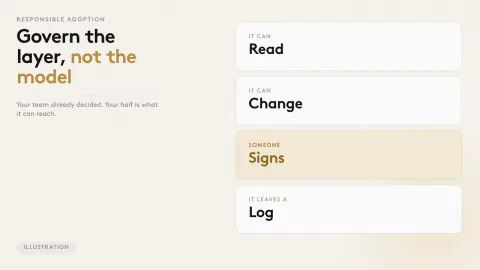
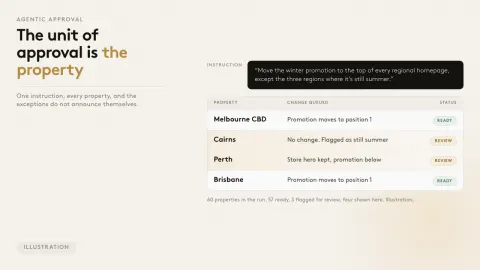
An enterprise AI agent is a software actor that takes goals, plans actions, and calls tools against your production systems on its own initiative. The distinguishing trait is autonomy with consequence. Unlike a chatbot, an agent is doing work that changes state - updating records, dispatching workflows, calling APIs that move money or content or customers. Enterprise-grade means it operates inside the same identity, audit, and governance perimeter as the rest of your platform.
There are a number of differences between Monolithic systems and a Headless system, these include:
- Monolithic systems have lots of functionality built into them that not all customers need.
- A headless platform gives you access to entities, examples of these are pages, menus, products, blogs, people, etc. Entities are the base objects that you can then modify and enhance to your requirements.
- Monolithic systems are more focused on delivering solutions to the end client rather than the developer. Core dna’s platform strikes a balance between the developer environment and the admin environment.
- Headless platforms in many cases don’t come with admin tools for end clients. Core dna continues to provide admin friendly tools inside our headless platform.
- Access to information from a monolithic system can be difficult.
- Monolithic systems require you to establish the infrastructure and the security tools to make them work.
- Monolithic systems can take time to learn and understand the way they work.
- Headless platforms allow you to create your own publishing environments.
Read this next: Headless CMS vs Decoupled CMS: The Ultimate Guide
A chatbot answers. An agent acts. The chatbot lives in the conversation layer and hands off to a human or a workflow when something needs to happen. The agent owns the doing. That difference is why the governance model for agents looks more like the model for a privileged service account than like the model for a content surface.
You sure can. Global brands trust Core dna to build and operate eCommerce websites in multiple regions and continents. Our eCommerce feature set includes everything from inventory management to detailed analytics.
See Core dna’s eCommerce features.
MCP, the Model Context Protocol, is a standard for exposing tools to AI agents as a declarative surface. Instead of every agent integrating against every system through bespoke code, the system publishes its tools through MCP and the agent discovers and calls them through a single protocol. For enterprise rollouts, MCP matters because tool boundaries become enforceable. You grant an agent access to specific tools rather than to whole systems, and you can revoke access without rewriting the agent. Core dna's MCP server exposes 80+ tools across 400+ APIs, in production today.
In phases, with read-only first. The pattern that works is: prepare the environment with scoped identity and audit, validate the agent in discovery mode where it can plan but not write, promote it to governed execution with tight tool boundaries and rollback, then run it under continuous governance with a standing review cadence. The single most common failure mode is granting write access before discovery-mode validation is honestly complete.
Core dna was launched in 2015, but our team was operating as a digital agency since the year 2000, building, tweaking and using Core dna for our clients as we grew.
Yes, Core dna creates a staged approach to building an effective website. Our technology allows you to create a website that serves your current needs while providing the flexibility to quickly and easily add products as your business grows.
Core dna is what creates an aesthetically appealing website that is also backed by strategy. While to the average user, the full capabilities of the DXP are not visible, its robust backend infrastructure provides your business with an unparalleled advantage. We offer the backend user the ability to effectively manage content, layout, and statistics, whilst increasing ROI, attending to customer requests and ensuring the online strategy is fluid and traceable.
With a standing governance group, a monthly cadence, and the audit log as the agenda. Governance covers tool-permission drift, new-tool onboarding, model changes, incident review, and retiring tools the agent no longer needs. The governance group needs representation from digital, platform, security, and risk - not just the team that built the agent.
Cloud based infrastructure refers to how it is it delivered. In this case, Core dna is delivered as a service (SaaS) as opposed to an actual product. What cloud infrastructure allows is shared resources, software, and information to be provided as a utility over the internet.
By the four-phase exit criteria, not by the model's benchmark scores. The readiness signal is operational: scoped identity in place, audit captures intent, discovery-mode plans match human-operator plans, governed execution has run a representative volume of writes with zero unrecoverable actions, and a governance cadence is established and attended. If any of those is missing, the agent is not ready to scale, regardless of how the model performs in isolation.
Core dna is a SaaS (Software-as-a-Service) platform, meaning you’ll be charged a monthly subscription fee, with none of the headaches of hosting or maintaining the infrastructure.