YMCA of Greater Toronto runs health and fitness, child care, camps, employment and community services, youth programs and fundraising across the region. Online, that meant ymcagta.org, its main website organised around those programs, plus a long list of microsites for individual programs, campaigns and centres, many of them on their own subdomains.
In 2023, YMCA brought ymcagta.org and its microsites onto Core dna, the platform that already ran its Y Guide class catalogue, and folded the microsites into the main website as sections.
Today one Core dna setup runs ymcagta.org, the Y Guide, the Ignite learning platform and 8 branded program microsites: about 2,300 pages in English and French, including 498 Find a Y location pages. Each program team edits its own microsite, and YMCA's digital team runs the shared parts without outside help.
The challenge
ymcagta.org ran on an ASP.NET and Sitecore build that had become so complex the marketing and content teams couldn't change it without outside help. The blog sat on its own subdomain.
Around the main website sat the microsites, many on their own subdomains:
- Program tools: the Y Guide class catalogue, the day camp bus schedules and the Find a Y location search.
- Membership and campaign sites: Try the Y, which signs visitors up for a free trial pass at the location they choose, and the Sweat for Good campaign.
- Employment and youth programs: Peel Jobs, Go to the Y and YCAN, plus program sites in English and French such as SWSE.
- Camps and centres: YMCA Cedar Glen, YMCA Pine Crest and the David Braley centre.
Each had grown on its own. Forms ran in a separate form tool, and Find a Y's location details lived in a separate database. YMCA wanted one brand and one way of managing content across all of them.
What YMCA asked for
- One brand across ymcagta.org, the Y Guide and every microsite, with content managed centrally.
- Microsites moved from subdomains into sections of ymcagta.org, with exceptions where needed.
- A team that could manage pages, menus and fonts in the admin without Core dna's help.
- Location details moved into the platform, with staff limited to the locations they look after.
- English and French microsites set up properly for search engines.
- Writer and editor roles, approval before publishing, and single sign-on for staff.
- Every site meeting WCAG 2.0 accessibility requirements on desktop and mobile.
What every site shares
The microsites now live inside ymcagta.org as sections, and every section is built from the same parts.

One set of components
Core dna built YMCA's components to its style guide for ymcagta.org, then used the same components on every microsite. A page on a camp site is built the same way as a page on the main website.
Two header styles
Every section uses either the ymcagta.org header or the Y Guide header, each carrying the microsite's own logo. Core dna set up the first program category in the mega menu, and YMCA's team sets up the rest in the admin.
One banner, one search, one error page
An announcement banner can be switched on across every page of every section, or page by page. One search covers everything, and every section shares the same error page.
One domain
Microsites that lived on subdomains became sections of ymcagta.org, and new microsites are set up the same way. Today the sections with their own logo include SWSE, YEC and Youth Cannabis Awareness in English and French, YMCA Cedar Glen, YMCA Camp Pine Crest, Know the Game Y GAP, Get Hired and Summer Day Camps. Ignite runs on its own subdomain.
What each team controls
Its own microsite
Each program team signs in to the same admin and can only see and edit its own microsite. YMCA's digital team looks after the shared components, header styles and site-wide banner.
Locations
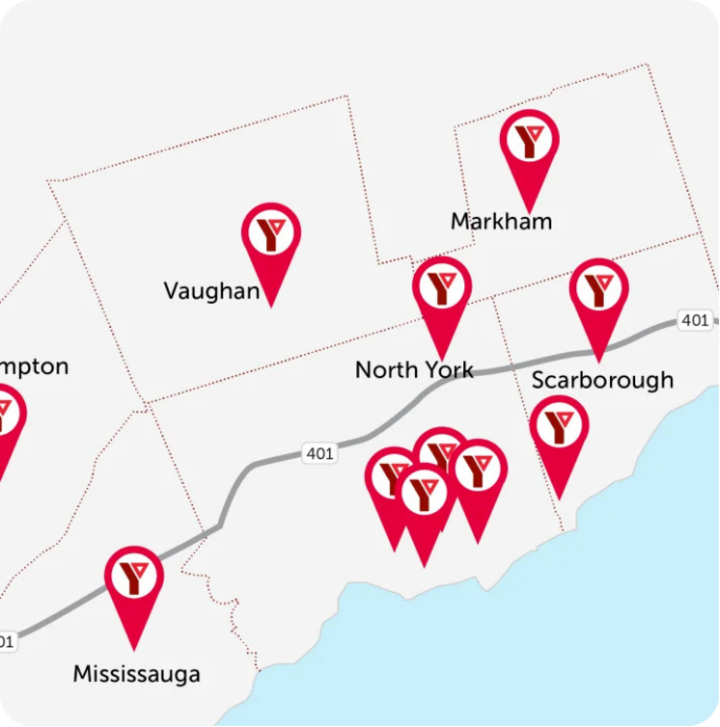
Find a Y's location details moved out of a separate database into Core dna. Find a Y now has 498 location pages, from YMCA centres to child care centres, before and after school programs and day camps. Staff can only see and edit the locations assigned to them, and a Find a Y widget with preset filters can sit on any page.
Forms
Forms moved into Core dna and can be added to any page. Notifications go to the right team based on the location a visitor picks.
English and French
Bilingual microsites have /en/ and /fr/ sections, a language switcher, and pages linked across languages for search engines.
Publishing
Writers draft and editors publish. New content goes through approval before it's scheduled to go live, and staff sign in with single sign-on.
Running many sites on different setups?
Book a call with Core dna. We'll show you how a main website and its microsites run from one platform, and what that would look like for your organisation.
How the sites moved
YMCA and Core dna agreed a launch order and moved the sites in groups. While some microsites were still on the old platform, their new addresses on ymcagta.org already worked: Core dna's CDN sent those visitors through to the old servers until each group went live.
More than 1,000 redirects carried old URLs to the new ones. They run at the CDN, so they don't slow the site down, and the YMCA team adds new redirects in the admin.
Core dna migrated about 170 pages of ymcagta.org, along with the blog, news, volunteer roles and FAQs, and kept them unpublished until launch so the YMCA team could review everything first.
The results
- ymcagta.org, the Y Guide, Ignite and 8 branded program microsites on one platform: about 2,300 pages in English and French, including 498 Find a Y location pages and 13 day camp pages.
- A record 8,000 online registrations in a single day, up from 1,500, and the marketing team using nearly 90% of the platform's features, up from about 20%.
- In 2026, YMCA added its Ignite learning platform to the same setup, with user records shared between the website and the LMS.
Read how YMCA of Greater Toronto took online registrations from 1,500 in a day to 8,000 and how YMCA Ignite moved off Absorb. For the approach behind this setup, see multi-site management on Core dna.