

B2B distributors face an interesting dilemma. On the one hand, businesses are expected to deliver a seamless, intuitive buying experience as exemplified by B2C brands such as Amazon. Many are also weighing whether to sell through B2B eCommerce marketplaces alongside their own storefront.
On the other hand, distributors need to provide enterprise-grade functionality that the business actually needs to operate, including complex pricing structures, multi-level approvals, account-specific catalogs, and ERP integrations.
Unfortunately, traditional commerce platforms aren’t able to manage both of these requirements. Consumer-focused platforms offer slick interfaces but struggle with B2B complexity. Enterprise systems can handle the backend requirements but often deliver clunky, outdated experiences that frustrate modern buyers.
However, instead of accepting the limitations of a monolithic platform, distributors can now leverage composable commerce to combine best-in-class components, including commerce, content, search, personalization, and payments into a unified system that delivers both exceptional customer experiences and the complex B2B workflows your operations demand.

On this page:
The Dual-Audience Challenge
Unlike B2C brands, most B2B distributors aren't serving just one type of buyer but two distinctly different audiences, each with conflicting expectations.
Audience One: Prospects in the Discovery Stage
These prospects behave like retail consumers. They land on your site from search engines or referrals, without existing relationships or accounts. They need to quickly understand what you offer, browse products intuitively, compare specifications, and find answers without talking to a sales rep.
They expect fast load times and the kind of frictionless experience that modern digital retail has trained them to expect. If your site requires login credentials just to see a product catalog, they've moved on to a competitor instead.
Audience Two: Established Buyers and Account Holders
Current account holders don’t come to your website to browse, but they do need to order. They need to access their custom catalogs, review purchase history, and process orders from the same backend. These customers expect integration with their current procurement systems, bulk ordering capabilities, and self-service account management.
The challenge in managing these two separate groups is that traditional commerce platforms are built for one audience or the other, never both. Consumer-focused platforms can't handle account-specific pricing or approval workflows, which encourages enterprise B2B platforms to lock everything behind authentication, making discovery impossible for prospects.
Distributors end up compromising on one audience to serve the other or maintaining separate systems that fragment the experience and multiply operational complexity. However, composable commerce solves this by letting you build distinct experiences for different audiences on a shared foundation, without the limitations of a one-size-fits-all platform.
Building a B2B Ecommerce Platform for Distributors: Composable Commerce Capabilities
Composable commerce for distributors is about assembling proven capabilities that solve the dual-audience challenge while maintaining the operational complexity your business requires. Here are the core capabilities to look for when assessing any platform:
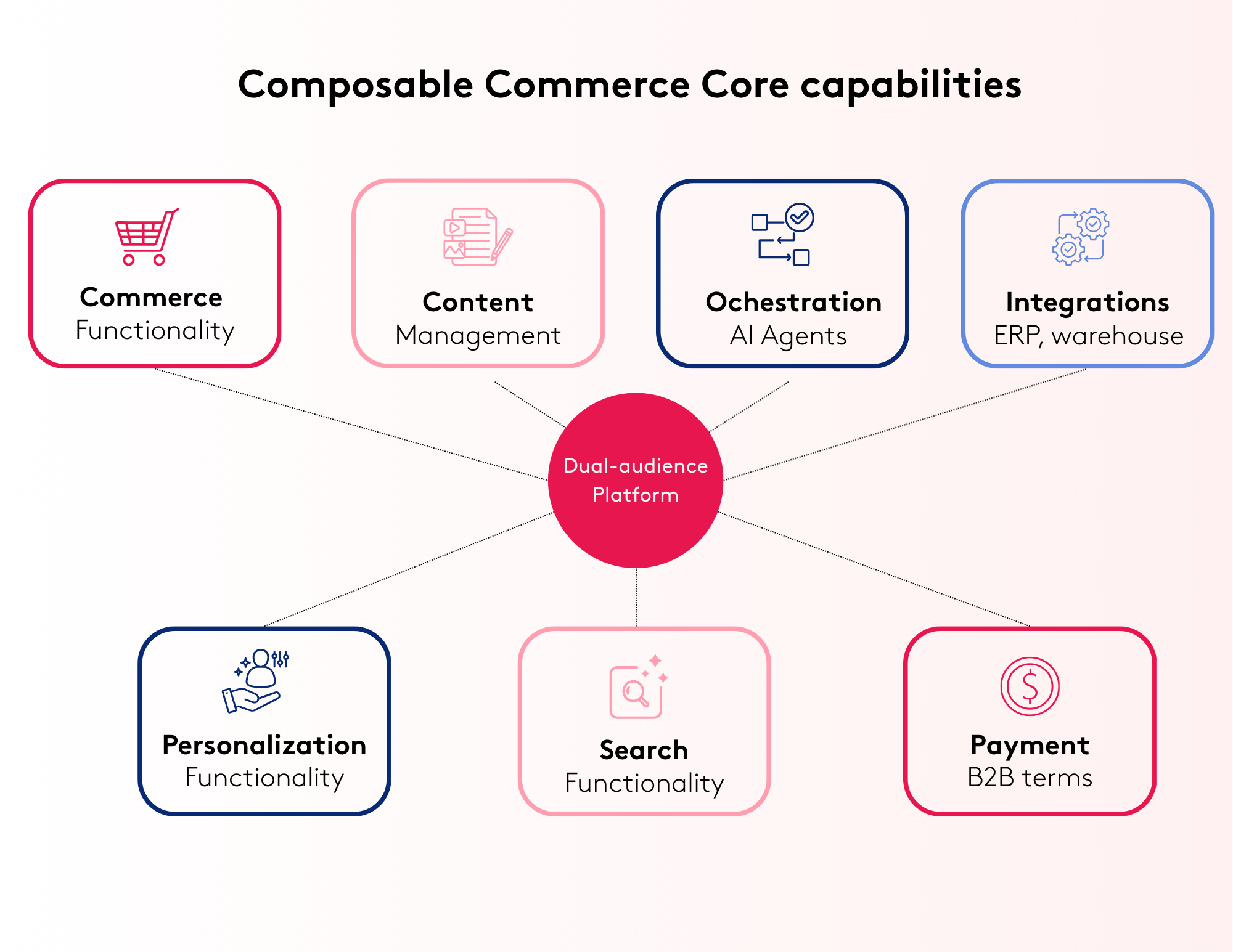
Commerce Functionality
The commerce engine handles transactions, cart management, and checkout workflows. For distributors, this means supporting both guest checkout for prospects and authenticated experiences for account holders, with the flexibility to route different buyer types through different flows on the same platform.
Content Management
Content management, particularly via an API-first CMS, decouples content from presentation, letting you create rich product stories, educational content, and discovery experiences for prospects while delivering streamlined, data-focused interfaces for established buyers.
Search
Distributors need a search that works for both audiences. Prospects need intuitive search with filters and facets that help them discover products. However, account holders need a precise search experience that lets them find exact SKUs, reorder by part number, and filter by their specific catalog. Advanced search with AI-powered recommendations bridges both needs.
Personalization
For distributors, personalization means showing prospects general pricing and broad catalogs, while established buyers see their negotiated rates, custom catalogs, and reorder suggestions based on purchase history.
Payments
B2B payment requirements differ drastically from B2C. Distributors need to support credit cards for small transactions, as well as net payment terms for established accounts, wire transfers, ACH, and purchase orders.
Orchestration
Orchestration engines automate workflows across systems, allowing distributors to sync inventory in real time, trigger personalized emails after purchases, route orders to the right fulfillment centers, and coordinate data between the commerce platform and backend systems without custom code.
Integrations
APIs allow distributors to connect specialized tools as needed, such as PIM and ERP systems. However, with composable commerce, the key is having an integration framework that doesn't require armies of developers to maintain.
B2B Commerce Functionality
For distributors, the added B2B commerce functionality is a critical component for a viable composable commerce solution.
- Custom Pricing & Contracts: Distributors operate on negotiated terms, not list prices. They need tiered pricing based on volume, customer-specific pricing tied to contracts, contract expiration management, multi-currency support for global operations, and dynamic discounting rules that apply automatically at checkout.
- Complex Catalogs: B2B distributors need to manage product variants, SKUs with custom attributes, customer-specific catalogs that show only what each buyer is approved to purchase, product hierarchies across categories, bundling and kitting options, and intelligent cross-sell relationships based on compatibility or buying patterns.
- B2B Workflows: Distributors need the ability to create robust workflows that include multi-level approval processes for large purchases, purchase order management and tracking, quote-to-order processes for negotiated deals, and other custom workflows that could improve the customer experience.
- Account Portals & Self-Service: Modern B2B buyers expect self-service capabilities. That means customer-specific dashboards and B2B commerce portals showing order history and spending, invoice access with payment tracking, saved carts and quick reorder from past purchases, multi-user account management with role-based permissions (so procurement, approvers, and admins each see what they need), shipment tracking with delivery notifications, and streamlined returns and claims management.
- Inventory Management: Distributors need low-stock alerts, multi-location fulfillment logic that routes orders to the closest warehouse, and the ability to display inventory availability to account holders while hiding it from prospects.
- Order Management Beyond basic order processing, distributors need bulk ordering capabilities, recurring order automation for consumables, quote-to-order workflows, split shipment handling when products come from different locations, and backorder management that keeps customers informed without losing the sale.
- Analytics & Reporting Sales dashboards that show revenue by customer segment, customer behavior insights that reveal buying patterns, order trend analysis to optimize inventory, and performance tracking across products, regions, and sales channels are just some of the extensive analytics and reporting capabilities required by B2B distributors.
- Security & Compliance: B2B transactions involve sensitive data, customer contracts, negotiated pricing, and payment details. Platforms must offer PCI-DSS compliance for payment processing, data encryption, audit trails for regulatory requirements, and granular role-based permissions to control who sees what.
- Marketing & Promotions Distributors need customer segment-specific promotions, contract-based discounting that applies automatically, loyalty programs that reward volume buyers, and targeted campaigns that speak to different buyer personas based on their relationship with the business.
When these capabilities work together, distributors can finally deliver Amazon-level experiences without sacrificing the enterprise functionality their business demands.
Core dna’s Composable Commerce Platform for Distributors
Most composable commerce approaches trap distributors between two bad options: DIY best-of-breed, which leads to vendor sprawl and fragile integrations, or enterprise suites that are too expensive and complex for mid-market needs.
Core dna takes a different approach by offering a complete digital experience platform (DXP) with a built-in commerce engine, headless CMS, personalization, search, payments, customer portals, and orchestration unified in a single platform. Additionally, Core dna offers:
- Native B2B functionality: Customer-specific pricing, contract-based discounting, custom catalogs, multi-level approvals, purchase orders, net payment terms, bulk ordering, and role-based portals.
- Orchestration & AI workflows: The embedded orchestration engine connects commerce with backend systems, automates workflows, and syncs data in real time. Also, built-in AI agents can handle translation, personalization, SEO generation, and customer support without adding another vendor.
- API-first integration: Distributors can connect existing ERP, PIM, CRM, and specialized systems through robust APIs.
For mid-market distributors, Core dna delivers the sweet spot that provides exceptional experiences for both prospects and account holders without the complexity or cost of alternatives.
Modern Distributor Examples
Core dna has helped modern distributors to solve some of their most complex challenges and allow them to deliver a better buying experience for customers.
 Clark Rubber
Clark Rubber operates 70 franchise locations across Australia and is known for its pool, rubber, and foam products. However, their previous Shopify Plus platform couldn’t handle their unique needs.
However, by migrating to Core dna, they received a multi-site, multi-market platform that integrated with ERP, CRM, and marketing systems, giving them a single digital presence and streamlined operations across all outlets.
 RANDYS Worldwide
RANDYS Worldwide grew through acquisitions to manage seven distinct auto parts brands, each with unique catalogs, customer bases, and pricing structures. However, running seven separate platforms created operational chaos, and trying to build a viable franchise website on WordPress and connecting it to the rest of their infrastructure left them struggling.
By migrating to Core dna, they can now take advantage of customized websites for each of the seven brands, deep integrations with their ERP and CRM back-end systems, and a unified B2B portal to create smooth customer interactions.
Composable commerce is one architectural choice. For the complete picture, see our guide to B2B eCommerce.
Summarize with